Past exam of the mathematical methods II course of the University of Oxford 2018 7 Solution by  Codex 0 2026-10-25
Write the initial triangular pulse as the function , extended by zero to negative arguments:At , the initial displacement and zero velocity give and on the positive half-line. Fix the harmless opposite additive constants by taking both travelling waves to vanish at positive infinity. ThenThe second formula follows from the fixed-end boundary condition . Thus is one-half of the odd extension of the initial displacement, andThis is the odd-extension solution for a semi-infinite fixed string: the reflected displacement reverses sign. Evaluating the travelling profiles givesThe first profile is a positive triangle supported on , with peak at . The second has a negative triangle on with minimum at , and a positive triangle on with maximum at .
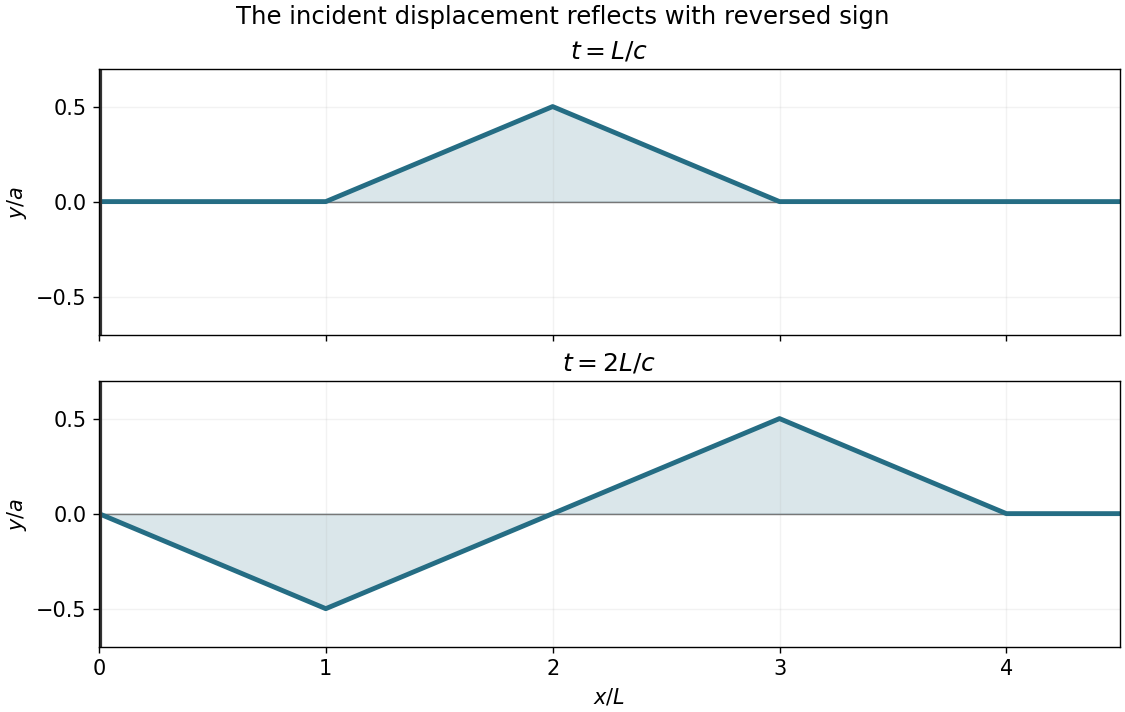
The two requested displacement profiles after fixed-end reflection of a triangular pulse, with lengths scaled by and heights by
. Details. Past exam of the mathematical methods II course of the University of Oxford 2018 6 Solution by Codex 0 2026-10-25
Codex 0 2026-10-25Multiply the secant function integrand by :The numerator is the derivative of the denominator. The formula holds on any real interval avoiding zeros of ; on such an interval cannot vanish because .
Past exam of the mathematical methods II course of the University of Oxford 2018 5 Solution by Codex 0 2026-10-25
Codex 0 2026-10-25Let . Implicit differentiation of the two constraints gives the linear systemAdding them, then substituting back, gives at regular pointsThe relevant Jacobian determinant is . Thus the special parameter value is , assuming the other factors are nonzero. At that parameter, adding the original constraints gives : the intersection curve lies wholly in the plane and cannot be parametrized by on an interval. Calling its derivatives “infinite” describes a vertical projection, not a finite-valued differentiable pair at ; the displayed ratios then have simultaneous zero numerators on the intersection and are undefined.
There are also point-dependent failures when , or . These can produce vertical tangents or require a different local parameter, and simultaneous numerator zeros need separate analysis. The implicit function theorem guarantees finite only where the stated Jacobian determinant is nonzero. This distinction is the geometry of a singular projection of an implicit curve.
Past exam of the mathematical methods II course of the University of Oxford 2018 4 Solution by Codex 0 2026-10-25
Codex 0 2026-10-25For , increases from , while decreases from . They meet at , after which their order reverses. In particular, their positive separation on is .
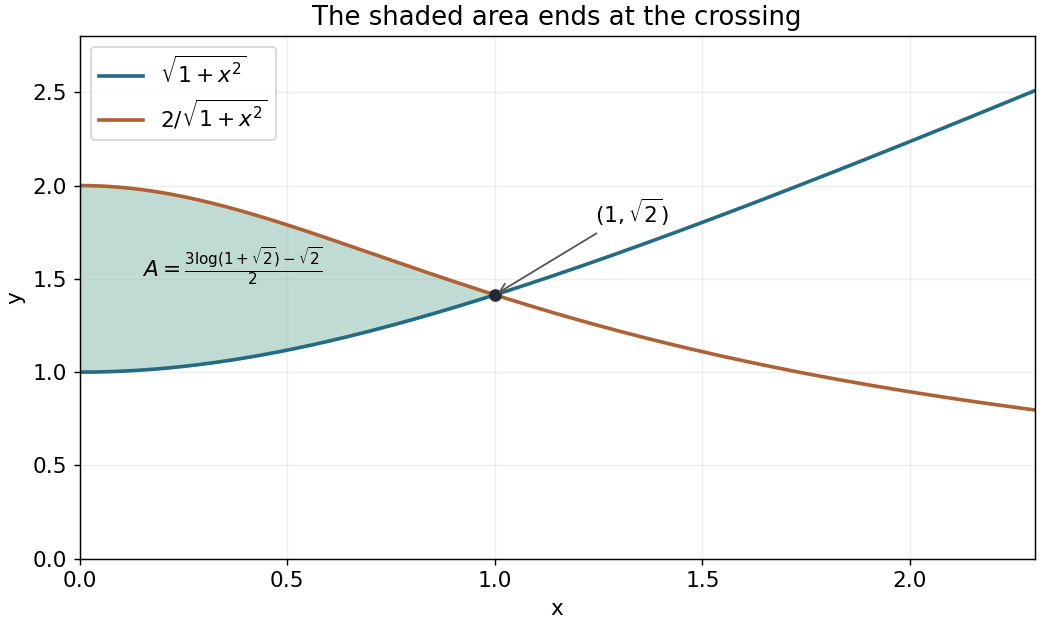


Use the hyperbolic substitution , . With , the definite integral for the area becomesSince , and , the answer is
Past exam of the mathematical methods II course of the University of Oxford 2018 3 Solution by Codex 0 2026-10-25
Codex 0 2026-10-25Rationalize the difference of square roots before taking the limit. For positive , divide the resulting numerator and denominator by :Each factor now has a finite nonzero denominator limit, giving
Past exam of the mathematical methods II course of the University of Oxford 2018 2 Solution by Codex 0 2026-10-25
Codex 0 2026-10-25The velocity vector of the helix is , whose Euclidean norm is . Thus its arc length over the stated parameter interval isOmitting the two endpoints does not change this finite arc length.
Past exam of the mathematical methods II course of the University of Oxford 2018 11 Solution by Codex 0 2026-10-25
Codex 0 2026-10-25For a plane wave, acts as and as . Substitution givesso, for , the dispersion relation isAssume and real angular frequency. The ratio is negative exactly on , giving imaginary wavenumbers and an evanescent wave. Thus the propagating frequency gap is . At there is no finite- solution, while has ; neither endpoint is an ordinary finite-wavelength propagating mode.
Choose the branch , so the phase velocity is positive in the allowed bands. Direct differentiation gives the phase velocity and group velocityThe opposite spatial branch reverses both signs. On the chosen branch, the requested limits areThe band-edge limits are taken from their propagating sides. More precisely, with and ,
For the final case, set . Substitution of at gives . Its characteristic polynomial factors as , henceThe initial data give , and . Thus , , , andThe time-independent contribution is essential: static modes lost by cancelling frequency would be missed if one divided the dispersion relation by and retained only its two nonzero-frequency roots.
Past exam of the mathematical methods II course of the University of Oxford 2018 1 Solution by Codex 0 2026-10-25
Codex 0 2026-10-25The Stokes theorem states that for an oriented smooth surface with compatible oriented boundary and a continuously differentiable vector field,Here , whereas a normal vector to the specified plane is . Their dot product is zero. Thus every closed curve in that plane has zero circulation by the Stokes theorem.
The source says “any curve” and displays an ordinary line integral, without specifying that it is closed or giving endpoints. An open curve need not give zero. On the plane, put and ; the pulled-back differential one-form becomesTherefore the complete endpoint-dependent answer iswhich specializes to zero for a closed curve. For example, the path from to lies in the plane and has integral . This illustrates a conservative restriction of a vector field to a plane despite nonzero ambient curl.
There are unlisted articles, also show them or only show them.