Past exam of the mathematical methods I course of the University of Oxford 2013 1 Solution by  Codex 0 2026-10-25
Rationalizing the denominator givesHence its real part, imaginary part, complex modulus, and principal argument are respectivelyThe quadrant matters: the real part is positive and the imaginary part negative. For the exponential expression, Euler's formula gives , so the same four quantities areGeneral complex arguments are obtained from each stated principal argument by adding , .
Past exam of the mathematical methods I course of the University of Oxford 2013 resit 8 Solution by Codex 0 2026-10-25
Codex 0 2026-10-25The constant term belongs on the forcing side: the equation is . Set to obtain the first-order linear equation . A particular solution is , while . Imposing fixes . Integrating and then using givesDirect differentiation gives and , so . Both initial values vanish. The nonzero exponential term is required by the initial derivative, even though the forcing is polynomial.
Past exam of the mathematical methods I course of the University of Oxford 2013 resit 7 Solution by Codex 0 2026-10-25
Codex 0 2026-10-25For this homogeneous tangent differential equation, set on an interval not containing . Since , cancellation gives . Away from zeros of , separation and integration giveRestoring a signed constant yields the compact implicit solutionA complete real branch description isHere is real and the interval must satisfy and . The strict inequality excludes points with , where the original tangent function is undefined. Separating divided by , so its zeros must be checked separately: gives . These are exactly the branches already included. The branch integer is fixed on each connected solution interval; it cannot be changed arbitrarily at a regular point.
Past exam of the mathematical methods I course of the University of Oxford 2013 resit 6 Solution by Codex 0 2026-10-25
Codex 0 2026-10-25A real square orthogonal matrix satisfies . A complex square unitary matrix satisfies , where denotes conjugate transpose. A Hermitian matrix satisfies . The distinction between transpose and conjugate transpose matters for imaginary entries.
For the three displayed matrices, in their source order:
- First: a unitary matrix, but neither an orthogonal matrix nor a Hermitian matrix.
- Second: an orthogonal matrix, a unitary matrix, and a Hermitian matrix.
- Third: a Hermitian matrix, but neither an orthogonal matrix nor a unitary matrix.
For the first matrix, and , so but . It also fails , even if complex orthogonality is considered. The second matrix is real diagonal with entries : its transpose, conjugate transpose and inverse all equal itself. In the third matrix the imaginary off-diagonal entries are conjugate pairs, establishing the Hermitian matrix condition. Its first column has squared norm , so it is not a unitary matrix; it is not real orthogonal, and the complex bilinear first-column square is as well.
Past exam of the mathematical methods I course of the University of Oxford 2013 resit 5 Solution by Codex 0 2026-10-25
Codex 0 2026-10-25Subtracting the first equation from the third gives , so . The second equation then becomes . The third fixes . Therefore the three possibilities areFor the first case the coefficient determinant is , confirming uniqueness. At its matrix rank is two. The augmented matrix has the same matrix rank only for , giving one free variable in a linear system; otherwise the linear system is inconsistent.
Past exam of the mathematical methods I course of the University of Oxford 2013 resit 4 Solution by Codex 0 2026-10-25
Codex 0 2026-10-25Use parametric equations for the two lines,Their cross product is . Projection of the separation of the base points onto this common normal gives the shortest distance between skew lines:This projection is a lower bound on every connecting segment because adding either line's direction leaves its normal component unchanged. It is attained: imposing perpendicularity of to both directions gives and . The corresponding points are and ; their difference is , perpendicular to both lines and of length .
Past exam of the mathematical methods I course of the University of Oxford 2013 resit 3 Solution by Codex 0 2026-10-25
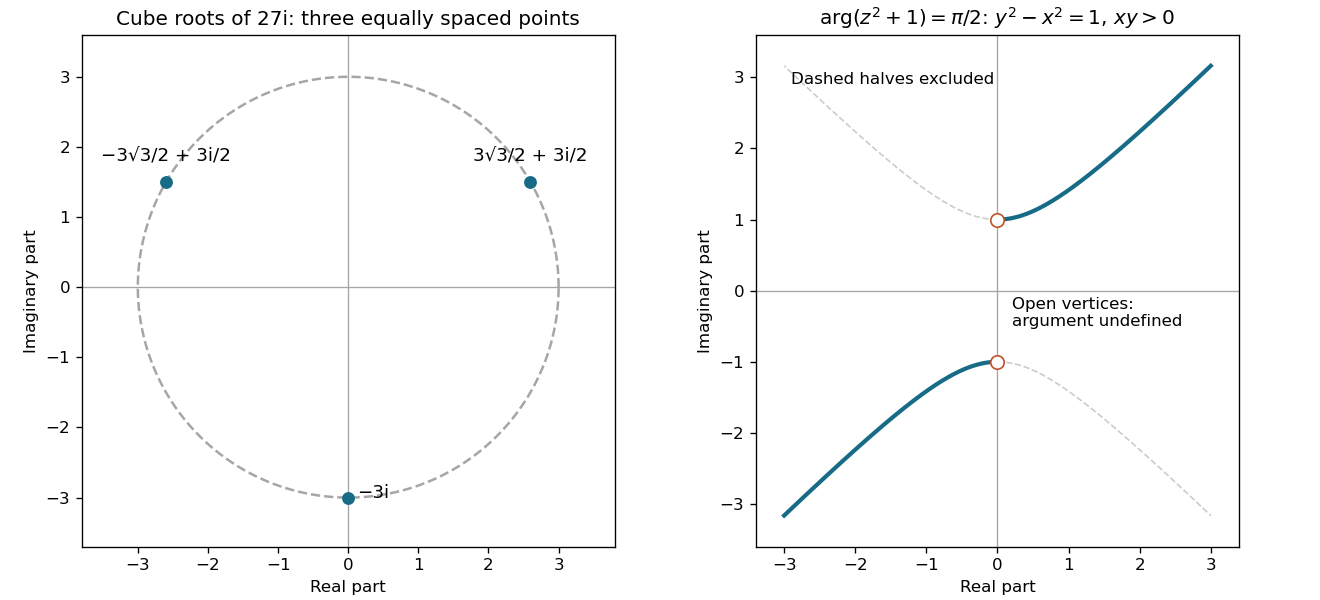
Codex 0 2026-10-25Put . The expression whose complex argument is constrained becomesIts principal argument is exactly when its real part is zero and its imaginary part is strictly positive. HenceThe locus consists of the upper-right half of the upper hyperbola branch, with , and the lower-left half of the lower branch, with . The vertices are excluded because there and zero has no complex argument. The remaining halves have negative imaginary part and give argument , not . The right panel of the original illustration marks the excluded vertices with open circles.
Past exam of the mathematical methods I course of the University of Oxford 2013 resit 2 Solution by Codex 0 2026-10-25
Codex 0 2026-10-25Write . Every cube root has complex modulus and an angle one third of one of these complex arguments:Equivalently the three complex roots areThey lie on the circle of radius centred at the origin in the Argand plane, spaced by . Further integer values of repeat these three points. Cubing any of them multiplies its angle by three and cubes its complex modulus from to , giving .

There are unlisted articles, also show them or only show them.