
The financial payoff obtained by exercising a financial option at a permitted stopping time . An American option compares this immediate payoff with the value of keeping the exercise right, whereas a European option restricts exercise to expiry.
A boundary marking the joining of previously separated tectonic regions, often associated with remnants of an intervening oceanic system.
The adequacy with which a measure's items cover the intended domain of content. Expert review, target-user input and cognitive interviewing can identify missing or irrelevant material. Good numerical fit cannot compensate for a questionnaire that omits essential parts of its intended construct.
Agreement among defensible measures intended to assess the same construct. A lack of association can reflect different constructs, measurement error or restricted variation; a positive association can also arise from shared incidental demands.
Evidence that measures distinguish the intended construct from relevant competing constructs. It requires substantive expectations about relationships, not a universal rule that every correlation with another construct must be zero.
A task intended to measure one cognitive process also requires other processes, such as perception, language comprehension or producing a response. Impaired performance therefore does not identify the intended process uniquely. Matched control conditions and converging tasks with different incidental demands help constrain the explanation.
A set of vertices whose deletion leaves a forest. For a binary constraint satisfaction problem, fixing these variables and filtering the remaining constraint domains leaves independent instances of tree-structured constraint satisfaction. A valid cutset need not be minimum; smaller cutsets reduce the exponential enumeration in cutset conditioning.
For a core allocation , the inequalities for and its complement, together with efficiency, give and . Thus equality holds for every coalition; singletons force and all other values must be their sums. Conversely, if the characteristic function of a coalitional game is additive, that unique allocation satisfies every core inequality with equality. Hence a constant-sum cooperative game has either an empty core or this one-point core.
For a group , inversion sends the conjugacy class of to that of , because . It therefore defines an involution on the collection of conjugacy classes, even in a noncommutative group where inversion is not a group homomorphism.
A conjugacy class is real when it is stable under inversion of conjugacy classes. Equivalently, one, and therefore every, member is conjugate to its inverse. Members need not themselves be involutions.
For a finite group , write for its number of conjugacy classes. Exactly the elements of the center of a group have singleton conjugacy classes; every other conjugacy class has at least two elements. Since the conjugacy classes form a partition of a set , . If is a nonabelian group, the cyclic quotient by the center criterion and the fact that every group of group order at most three is a cyclic group give , hence . The quaternion group attains this bound, with five conjugacy classes among eight elements.
If , a null geodesic with affine parameter for has affine parameter for when along the curve. Indeed the conformal change of the Levi-Civita connection gives ; rescaling by cancels this tangential acceleration. Constant preserves the direction of parametrization. Agreement of unparametrized null geodesics does not imply agreement of their affine parameters or completeness.
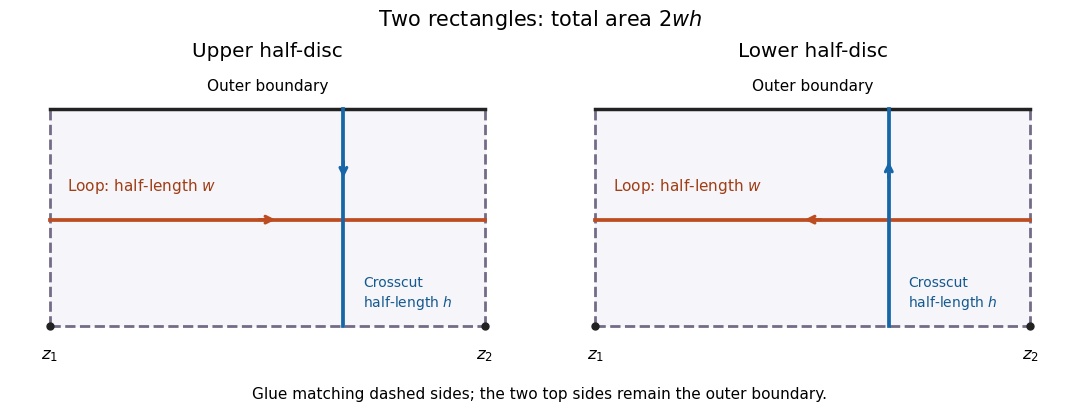
Glue two copies of along their left, bottom and right sides. Their unglued top sides form the outer boundary of a disk; the two bottom corners are marked interior points. Let be the loops surrounding both points, and the boundary-to-boundary crosscuts separating them. Then .
Each vertical seam joins a marked point to the outer boundary, so the Jordan curve theorem forces a loop surrounding both points to meet both seams. In the flat conformal metric, its total horizontal travel is therefore at least . Doubled horizontal segments attain this length. Each separating crosscut meets the bottom seam and starts and ends at height , so its total vertical travel is at least ; doubled vertical segments attain it. The total area is .
For an arbitrary density, integrate the lengths of the doubled horizontal segments over their height. The Cauchy-Schwarz inequality yields . Doubled vertical segments similarly give . These upper bounds equal the flat-metric ratios, proving both displayed formulas. Mapping the upper and lower halves of a disc to these rectangles gives the corresponding duality for a simply connected domain with two marked interior points.

A positive-integer labeling with and exists exactly when the condensation graph is totally ordered by reachability. Mutual paths force equal labels, and equal labels force mutual paths. Two incomparable components would require strict inequalities in both directions. Conversely number the components in topological order; total comparability forces every earlier component to reach every later one, proving both conditions. Compute the labeling in linear time. Reachability here includes length-zero paths.
Every two-by-two complex orthogonal matrix has form , where and . This follows by equating to in the two-by-two inverse formula, and direct multiplication proves the converse. A complete parametrization is , with complex ; restricting to real values selects only a subfamily.
There are unlisted articles, also show them or only show them.