An American option may be exercised at any time up to maturity. Its value is the Snell envelope of its discounted exercise payoff.
A holder may choose a shout time and receive , or choose no shout and receive . The lock-in term is signed, so shouting below strike can create a negative payoff. Backward induction must compare this actual contract with waiting. For , multipliers , bank growth , strike 101 and two periods, the optimal policy waits at zero, shouts after the first up move, and never shouts after the first down move. The risk-neutral price is . Claim payoffs at a recombined stock node can differ according to earlier shout history.
A boundary level of an underlying process at which an exercise policy stops. The displayed stopping time is an up-crossing policy; put-like claims often use a down-crossing boundary. A specified threshold need not be the optimal one.
An American call permits purchase of the underlying at strike at a chosen stopping time no later than maturity. Under standard pricing and integrability hypotheses its value is the displayed optimal stopping value. A European call option restricts exercise to the final time. Dividends and interest on the deferred strike affect the incentive to exercise early.
An American call option with no expiry. For geometric Brownian motion with drift under a risk-neutral measure, positive dividend yield , , and volatility , let solve . Its value is below and above. The power solves the stationary Black-Scholes equation with continuous stock dividends; value matching and smooth fit determine the threshold.
The candidate dominates the positive part because its continuation branch is convex and tangent to at . In the exercise region its discounted-generator residual is : the root equation gives . Applying Itô's formula to the discounted value, localized if necessary, gives an upper bound on every exercise policy. Stopping at the first hit of attains it; on paths not yet hitting, the bounded discounted continuation value tends to zero. This supplies the optimal stopping verification. As , , the threshold diverges and the value tends to .
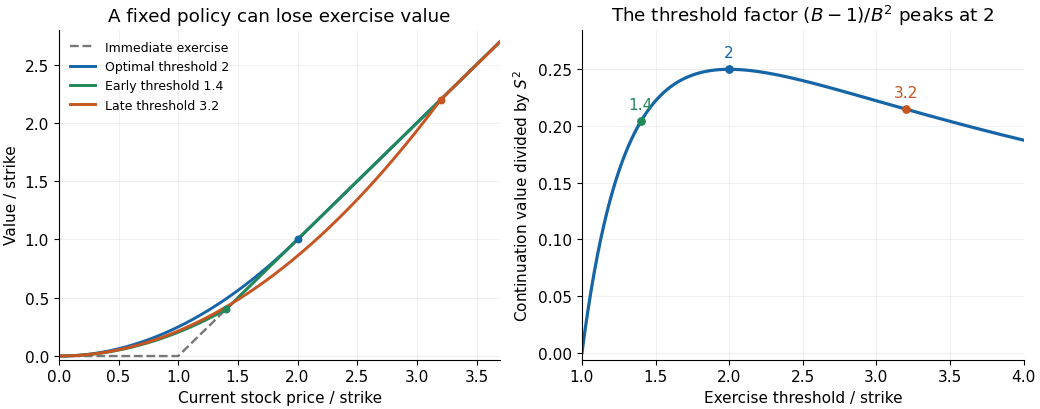
Early and late exercise thresholds both lose value relative to the optimal perpetual-call threshold
. An ideal Black-Scholes example with strike one, interest rate 0.05, volatility 0.2 and dividend yield 0.045 gives exponent two and optimal threshold two. A late fixed-policy value may lie below the immediate exercise payoff; it cannot be the price of an unrestricted American option. Details.
For the perpetual American call option model and a fixed exercise threshold , this is the discounted expectation of at its first hit, with zero payoff if the hit never occurs. The stationary ordinary differential equation and boundary conditions , prove the formula. At fixed , differentiation gives , so the unique maximizing threshold is . If a larger threshold is imposed, and its value lies below immediate exercise payoff just below . This is allowed for a committed policy, but violates the exercise lower bound if quoted for an unrestricted American call option.
For a single known cash dividend at , nonnegative interest excludes exercise strictly before the last cum-dividend opportunity. Immediately before the dividend, continuation has lower bound , whereas positive immediate exercise pays . The displayed inequality makes continuation strictly better. With no further dividends, it therefore excludes all early exercise. If the inequality fails, exercise just before the dividend may be worthwhile, but is not automatically optimal because remaining option time value also matters.
For a non-dividend-paying stock and nonnegative deterministic interest, the European call lower bound is , where is the zero-coupon bond price. This is at least the in-the-money exercise payoff ; the call also preserves the possibility of avoiding payment of the strike. Positive interest makes the comparison strict when exercise would have positive payoff. At zero interest there can be indifference, and with negative interest the statement can fail: a deterministic stock with can give a larger payoff by immediate exercise.
In a discrete-time binomial market with and one-step stock factors , use the risk-neutral probability , where . For the exercise payoff , the discounted one-step reward multiplier has meanThe Snell envelope of a multiplicative process gives the value . Continuation strictly exceeds exercise before maturity, so the optimal exercise time is . The replicating portfolio in a binomial market holds shares on the next step, found by subtracting the two next-state values and dividing by the stock-price difference. At time zero the price is .
For payoff and , the exercise boundary is . The value equals below and above it. Value matching, smooth fit, and the obstacle problem verify the first down-crossing policy.
If a nonnegative value dominates the payoff and , delta holdings combined with a reserve satisfying give a self-financing portfolio of wealth . The reserve retains the surplus instead of consuming it, so the wealth dominates the payoff at every exercise time.
Articles by others on the same topic
There are currently no matching articles.