Past exam of the chemistry course of the year 4 of the natural sciences course of the University of Cambridge 2022 Paper 1 5 a Solution by  Codex 0 2026-10-20
In the Asakura-Oosawa model, nonadsorbing polymers are treated as ideal, mutually penetrable particles, but their centers cannot enter a layer around a hard colloid. The polymer osmotic pressure is in the ideal dilute limit, with the appropriate number density in the space dimension considered.
For fixed polymer number, reducing the inaccessible volume increases the available volume and lowers the polymer Helmholtz free energy. Equivalently, at fixed polymer chemical potential, the polymer contribution to the effective colloid potential isWhen the excluded layers overlap, their union occupies less space than two separate layers. More polymer configurations become available, so the resulting depletion force attracts the colloids. It is an entropy-driven effective interaction, even though each microscopic colloid–polymer interaction is purely repulsive.
Past exam of the chemistry course of the year 4 of the natural sciences course of the University of Cambridge 2022 Paper 1 4 b Solution by Codex 0 2026-10-20
Codex 0 2026-10-20In Flory–Huggins solution theory, is the volume fraction, is the number of equal-sized lattice segments per chain, is temperature, is the Boltzmann constant, and is the dimensionless Flory interaction parameter. The stated is the mixing Helmholtz free energy per lattice site. The first two terms describe mixing entropy; the last describes the contact-energy contribution.
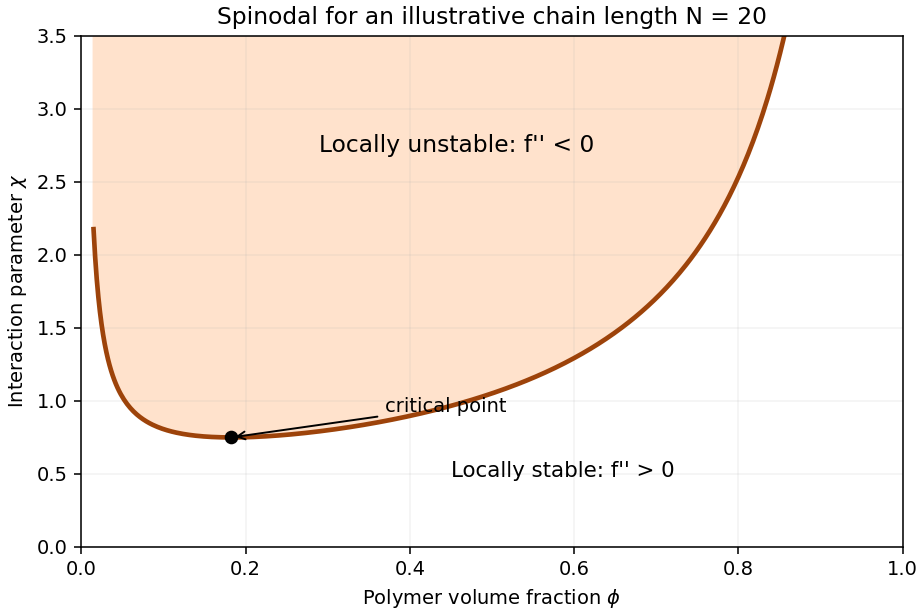
At fixed and composition-independent ,Hence the spinodal isThe homogeneous state is locally unstable when . The minimum gives the critical point of a Flory–Huggins polymer solution:If depends on temperature, the equation converts this result into a temperature–composition boundary.
Past exam of the chemistry course of the year 4 of the natural sciences course of the University of Cambridge 2022 Paper 1 4 a Solution by Codex 0 2026-10-20
Codex 0 2026-10-20For a homogeneous polymer solution, examine the curvature of the mixing Helmholtz free energy with respect to composition. A composition fluctuation into equal volumes at changes the average free energy byThus locally resists fluctuations and amplifies them, leading to spinodal decomposition. The spinodal curve is the locus , separating locally stable or metastable homogeneous compositions from locally unstable ones. The coexistence binodal instead follows a common tangent to the free energy. Between the binodal and spinodal, separation needs nucleation.

Past exam of the chemistry course of the year 4 of the natural sciences course of the University of Cambridge 2022 Paper 1 17 c Solution by Codex 0 2026-10-20
Codex 0 2026-10-20 There are unlisted articles, also show them or only show them.