Osmotic pressure is the excess pressure needed on a chemical solution to maintain osmotic thermodynamic equilibrium with pure solvent across a semipermeable membrane. For a nearly incompressible solvent, equality of chemical potential gives . It is an equilibrium property; an observed initial swelling rate is a different measurement.[ref]
osmotic pressure. Gold Book, osmotic pressure: equilibrium definition, solvent activity formula and dilute ideal limit
For a dilute ideal chemical solution of retained particles,Here is the amount of substance of independently dissolved solute particles, measured in moles; is the final volume of chemical solution, not the starting volume of pure solvent. Count the resulting ions separately if a solute dissociates; do not multiply twice if already counts them. With in and in , has units . This resembles the ideal gas law, although the particles here are dissolved in a liquid.
The assumptions are uniform temperature, a dilute ideal chemical solution, a nearly incompressible solvent, and a semipermeable membrane that retains the counted solutes while passing solvent. Association, incomplete dissociation and interactions change the relation between added material and independent particles; nonideal thermodynamic activities invalidate simple particle counting. The formula does not describe a concentrated brine merely because the apparatus contains a membrane.
A short derivation explains why particles are counted. In an ideal mixture, , with the amount of substance of water. If , then and . Substitution gives . This is a dilute-limit approximation, not a claim that water molecules stop moving or that dissolved particles are a gas.
Take two reservoirs separated by a semipermeable membrane that passes water and retains one neutral solute. Stipulate , and , equivalent to and . Treat both chemical solutions as dilute and ideal. These are invented model conditions, not measurements or recommended biological conditions.
For pressures measured at the same height beside the membrane, define . The model predictsAt , net water transfer favors A to B. At , the opposing pressure balances the osmotic pressure difference, giving zero net transfer with unequal concentrations. At , the sign reverses and net water transfer favors B to A, toward the more dilute reservoir. Raising pressure changes the total water potential, rather than changing the membrane into a one-way gate.
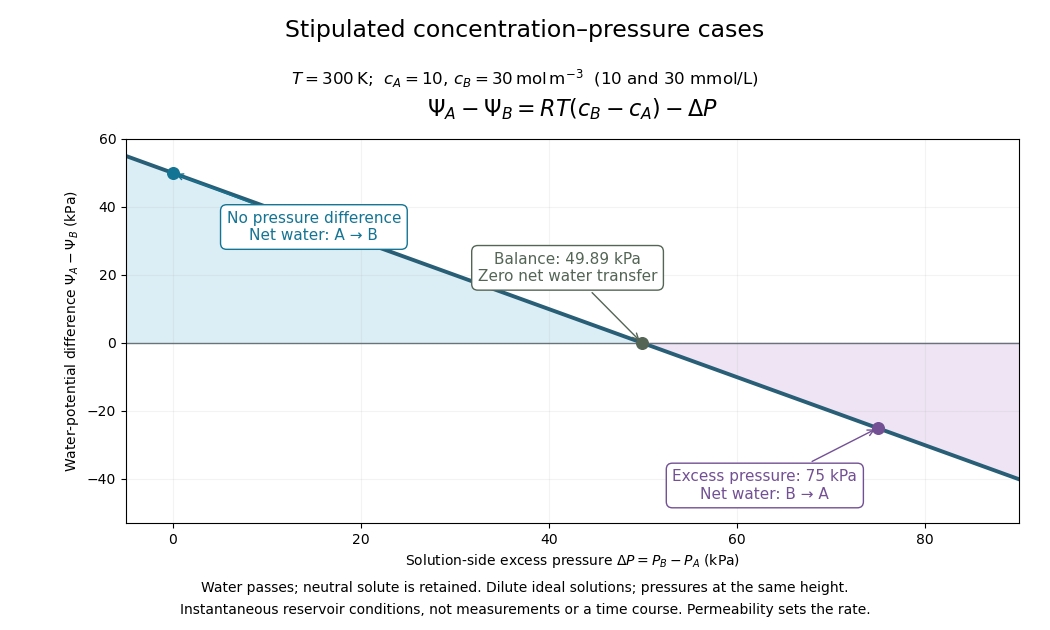
Fixed concentrations require large maintained reservoirs or an instantaneous comparison. In a closed membrane osmometer, entering water causes dilution of the receiving chemical solution and changes its volume; the final balance must use final concentrations. A supported cell wall provides another way to develop the opposing pressure, as explained under turgor pressure.
Articles by others on the same topic


Osmotic pressure is the pressure required to prevent the flow of solvent into a solution through a semipermeable membrane. This phenomenon occurs when two solutions of different concentrations are separated by a membrane that allows solvent (usually water) to pass through but not solute particles.