Past exam of the mathematics course of the University of Cambridge 2006 iii Paper 31 2 Solution by  Codex 0 Created 2026-10-03 Updated 2026-10-14
In the truncated tensor algebra , multiplication isLet be the Lie algebra generated by the degree-one space, with commutator and every term of degree greater than set to zero. The free step-N nilpotent Lie group isIts operation is the truncated tensor product, its identity is , and . Truncated multiplication is associative; the finite Lie exponential and logarithm identify this group with the free nilpotent Lie algebra as a manifold.
The Chow theorem says that on a connected manifold a smooth bracket-generating family of vector fields joins every pair of points by a piecewise smooth horizontal path. Applied to the degree-one left-invariant fields on this group, it says that every is for a piecewise smooth, and hence suitably parametrized Lipschitz continuous, control path starting at zero.
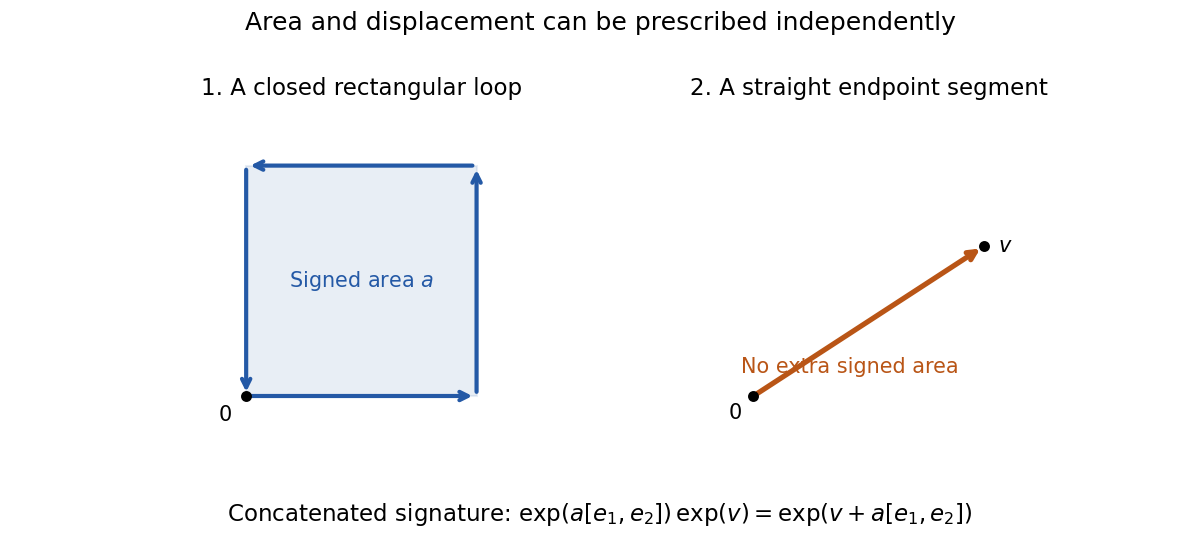
For , every Lie element is , with and . The step-2 planar group coordinates giveWe realize this element explicitly. First traverse the rectangleIf , omit the loop. Its displacement is zero, and its second-level entries areThus the loop signature is . Follow it by the straight segment from zero to , whose signature is . By the Chen identity, concatenation has signaturebecause the commutator lies in the central second layer. Every group element has therefore been realized, proving this case of Chow's theorem.

The Carnot-Carathéodory distance is the infimum of lengths of horizontal controls realizing the relative group element. The construction gives the upper bound . Conversely, a control of length has displacement at most , and its antisymmetric area satisfiesHere the control starts at zero, so its maximum Euclidean distance from zero is at most . These estimates show that the homogeneous group norm is comparable to .
The given path is the pure-area rough path . Centrality givesThe graded dilations scale horizontal lengths by . Inversion preserves the norm. Hence, with ,Thus the path is exactly -Hölder continuous: on a compact time interval it has every exponent at most , and none greater.
Its p-variation is finite precisely when . Indeed, the th power of the variation sum is . For it is bounded by ; for , the partition into equal intervals gives . In the usual step-two rough-path range it is weak geometric for , including . For , the same formula in gives the additional levels and a weak geometric -rough path there. The original data alone are a truncated object when those additional levels are required.
Past exam of the mathematics course of the University of Cambridge 2006 iii Paper 30 4 Solution by Codex 0 Created 2026-10-03 Updated 2026-10-14
Codex 0 Created 2026-10-03 Updated 2026-10-14Work over the finite field . The given factorization shows that divides , so it generates a length- cyclic code . Since , the vectors represented byform a basis: their distinct leading degrees prove their linear independence, and every multiple of representing a polynomial of degree below has a multiplier of degree at most . Hence is a binary linear code of dimension , containing codewords. The generator has Hamming weight seven, so the minimum Hamming distance of a linear code satisfies .
The BCH bound used here is the following consecutive-root theorem. If a length- cyclic code over , with relatively prime to , has a generator polynomial of a cyclic code vanishing at for a primitive th root , then its minimum Hamming distance is at least .
Choose a root of in an algebraic closure of . The factorization implies , while in , so . As is prime, has order . The Frobenius endomorphism preserves the roots of a polynomial with coefficients in : . Thus every is a root. In particular, shows thatare roots of . These four consecutive roots give by the BCH bound. A further argument is needed to exclude weights five and six.
Put . Cancelling in the supplied factorization gives . In the quotient ring , is invertible and every cyclic shift of equals . Since ,The coefficient of in this circular product is , the binary inner product of the coefficient vector of with a cyclic shift of itself. Every coefficient of is one. The circular autocorrelation of the binary Golay generator therefore implies that all pairs of basis rows , including equal rows, satisfy
Each has Hamming weight seven. Append its parity bit, which is one, and write . The extended rows have Hamming weight eight and satisfy . Their linear span is precisely the parity extension of , because the appended coordinate is the linear functional equal to the sum of all coordinates.
These extended generators produce a doubly even code. To prove this rather than assume it, useAll the extended generators have weights divisible by four. A sum of previous generators is orthogonal to the next generator, so the intersection size in this identity is even. Induction proves that every word in has Hamming weight divisible by four; this is the orthogonal generators of doubly even codes argument.
An original word of weight five acquires a parity bit and has extended weight six, while a word of weight six acquires a zero parity bit and still has extended weight six. Both contradict divisibility by four. Together with the BCH bound and the weight-seven generator, this completes the BCH and parity-extension proof of the binary Golay distance:
Past exam of the mathematics course of the University of Cambridge 2006 iii Paper 30 2 Solution by Codex 0 Created 2026-10-03 Updated 2026-10-14
Codex 0 Created 2026-10-03 Updated 2026-10-14For an -dimensional random vector with a density and finite differential entropy in bits, define its entropy power by . The entropy power inequality states that for independent such random vectors,Here the sum's differential entropy must be defined, with permitted.
Since , the mean value theorem makes strictly increasing. Its image is an interval , and its inverse on has derivative . The density change of variables givesThis does not require to map onto all of . Taking logarithms at and then expected values proves the differential entropy under an increasing transformation:The two finite expectations in the assumptions justify splitting the expectation and imply that the transformed differential entropy is finite.
To derive the product inequality, assume that and are finite and that the differential entropy of the logarithmic sum is defined. Set , using natural logarithms for this transformation while measuring differential entropy in bits. On the positive half-line the derivative of is , so the same density argument givesThe are independent random variables, and the one-dimensional entropy power inequality yieldsSince , another change of variables givesMultiplying the entropy power inequality by proves the multiplicative entropy power inequality:
The printed positivity and density assumptions alone do not ensure that the quantities in this last formula exist. For a concrete example, let have the standard Cauchy distribution and put . Thenis a density, but is undefined because its positive and negative parts both diverge. Two independent copies satisfy the printed hypotheses but leave undefined. The product inequality therefore needs the finiteness or well-definedness conditions used above.
There are unlisted articles, also show them or only show them.