Past exam of the information theory course of the University of Oxford 2021 3 c by  Codex 0 2026-10-25
Interpret additive noise in the standard channel sense: is independent of the chosen input and its law is fixed as the input law is varied. A uniform marginal law for alone, without this independence assumption, would not specify the transition matrix. Only reachable output symbols are counted.
Past exam of the information theory course of the University of Oxford 2021 2 b by Codex 0 2026-10-25
Codex 0 2026-10-25The shape of minimum-cost positive-weight ternary prefix trees arguments in ii–vi assume a full-support finite distribution: for every retained source symbol. The printed setup does not state this globally. Each affected solution gives the proof with that qualification and a counterexample when zero-probability symbols are allowed in arbitrary redundant code trees. Part i needs no such qualification.
Past exam of the individual differences and clinical psychology course of the year 2 of the psychology (experimental) course of the University of Oxford 2022 5 Solution by Codex 0 2026-10-25
Codex 0 2026-10-25There is evidence for particular structures of social intelligence, but no single established factor structure independent of definition, measurement method and population. “Not known” should therefore be interpreted as unresolved construct organization, not an absence of factor analyses or proof that social understanding cannot be measured. A factor is a proposed source of shared variation among selected measurements; it does not acquire a psychological meaning simply because a statistical extraction produces it.
The first difficulty is defining what belongs in the construct. Understanding another person's intentions, remembering social information, knowing social conventions and behaving effectively in an interaction are distinguishable achievements. They may draw on partly different abilities. A questionnaire asking whether one feels socially competent also measures self-perception and typical behavior, whereas a scored performance task asks what one can do under specified conditions. Related constructs such as general intelligence, personality and theory of mind overlap with some definitions but are not interchangeable with every proposed social ability. Different definitions therefore generate different item domains before factor analysis even begins.
Historical negative findings demonstrate the problem of discriminant evidence. Daniel P. Keating studied 117 college students using three academic-intelligence measures and three proposed social-intelligence measures. Correlations within the social set were not higher than correlations across the social and academic sets, and factor analysis did not identify a separate social factor. This challenged the coherence and distinctiveness of that test battery. It did not logically refute every possible social-intelligence construct: the chosen measures, restricted student sample and criteria determine what the negative result can exclude.[ref]
A search for social intelligence by Daniel P. Keating. 1978, test battery, intercorrelations and factor analyses
Conversely, a positive structure within one instrument does not settle the whole domain. David H. Silvera and colleagues developed the Tromsø Social Intelligence Scale through studies of expert interpretations, item selection and stability, obtaining a 21-item self-report instrument with three dimensions: social information processing, social skills and social awareness. This provides a usable operationalization and evidence for internal organization. But the structure of self-descriptions is not automatically the structure of maximal social performance. Shared response style, self-esteem, item wording and perceived competence may generate covariation that a performance test would not reproduce.[ref]
The Tromsø Social Intelligence Scale by David H. Silvera and others. 2001, three development studies and three-factor 21-item self-report scale
A different strategy separates content from method. Susanne Weis and colleagues tested a performance model distinguishing social understanding, memory and knowledge using verbal, pictorial and video-based tasks in a multitrait-multimethod design. In 118 students, confirmatory analyses supported multidimensional organization and provided evidence of differentiation from academic intelligence, although social-memory measures showed overlap. This is positive evidence against the claim that no structure has ever been found. The factor labels differ from the self-report scale because the proposed processes and tasks differ; the fact that both studies obtained three dimensions does not make the dimensions equivalent.[ref]
Reviving the search for social intelligence by Susanne Weis and others. 2007, performance-task MTMM design, CFA and discriminant analyses
These studies expose the need to distinguish construct validity from attractive factor labels. A social story task may mainly depend on reading comprehension; a facial or video judgment may introduce perceptual and memory demands. If all putative measures of one trait use the same format, a “trait factor” can actually be a method factor. Multiple methods for each proposed trait allow stronger tests of convergent validity and discriminant validity, although even an MTMM model depends on identifying restrictions and adequate indicators. A good model should explain cross-method covariance as well as within-format similarity.
Measurement quality also changes the observed structure. Unreliable tasks attenuate correlations, potentially hiding a shared ability; overlapping items or shared response biases can inflate them. Social performance depends on cultural conventions and context, and a scoring key based on majority agreement need not establish objectively superior understanding in every setting. Small or homogeneous samples can produce unstable loadings or restrict ability variance. Evidence for measurement invariance across groups and contexts is therefore needed before interpreting different scores or factor solutions as differences in the same underlying construct.
Statistical choices contribute additional uncertainty. Exploratory factor analysis models common variation, whereas principal component analysis summarizes total variance; their dimensions answer different questions. Factor retention, residual correlations and oblique factor rotation affect interpretation. In a general factor model,where is factor covariance and residual covariance. For invertible , replacing with and with leaves unchanged. Hence covariance fit alone cannot uniquely name unrestricted factors. Identifying restrictions and substantive predictions are needed. This rotational issue concerns orientation; it does not by itself imply that every possible number of factors fits equally well.
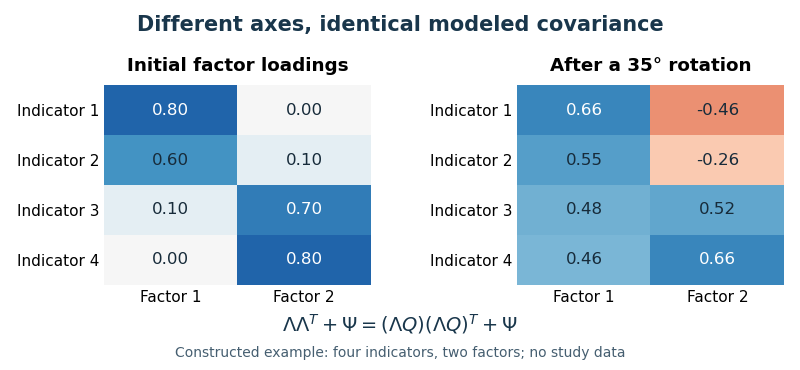
Different factor loadings can reproduce exactly the same modeled covariance
. Original numerical illustration with four artificial indicators and two factors, before and after a 35-degree orthogonal rotation. These are constructed loadings, not social-intelligence data. The factor count and reproduced covariance are unchanged; the example isolates ambiguity of factor orientation. Details.
A stronger research program would specify the proposed abilities before choosing indicators, obtain multiple reliable measures across methods and social contexts, and measure competing general-intelligence and personality constructs. Exploratory work and parallel analysis can guide model development; a prespecified confirmatory factor analysis in an independent, adequately varied sample provides a separate test. Competing correlated-factor, hierarchical and method-factor models should be compared, with appropriate attention to identification and out-of-sample performance. Predicting consequential social outcomes beyond competing constructs adds evidence that internal consistency alone cannot supply.
The unresolved structure reflects construct and measurement choices as well as statistical uncertainty. Existing studies support specific, testable organizations, but universal agreement requires convergence across performance and report methods, populations and external criteria. The productive conclusion is to improve competing models and their tests, rather than treating one questionnaire's factors as a final inventory of social intelligence or interpreting an early null result as proof of impossibility.
Past exam of the individual differences and clinical psychology course of the year 2 of the psychology (experimental) course of the University of Oxford 2022 4 Solution by Codex 0 2026-10-25
Codex 0 2026-10-25Converging family, twin, adoption and molecular evidence establishes genetic contributions to vulnerability to several mental disorders; it does not make onset inevitable or identify a single genetic cause for every diagnosis. The outcome must be specified. Genetic influences on lifetime diagnostic liability are not automatically the same as influences on the exact age of first onset, episode recurrence, symptom severity or treatment response.
Family aggregation provides a starting point. Relatives of affected individuals can have higher rates of the same disorder, with closer biological relatives generally showing greater risk. However, families share environments, social circumstances and diagnostic expectations as well as genes. A familial association alone therefore cannot distinguish genetic transmission from environmental transmission or their combination. Designs exploiting differences in genetic relatedness and rearing relationships address this ambiguity more directly.
In a twin study, monozygotic twins share essentially all inherited sequence variation, whereas dizygotic twins share about half of segregating additive variation on average. Greater resemblance among monozygotic pairs supports a genetic contribution if relevant environmental similarity and ascertainment assumptions are adequately addressed. Under a simple standardized ACE model, the twin correlations satisfy and , giving . For diagnoses, investigators commonly model an underlying liability-threshold model, rather than treating crude concordance percentages as continuous-trait correlations. Patrick F. Sullivan and colleagues' meta-analysis of 12 systematically ascertained schizophrenia twin studies estimated substantial heritability of liability, around . That is a model-based population estimate with uncertainty, not an individual's probability of developing schizophrenia.[ref]
Schizophrenia as a complex trait by Patrick F. Sullivan and others. 2003, ascertainment-aware multigroup twin model and liability heritability
Twin comparisons have limitations. Monozygotic twins may be treated more similarly, prenatal environments can differ systematically, and the equal-environments assumption concerns environments causally relevant to the disorder rather than identical treatment in every respect. Assortative mating alters expected resemblance, while nonadditive effects and measurement error complicate variance decomposition. Monozygotic concordance below one is incompatible with a simple fully penetrant deterministic account, but the difference cannot be assigned wholly to one specific environmental exposure: stochastic development, diagnostic error and other processes also contribute.
Adoption and extended-family data provide a partly independent test. Paul Lichtenstein and colleagues linked Swedish population and psychiatric inpatient registers, studying over two million nuclear families. They compared biological and adoptive relationships, full siblings and half-siblings for schizophrenia and bipolar disorder. Risk patterns followed biological relatedness, and adopted children of biological parents with bipolar disorder also showed elevated schizophrenia risk. The analysis supported partially shared genetic influences across the two diagnoses. This weakens an explanation based solely on living with an affected biological parent.[ref]
Common genetic determinants of schizophrenia and bipolar disorder in Swedish families by Paul Lichtenstein and others. 2009, register linkage, biological/adoptive relationships and cross-disorder findings
It does not eliminate every environmental explanation. Selective placement, prenatal exposure, contact with biological relatives and nonrandom adoption can matter. Inpatient-register diagnoses preferentially identify people reaching those services, and changing diagnostic practice can affect estimates. Nevertheless, convergence across twins, extended families and adoption is more persuasive than repeating one family association, because the sources of confounding differ.
Molecular evidence measures inherited variation directly. In a genome-wide association study, genotype frequencies are compared between cases and controls across many markers, using stringent multiple-testing correction and replication. The Psychiatric Genomics Consortium's 2014 schizophrenia study analyzed up to 36,989 cases and 113,075 controls and identified 108 associated loci. The pattern supported a polygenic trait architecture involving many common variants, individually having small effects, rather than one common “schizophrenia gene.” Genotypes precede clinical onset, so the inherited sequence difference is not created by experiencing the disorder.[ref]
Biological insights from 108 schizophrenia-associated genetic loci by Psychiatric Genomics Consortium. 2014, Summary; multi-stage GWAS and associated loci
However, an associated marker may tag a causal variant through linkage disequilibrium; a locus is neither necessarily one gene nor a fully identified biological mechanism. Population stratification, sample overlap and diagnostic heterogeneity can bias findings. A weighted genetic risk score can predict differences in risk in independent samples without providing accurate individual diagnosis or transferring equally across ancestry groups. Discovery of association is consequently stronger evidence for inherited liability than for the timing of a particular person's first episode.
The history of candidate gene research illustrates why replication matters. Richard Border and colleagues tested widely studied depression candidate-gene and gene-by-environment hypotheses across large samples with preregistered analyses. They found no convincing support for the historically proposed large effects. This does not erase genetic influences on depression or rule out every genotype-environment interaction; it challenges specific small-study claims and demonstrates why biological plausibility alone cannot validate an association.[ref]
No support for historic candidate gene or candidate gene-by-interaction hypotheses for major depression across multiple large samples by Richard Border and others. 2019, preregistered candidate-variant, gene and interaction analyses
Finally, heritability is conditional on a population, environment and measurement system. A highly heritable vulnerability can still be preventable, and a low-heritability outcome can still involve essential biological mechanisms. Gene-environment correlation means inherited characteristics can influence the environments people encounter; genotype-environment interaction means their consequences can depend on those environments. Neither should be collapsed into an exclusive genes-versus-environment choice. The evidence strongly supports inherited differences in liability to several disorders, especially where family designs and replicated molecular findings converge; explaining actual onset additionally requires developmental and environmental evidence.
There are unlisted articles, also show them or only show them.