For integers , adding to a frequency index changes the complex exponential by . Thus different continuous Fourier modes become identical discrete Fourier modes on the sampling grid. This is aliasing, caused by sampling before any discrete Fourier transform is computed.
For , compare the continuous functions and with and , sampled at , . With , both cosines give exactly the first row and both sines give exactly the second:The nine-cycle sine agrees in sign as well as magnitude with the one-cycle sine: the frequency indices differ by , rather than by a sign reversal. Consequently, either cosine produces the same discrete Fourier transform, with all other coefficients zero; either sine produces , , with all other coefficients zero.
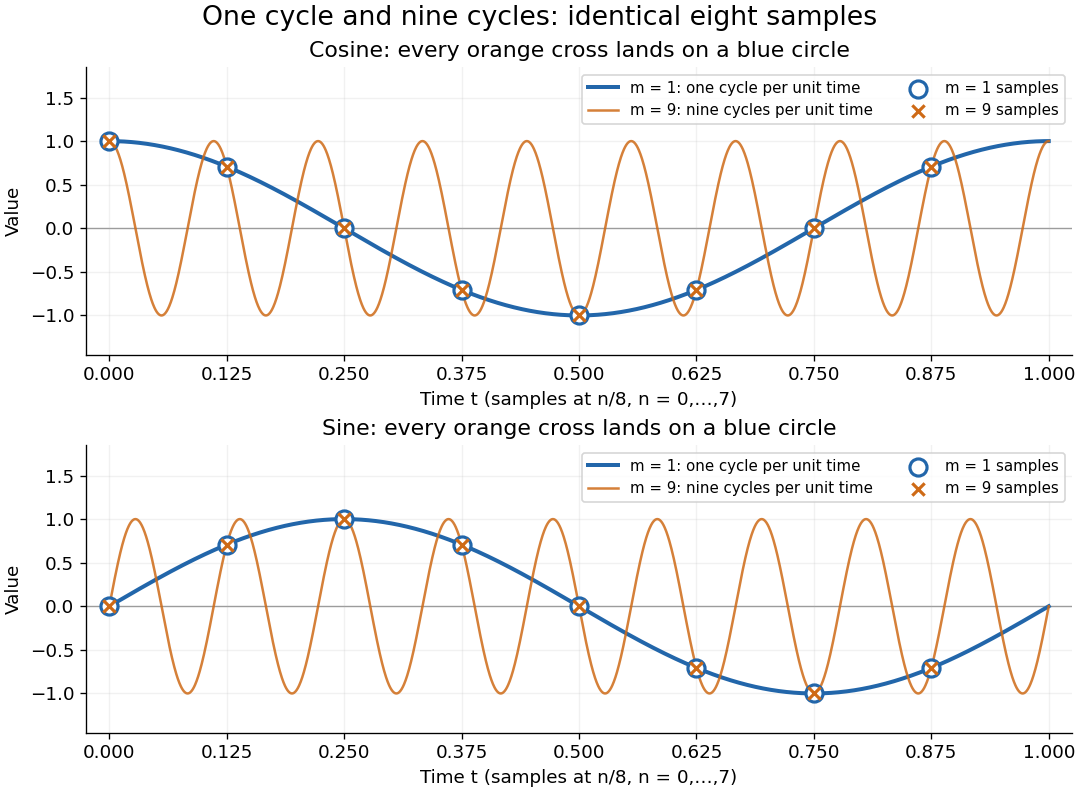
One-cycle and nine-cycle cosine and sine waves have exactly the same eight samples
. Details. 
An observed low frequency therefore does not establish that physical high frequencies are absent. To exclude such alternatives, the Nyquist–Shannon sampling theorem requires a specified class of bandlimited functions. For arbitrary pure sinusoids with frequencies at most , choose sampling rate ; equality needs care because vanishes at every . The finite-energy L2 space version of the Nyquist–Shannon sampling theorem permits equality under its own hypotheses. In either case, exact continuous reconstruction generally requires the entire infinite sample sequence; eight observed samples alone do not supply it. Demanet derives the grid aliasing condition as a difference by an integer multiple of the sampling angular frequency.[ref]
https://math.mit.edu/icg/resources/teaching/18.330/18.330-Mar21.pdf. Laurent Demanet, MIT 18.330 notes, §6.2, Definition 11, p. 57: aliases on a grid, 2012
Articles by others on the same topic
There are currently no matching articles.