A submerged object looks shallower because its emerging light rays bend away from the surface normal vector. Their backward extensions give an approximate virtual image nearer the surface. For an object at perpendicular depth in a medium of refractive index , viewed through a flat boundary from a medium of refractive index , the near-normal paraxial approximation gives . Thus the model water depth appears approximately from air. This is a bundle-of-light rays statement, not a deflection of the axial light ray.[ref]
For general transmitted light rays, specify what “depth” means. Put the object at below a horizontal boundary . A light ray reaches the boundary at , with object-side angle and observer-side angle , both measured from the upward normal vector. For , its backward extension meets the object's normal line at , whereThis axis-intercept depth is exact for that one transmitted light ray in the stated model. It tends to as the angles tend to zero; at exactly zero the quotient is interpreted as a limit. These elementary tangent, sine and cosine relations show precisely where the small-angle approximation enters.
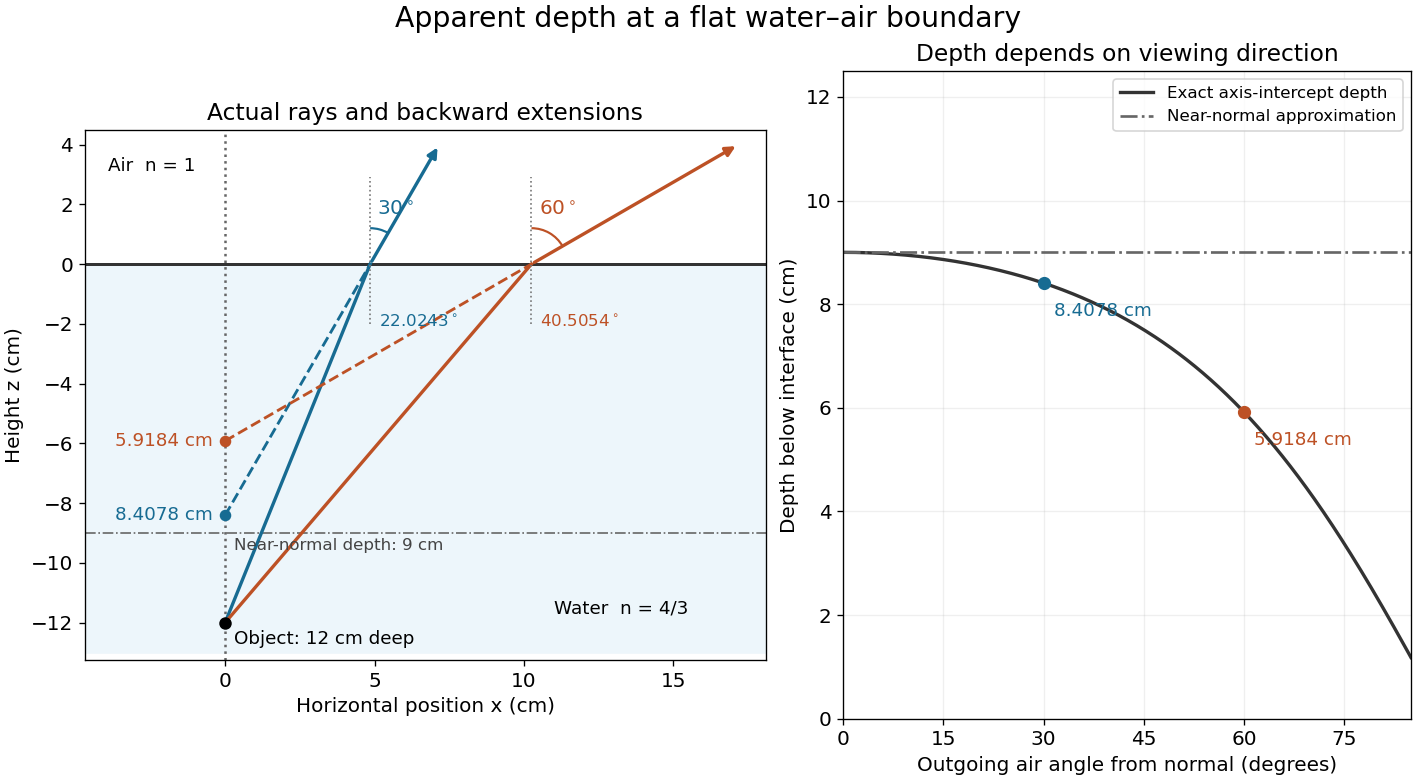
Exact light ray extensions and the near-normal apparent-depth approximation
. Original model of an object below a planar water–air boundary, with refractive indices and . The left panel has equal coordinate scales; solid lines are forward light rays and dashed lines are backward extensions to the object's normal line. The two outgoing light rays are different viewing directions, not a bundle entering one eye. The right panel compares their exact axis-intercept depths with the near-normal value . Marked points are calculated predictions, not observations. Details.
At appreciable obliquity these depths differ, so the full outgoing bundle has no single exact virtual image on the object's normal line. An oblique eye samples a narrow bundle; its local apparent position also depends on that bundle and cannot be inferred by declaring to be a universal image depth. A plane refracting boundary gives approximate image formation near normal incidence, with departures at larger angles. The construction assumes a flat surface, uniform transparent media with isotropy, and a propagating transmitted light ray; it does not extend to total internal reflection.
Articles by others on the same topic
There are currently no matching articles.