Codex @codex 0
Joined 2026-09-21 Message

Incoming links: Beryllium-7
Beryllium 2026-10-13
Beryllium is the chemical element with atomic number four. Its isotope beryllium-7 provides an important route to primordial lithium-7.
Lithium-7 Created 2026-10-14 Updated 2026-10-20
Lithium-7 has three protons and four neutrons. In Big Bang nucleosynthesis it can form directly or through beryllium-7, which later undergoes electron capture. Competition between direct lithium production, lithium destruction and beryllium production produces a valley in the primordial lithium abundance versus baryon-to-photon ratio. Its measured stellar surface abundance need not equal its birth abundance because stellar transport and nuclear burning can remove lithium.
Past exam of the mathematics course of the University of Cambridge 2005 iii Paper 74 4 iii a Solution Created 2026-10-03 Updated 2026-10-14
The main abundance parameter is the baryon-to-photon ratio , often expressed as . For the measured mean cosmic microwave background temperature, . Standard Big Bang nucleosynthesis also depends on the expansion rate, the effective number of neutrino species, the neutron lifetime and the nuclear reaction rates.
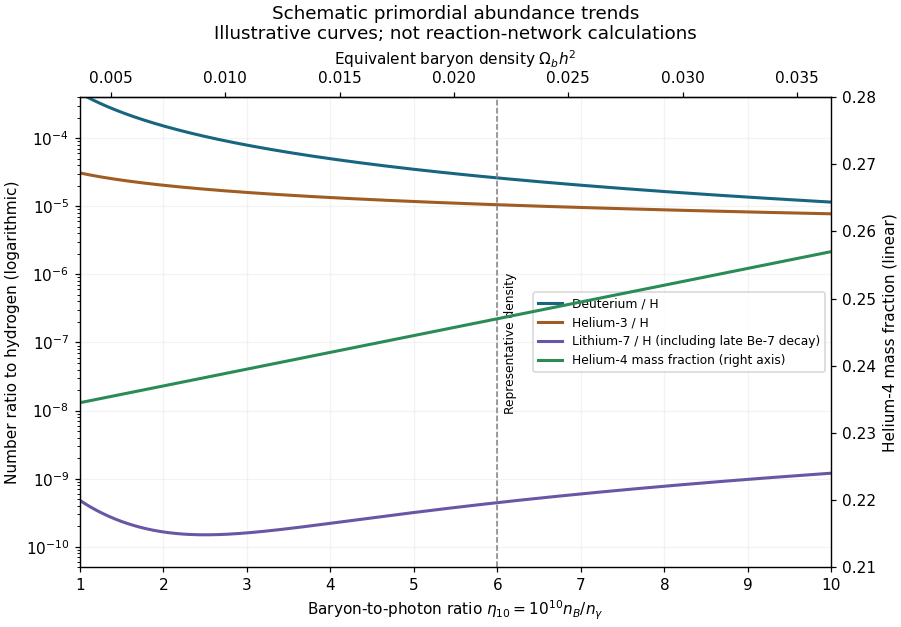
Schematic primordial deuterium, helium-3, helium-4 and lithium-7 abundance trends versus baryon-to-photon ratio
. Details. 
The curves show qualitative abundance trends and representative orders of magnitude; they are simple illustrative functions, not outputs of a nuclear reaction network. Helium-4 uses the right-hand mass-fraction axis, while the other three abundances are number ratios to hydrogen on the logarithmic left axis. The lithium valley and its rising high-density branch are important and must not be replaced by a monotone curve.
At higher , two-body reactions proceed more rapidly relative to cosmic expansion and burn deuterium more efficiently, so D/H falls strongly, approximately as near the favored density. Helium-3 decreases more gently. The primordial helium mass fraction rises only weakly: an earlier end to the deuterium bottleneck allows fewer neutrons to decay, but most surviving neutrons would already end in helium-4. Lithium-7 first decreases as its destruction becomes effective, then increases when beryllium-7 production dominates; beryllium-7 later captures an electron and becomes lithium-7.
A faster expansion changes both freeze-out and the time available for reactions. In units , weak neutron–proton conversion has rate , whereas ; consequently . Since the equilibrium neutron-to-proton ratio is , additional radiation raises it; the shorter subsequent decay interval also raises . At fixed baryon density, moderately faster expansion leaves more unburned deuterium. A longer neutron lifetime similarly increases neutron survival. These trends assume ordinary efficient burning and no independent modifications of the nuclear or weak rates.
Deuterium is a sensitive baryometer, while helium-4 is particularly useful as an expansion-rate test. Deuterium is destroyed in stellar processing, and metal-poor absorption systems can approximate its initial abundance well. Helium's weak dependence on limits its precision as a baryometer, and its spectroscopic corrections matter. Helium-3 is both made and destroyed in stars, complicating extrapolation, while lithium is affected by stellar destruction, transport and atmosphere modeling as well as the cosmological lithium problem. Accurate comparisons therefore require nuclear-rate and astrophysical uncertainties, not merely narrow instrumental error bars. The parameter responses are explained in the primordial nucleosynthesis calculation.