A chemical element is an identity shared by all chemical atoms whose atomic nuclei contain the same number of protons. That number is its atomic number, : six means carbon, eleven means sodium. The identity survives differences in neutron count, which distinguish isotopes, and differences in electron count, which distinguish neutral chemical atoms from ions. See the IUPAC Gold Book, chemical element.
The same name can also denote a pure chemical substance containing only that chemical element. These two uses answer different questions. Molecular oxygen, , is a chemical substance made entirely of oxygen; water, , is a chemical compound containing both hydrogen and oxygen. A water molecule contains three chemical atoms but only two chemical elements. Joining chemical atoms through chemical bonds changes their arrangement without changing their atomic numbers.
This distinction makes stoichiometry possible: ordinary chemical reactions rearrange chemical atoms, so one can count each chemical element before and after a transformation. Changing the proton count instead changes the chemical element and requires a nuclear reaction. The periodic table organizes these identities into a useful map, while atomic number bookkeeping keeps identity, isotope, and electric charge separate.
Lutetium is the chemical element with atomic number and chemical symbol . It is a dense rare-earth element whose ordinary chemistry is dominated by the oxidation state. The neutral atom has a filled shell with outer occupancy.[ref]
Its close chemical similarity to neighbouring rare earths makes separation difficult. This illustrates why identifying a new element and obtaining a pure metallic specimen are different experimental achievements. Element identity is fixed by nuclear charge, whereas similar outer-electron chemistry controls the practical separation.
Lawrencium is the synthetic radioactive chemical element , with atomic number . It lies at the end of the actinide series; studying it requires producing small quantities of short-lived isotopes, rather than handling an ordinary macroscopic mineral sample.[ref]
Its listed neutral-atom ground-state electron configuration is . That assignment is a reminder that a simple extrapolation of light-element shell-filling rules can fail for heavy atoms. A neutral-atom configuration also does not by itself determine every accessible chemical oxidation state.
Actinium is a radioactive metallic chemical element, symbol and atomic number . Its common chemistry is trivalent, and it is associated with the beginning of the actinide series. Naturally occurring actinium is present in trace quantities in uranium decay chains.[ref]
Radioactive abundance depends on both production and decay. A daughter isotope can remain rare even when continually replenished by its parent, so chemical separation and radiometric identification answer complementary questions about a sample.
Rhodium is a platinum-group transition metal with chemical symbol and atomic number . Both its metallic surfaces and its coordination complexes are important in catalysis; automotive exhaust treatment is a major application.[ref]
Different ligand environments can change a rhodium centre's accessible oxidation states and reaction pathways. Thus the relatively unreactive bulk metal and a reactive molecular rhodium catalyst are compatible descriptions of different chemical environments, rather than contradictory properties of the element.
Cerium is a lanthanide chemical element with symbol and atomic number . Its accessible and oxidation states distinguish much of its chemistry from rare earths dominated by only .[ref]
Changing the cerium oxidation state exchanges an electron with the surroundings and can couple to oxygen defects in cerium-containing oxides. Such redox flexibility helps explain why composition, defect population and chemical environment must be specified when describing a cerium material.
The chemical element identified spectroscopically through a characteristic green line in 1861.
A conventional class of chemical elements with properties intermediate between those commonly associated with metals and nonmetals; its membership is not a fundamental sharp boundary.
Yttrium is the chemical element with atomic number 39 and symbol . It is a metal. Its common oxidation state is , and its chemistry resembles that of many lanthanides. Yttrium-containing oxides are used in optical and ceramic materials, showing why a minor compositional change can alter a solid's properties.[ref]
Samarium is the chemical element with atomic number 62 and symbol . It is a lanthanide. Samarium-cobalt alloys provide strong permanent magnets. It also has useful and chemistry, illustrating that the common trivalent pattern of the lanthanides has chemically important exceptions.[ref]
A chemical element of atomic number 59. Its trivalent ion has a open-shell electron configuration. In LS coupling, Hund's rules select , , , the term symbol. The corresponding free-ion Landé g-factor is and its effective paramagnetic moment is .
Xenon is the chemical element with atomic number 54 and symbol . It is a noble gas. Although relatively unreactive, it forms compounds such as xenon fluorides. Its chemistry demonstrates that a filled valence shell does not imply absolute inability to form chemical bonds.[ref]
An alkaline-earth element whose divalent ions can substitute for calcium in suitable crystal hosts. Radioactive strontium isotopes are relevant fission-product constituents.
The existence of different structural forms of the same chemical element. Diamond and graphite are crystalline examples for carbon; molecular oxygen and ozone illustrate that allotropy need not consist only of different packing arrangements of identical molecules.
One of the different structural forms of the same chemical element.
Americium is the chemical element with atomic number 95 and symbol . It is a actinide. It has no stable isotopes. Americium-241 is an alpha emitter used in some ionization smoke detectors, where the radiation maintains a small electrical current that smoke particles disturb.[ref]
The linear oxo species and for Am(V) and Am(VI), respectively. The charge changes by one on a single-electron redox step.
Bromine is the chemical element with atomic number 35 and symbol . It is a halogen. Its elemental form is the reddish-brown molecular liquid near room temperature. Bromide is instead the anion , so the element and its reduced ionic form have very different chemical behavior.[ref]
Titanium is the chemical element with atomic number 22 and symbol . It is a transition metal. A protective oxide film gives the metal good corrosion resistance. Its combination of comparatively low density and useful alloy strength explains engineering applications, while titanium dioxide is a chemically distinct oxide used in pigments and other materials.[ref]
Hafnium is the heavier group-4 congener of zirconium. Changes in alkyl-bond energetics can change both propagation and chain-transfer rates in metallocene polymerization.
Zirconium is a group-4 metal; Zr(IV) is formally . Its cationic alkyl complexes can catalyze polymerization through alkene migratory insertion.
Arsenic is the chemical element with atomic number 33 and symbol . It is a metalloid. Its chemistry includes oxidation states , , and , and it occurs in both inorganic and organic compounds. Chemical form matters: elemental arsenic, arsine, and arsenic oxides differ in bonding and physical behavior.[ref]
An arsenic compound contains arsenic chemically combined with other elements. Examples include covalent arsine, arsenic trioxide, and arsenic trisulfide.
The oxidation state and chemical partners strongly affect behaviour. Elemental composition alone does not specify volatility, solubility, or biological effects, so identifying an arsenic-containing material requires its chemical form as well as the amount of arsenic.
Arsine is , a molecular hydride of arsenic with a pyramidal arrangement of three hydrogen atoms around arsenic. It is the arsenic analogue of Ammonia, although their chemical properties differ substantially.
The small molecular structure gives arsine a very different physical form from solid arsenic oxides or sulfides. This illustrates why an element's compounds cannot be assigned the properties of the pure element.
Arsenic trisulfide is , an arsenic-sulfur compound. Its crystalline mineral form is orpiment; amorphous forms have different structural order.
The distinction between a crystal and an amorphous solid matters for optical behaviour and material processing. The same nominal elemental ratio can therefore occur in materials with different local structure and physical properties.
Arsenic trioxide is the arsenic(III) oxide conventionally written . The formula expresses its elemental ratio; molecular units in some forms are .
This distinction separates an empirical formula from the structure of the actual species. Reactions involving arsenic trioxide depend on pH, dissolved speciation, and oxidation state, rather than on the oxide formula alone.
The hydrated arsenic(III) compound ; distinguish it from the historical dry product called arsenious acid, arsenic trioxide.
Historical pharmaceutical preparation; its composition and clinical use must be identified by edition. [ref]
The Essentials of Materia Medica and Therapeutics by Alfred Baring Garrod (1865). corresponding monograph and British preparation
The +3 oxidation state of arsenic. The actual aqueous species can depend on pH, hydrolysis and ligands; a bare ionic formula is an analytical shorthand.
Antimony is the chemical element with atomic number 51 and symbol . It is a metalloid. Its common oxidation states include and . Elemental antimony is brittle, while its compounds and alloys have distinct materials applications; potassium antimony tartrate is an example of a coordination compound rather than the free element.[ref]
A pentavalent antimony chloride whose solution behaviour depends strongly on hydrolysis and chloride concentration.
The chloride historically called butter of antimony. Hydrolysis on dilution can produce oxychloride-containing precipitates.
The sulfide with composition ; the mineral stibnite and a freshly precipitated material can differ in appearance and structure.
Potassium antimony tartrate is an antimony-containing salt with potassium counterions and tartrate ligands, historically called tartar emetic. Its composition includes both inorganic metal centres and organic coordinating groups.
The tartrate provides oxygen donor sites that bind antimony. This makes the compound an example of how coordination chemistry joins metal-ion chemistry with the stereochemistry and functional groups of an organic ligand.
Historical pharmaceutical preparation; its composition and clinical use must be identified by edition. [ref]
The Essentials of Materia Medica and Therapeutics by Alfred Baring Garrod (1865). corresponding monograph and British preparation
The +3 oxidation state of antimony. The actual aqueous species can depend on pH, hydrolysis and ligands; a bare ionic formula is an analytical shorthand.
Neptunium is the chemical element with atomic number 93. Its isotope neptunium-239 occurs between uranium-239 and plutonium-239 in a neutron-capture and beta decay production chain.
Neptunium-239 is a radioactive isotope with ninety-three protons and one hundred forty-six neutrons. It beta-decays to plutonium-239.
It occurs in the sequence following neutron capture by uranium-238 and beta decay of uranium-239. This is an example of transmutation changing the chemical element through a nuclear process, unlike an ordinary chemical reaction that rearranges electrons and bonds.
Gadolinium is the chemical element with atomic number 64 and symbol . It is a lanthanide. The ion has seven unpaired 4f electrons, giving it strong paramagnetism. This connects atomic electron configuration with magnetic behavior and with the effect of coordinated gadolinium on nearby nuclear-spin relaxation.[ref]
A gadolinium isotope with a very large thermal-neutron absorption cross section. Its isotope-specific cross section is not the same as the isotope-averaged value for natural gadolinium.
Thorium is the chemical element with atomic number 90 and symbol . It is a actinide. It has no stable isotopes, but thorium-232 is sufficiently long-lived to occur naturally. The oxidation state is characteristic of its chemistry, distinguishing it from the more usual chemistry of many neighboring f-block elements.[ref]
Lanthanum is the chemical element with atomic number 57 and symbol . It is a metal. The oxidation state dominates its chemistry. Lanthanum compounds occur in optical glasses and catalytic materials; the properties of those compounds should be distinguished from the reactive silvery elemental metal.[ref]
Vanadium is the chemical element with atomic number 23 and symbol . It is a transition metal. It supports several oxidation states, producing differently colored ions in solution. Vanadium-containing alloys strengthen steel, while vanadium oxides participate in oxidation catalysis; the same element therefore plays distinct structural and chemical roles.[ref]
Erbium is the chemical element with atomic number 68 and symbol . It is a lanthanide. Erbium ions in glass can absorb and emit infrared light near telecommunications wavelengths. Erbium-doped optical amplifiers exploit these electronic transitions, linking an element's energy levels to long-distance optical communication.[ref]
Curium is the chemical element with atomic number 96 and symbol . It is a actinide. It has no stable isotopes and is produced through nuclear transformations. Its common trivalent chemistry helps organize its separation from other actinides, while its radioactive decay gives it physical behavior absent from a stable chemical analogue.[ref]
Plutonium is the chemical element with atomic number 94 and symbol . It is a actinide. It has no stable isotopes and exhibits several accessible oxidation states. Its solid has multiple structural phases, so both nuclear composition and crystal structure matter when specifying a plutonium sample.[ref]
Chromium is the chemical element with atomic number 24 and symbol . It is a transition metal. A chromium-rich passive oxide layer helps stainless steel resist corrosion. Chromium(III) and chromium(VI) compounds have substantially different bonding, reactivity, and environmental behavior, so an oxidation state is essential when discussing a chromium compound.[ref]
Radium is the chemical element with atomic number 88 and symbol . It is a alkaline earth metal. All its isotopes are radioactive. Its chemistry resembles that of barium, often favoring the state, while radioactive decay distinguishes its long-term behavior from an ordinary stable alkaline-earth salt.[ref]
Niobium is the chemical element with atomic number 41 and symbol . It is a transition metal. Niobium and several niobium alloys are used as superconductors. Its common chemistry also appears in oxides, including lithium niobate, whose optical and electrical behavior differs from that of the metal.[ref]
Germanium is the chemical element with atomic number 32 and symbol . It is a metalloid. Crystalline germanium is a semiconductor with a diamond-like crystal structure. Its electronic and infrared-optical properties connect chemical bonding in a solid with devices and spectroscopy.[ref]
Indium is the chemical element with atomic number 49 and symbol . It is a metal. It is a soft group-13 metal, commonly forming compounds. Indium-containing transparent conducting oxides and indium gallium nitride illustrate how the element contributes to optical and electronic materials without behaving as a free metal.[ref]
Gallium is the chemical element with atomic number 31 and symbol . It is a metal. Its melting point lies just above ordinary room temperature. Compounds such as gallium nitride are important semiconductors; their electronic properties arise from the compound lattice, not from the low melting point of elemental gallium.[ref]
An alkaline earth metal is a group-2 element, including magnesium, calcium, and barium. A common oxidation state is , associated with loss of two outer-shell electrons.
The resulting salts can nevertheless have very different solubilities and lattice properties. Comparing magnesium and calcium carbonates or hydroxides shows why periodic similarity does not eliminate the role of ion size, hydration, and crystal structure.
An alkali metal is a group-1 metallic element, such as lithium, sodium, or potassium; hydrogen is in group 1 but is not ordinarily classified as an alkali metal. These metals commonly form singly charged positive ions.
Their outer-electron configuration helps explain related chemical behavior across the group. Physical properties and detailed reactivity still vary, so group membership is an organizing pattern rather than identity of all properties.
Bismuth is the chemical element with atomic number 83 and symbol . It is a metal. The oxidation state is common. Natural bismuth is dominated by the extremely long-lived radioactive isotope bismuth-209, showing that everyday apparent stability and strict nuclear stability are not identical.[ref]
The +3 oxidation state of bismuth. The actual aqueous species can depend on pH, hydrolysis and ligands; a bare ionic formula is an analytical shorthand.
Caesium is the chemical element with atomic number 55 and symbol . It is a alkali metal. It readily forms . A specified hyperfine transition of caesium-133 defines the SI second, linking a reproducible atomic frequency with time measurement rather than with a mechanical clock.[ref]
Polonium is the chemical element with atomic number 84 and symbol . All its isotopes are radioactive. Polonium-210 decays mainly by alpha emission, so a sample changes its nuclear composition with time even when no ordinary chemical reaction is occurring.[ref]
Rubidium is the chemical element with atomic number 37 and symbol . It is a alkali metal. It commonly forms a singly charged positive ion. Its optical transitions are useful in atomic spectroscopy and laser-cooling experiments, while rubidium-87 adds an experimentally useful isotope-specific nuclear-spin structure.[ref]
Rubidium-87 is a long-lived radioactive isotope with thirty-seven protons and fifty neutrons. Its beta decay to strontium-87 supports rubidium-strontium geochronology.
It is also a common isotope in laser-cooled atomic-gas experiments. Its nuclear spin and hyperfine states provide experimentally accessible internal structure, while the whole atom can behave as a boson. These atomic roles are distinct from the geological use of its slow nuclear decay.
Ground-state electronic angular momentum couples to nuclear spin , giving . For contact hyperfine interaction , their zero-field energies are and . The splitting is . Electronic weak-field contributions give and ; the small nuclear contribution refines these numbers.
Tin is the chemical element with atomic number 50 and symbol . It is a metal. Both and oxidation states are common. Its different solid allotropes have different structures, and tin-containing solders illustrate how alloy composition can change melting and mechanical properties.[ref]
The +4 oxidation state of tin. The actual aqueous species can depend on pH, hydrolysis and ligands; a bare ionic formula is an analytical shorthand.
The +2 oxidation state of tin. The actual aqueous species can depend on pH, hydrolysis and ligands; a bare ionic formula is an analytical shorthand.
Degradation associated with the slow transformation of white tin to lower-density grey tin. Nucleation, impurities and thermal history strongly affect its kinetics.
The diamond-cubic form of tin favoured below about at ambient pressure. Its lower density than white tin contributes to the damage associated with tin pest.
, a five-vertex trigonal-bipyramidal Zintl cluster. Removing five mainly s-rich lone pairs from its 22 valence electrons leaves 12 skeletal electrons.
Tungsten is the chemical element with atomic number 74 and symbol . It is a transition metal. Its very high melting point supports high-temperature applications. Electron emission from a heated tungsten filament connects thermal energy with the escape of electrons from a metal surface.[ref]
Tungstate commonly denotes the tungsten oxoanion and salts containing it. The formula specifies one tungsten and four oxygen atoms with a net charge of . The Protein Data Bank chemical-component dictionary identifies its WO4 ligand as tungstate(VI), while the corresponding PubChem record gives the dianion formula.[ref]
Tungstate WO4 in the Protein Data Bank Chemical Component Dictionary. WO4 chemical-component summary; PubChem CID24465
Taking each oxygen to have oxidation state , charge balance gives , hence for tungsten. Oxidation state and net ionic charge therefore answer different questions. A neutral salt needs two singly charged cations per tungstate anion, or one doubly charged cation. That count balances charge without requiring the ions to form a discrete isolated molecule in a crystal.
Tungstate also provides an experimental structural probe. In a 1995 study of Escherichia coli fumarase C, a competitive tungstate derivative helped locate an active site containing contributions from three protein subunits.[ref]
The multisubunit active site of fumarase C from Escherichia coli by T. M. Weaver and others. Abstract, tungstate derivative and multisubunit active-site assignment
Binding a detectable inorganic ion can reveal where a molecular interaction occurs. It does not by itself show that the ion is the enzyme's physiological substrate or that every binding site catalyzes a reaction.Mercury is the chemical element with atomic number 80 and symbol . It is a metal. It is liquid near ordinary room temperature, making it a familiar exception to the usual solid state of metals. Mercury(I) commonly contains the dimeric cation , while mercury(II) has different chemistry.[ref]
A mercury compound contains the chemical element mercury bonded or combined with other elements. The name refers to elemental chemistry, independently of the planet Mercury. Formula and oxidation state matter: mercury(I) ion contains a bonded pair , whereas mercury(II) denotes the +2 oxidation state.
Consequently a common anion need not give the same stoichiometry in the two cases. Combining with sulfate, , gives mercury(II) sulfate, , while the dimeric mercury(I) cation requires a different formula. These charge balances identify a composition; they do not by themselves determine the structure or aqueous speciation.
Mercury(II) sulfate is the salt represented by , combining mercury in oxidation state +2 with sulfate. The alternative name mercuric sulfate refers to the same composition.[ref]
Mercuric Sulfate in CAMEO Chemicals by National Oceanic and Atmospheric Administration. Chemical identity: mercuric sulfate and HgSO4
Charge balance distinguishes it from a mercury(I) sulfate: the latter contains the dimeric mercury(I) ion, , and has two mercury atoms per sulfate group. A formula alone does not establish which dissolved complexes or hydrolysis products occur in a particular solution; those also depend on chemical equilibrium and conditions such as pH.
The mercury(I) chloride historically called calomel. Reduction can give metallic mercury.
The +2 oxidation state of mercury. The actual aqueous species can depend on pH, hydrolysis and ligands; a bare ionic formula is an analytical shorthand.
Iridium is the chemical element with atomic number 77 and symbol . It is a transition metal. It is a dense platinum-group metal with strong corrosion resistance. Iridium-containing complexes and oxides can serve as catalysts, illustrating how oxidation state and coordination change the behavior of a chemically resistant bulk metal.[ref]
Platinum is the chemical element with atomic number 78 and symbol . It is a transition metal. It resists many corrosive environments but can be highly active at its surface as a catalyst. This contrast shows that bulk chemical persistence and catalytic surface activity are compatible properties.[ref]
Zinc is the chemical element with atomic number 30 and symbol . It is a metal. Its common ion is . Coating iron with zinc protects it through both a surface barrier and preferential zinc oxidation; zinc in an enzyme instead has a coordinated ionic role rather than behaving as a bulk metallic coating.[ref]
Copper is the chemical element with atomic number 29 and symbol . It is a transition metal. Its high electrical conductivity supports wiring, and and are common oxidation states. Copper-containing alloys include brass and bronze, whose properties differ from those of the pure metal.[ref]
The +2 copper oxide. It can supply oxygen for oxidizing suitable organic material in a combustion analysis, producing carbon dioxide and water from the material's carbon and hydrogen.
The +2 oxidation state of copper. The actual aqueous species can depend on pH, hydrolysis and ligands; a bare ionic formula is an analytical shorthand.
The periodic table arranges chemical elements in increasing atomic number, across successive periodic table periods. Its columns are periodic groups, numbered 1–18. The layout places recurring outer electron configurations above one another, making similarities in chemical bonds and chemical reactions easier to recognize. Ordering is by proton count, not by mass; the mass number of a particular isotope does not determine its box. See the official IUPAC periodic table and numbering conventions.
For the first eighteen neutral chemical atoms in their ground states, a compact description counts electrons in successive electron shells. Thus carbon has , meaning two electrons in the first electron shell and four in the second; the sum agrees with its atomic number. Sodium has , whose sum is . These are occupancy counts, not circular trajectories of electrons.
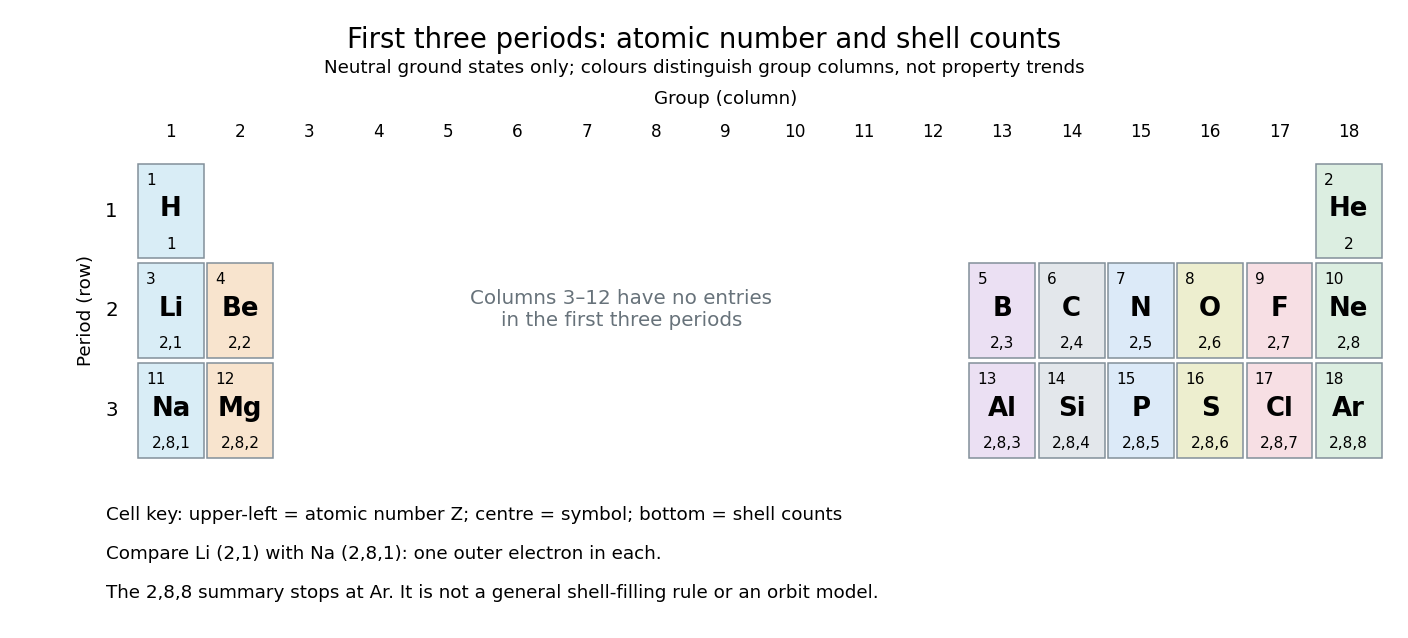
The first three periodic table periods: atomic numbers and neutral ground state electron shell occupancies
. Colours distinguish periodic group columns only, without encoding numerical property trends. The spaces in columns 3–12 preserve the eighteen-column periodic table layout: no chemical elements occupy those positions in these three periodic table periods. Each cell gives a chemical element's symbol, atomic number, and electron shell counts. Details.Reading each row from left to right gives:
The counting outline is short: the occupied electron subshells in this range are , , , , and , filled in that order for these neutral ground states. Each electron subshell holds up to two electrons and each electron subshell up to six, giving , , and along these three rows. This summary applies only through argon; it is not a general rule that each electron shell fills completely before the next begins, nor a claim that the third electron shell can hold only eight electrons. See Flowers et al., Chemistry 2e, electronic structure and electron configurations.
The recurring outer counts make the arrangement useful. Lithium and sodium each have one valence electron, whereas fluorine and chlorine each have seven valence electrons. Such similarities help anticipate chemical reactions, without making all properties identical throughout a periodic group. Helium is an instructive exception to an eight-electron shortcut: its two electrons complete the first electron shell, so it belongs above neon and argon in periodic group 18. Hydrogen shares column 1 with lithium and sodium but has its own distinct chemistry. See Flowers et al., Chemistry 2e, periodic-table organization.
The periodic law states that properties of chemical elements recur systematically when the Elements are ordered by atomic number. Similar outer electron configurations help explain recurring chemical behavior. For example, lithium, sodium and potassium belong to the same periodic group and commonly form singly charged positive ions.[ref]
Dmitri Mendeleev originally organized the pattern largely using relative atomic mass and chemical similarities. His 1889 lecture recounts predictions of undiscovered elements from gaps in the arrangement. The modern atomic number formulation supplies a more fundamental ordering than mass alone; the historical predictions show that the scheme could constrain unknown chemistry, rather than merely list known substances.[ref]
The Periodic Law of the Chemical Elements by Dmitri Mendeleev. 1889 Faraday lecture, numbered conclusions 6–8 and predictions of missing elements
An actinide is an element in the series from actinium, atomic number 89, through lawrencium, atomic number 103. The series is associated with occupation of 5f-derived electronic states, although individual ground-state configurations vary.
Variable oxidation states and ionic sizes affect coordination and separation chemistry. Radioactive isotopes add a distinct nuclear aspect to applications involving nuclear fuel and waste materials.
[ref]
Periodic Table by Royal Society of Chemistry. Actinium through lawrencium, atomic numbers89–103; element properties
A lanthanide is an element in the series from lanthanum, atomic number 57, through lutetium, atomic number 71. The progression is associated with filling the 4f shell and the systematic size change called the lanthanide contraction.
Many lanthanides favour trivalent ions with similar coordination chemistry. Their similarity makes separation demanding, while differences in ionic size and accessible oxidation states permit selectivity.
[ref]
Periodic Table by Royal Society of Chemistry. Lanthanum through lutetium, atomic numbers57–71; element properties
Ytterbium is the chemical element with atomic number 70 and symbol . It is a lanthanide. It has important and chemistry. Its narrow optical transitions are useful in precision atomic experiments, showing how a chemical element can also provide a highly reproducible spectroscopic reference.[ref]
Europium is the chemical element with atomic number 63 and symbol . It is a lanthanide. Its state is unusually accessible compared with many neighboring lanthanides. Europium ions are used in luminescent materials, where changes in electronic energy are emitted as characteristic colors.[ref]
A periodic trend is a systematic variation in an atomic or chemical property across the periodic table. Examples include atomic size, ionization energy, and electronegativity.
Electron-shell filling, screening, and nuclear charge help explain broad patterns, but definitions and exceptions matter. An atomic radius inferred from a covalent bond is not the same measurement as an ionic radius in a crystal, so trends should compare like quantities.
A conventional measure of atomic extent. Covalent, metallic, ionic and van der Waals definitions differ, so one universal hard-sphere radius should not be assumed.
Relative reluctance of a heavier main-group ns electron pair to participate in the higher oxidation state. Retained pairs can nevertheless influence structure through mixing and stereochemical activity.
The reduction in size across the lanthanide series associated with incomplete screening by electrons; it contributes to size similarities and contractions in subsequent elements.
Articles were limited to the first 100 out of 303 total.
Articles by others on the same topic

This is a section about Chemical element!
For example, this sentence. And then another one.

This is a section about Chemical element!
For example, this sentence. And then another one.

