The central prediction of the ATP synthase ATP synthase rotary mechanism is relative motion of the central shaft and catalytic head, not simply a change in bulk ATP concentration. In the foundational single-molecule experiment, a visible marker coupled to the central gamma shaft reported its angular position relative to the immobilized catalytic head. Sustained directional rotations during ATP hydrolysis demonstrated rotary motion directly. The catalytic head contains three beta sites within an alpha-three beta-three assembly; their changing nucleotide affinities motivate the binding-change mechanism. [ref]
An angular trajectory gives more information than an average rotational speed. At low ATP, pauses before roughly 120-degree advances become longer as ATP falls, supporting an ATP-binding-limited wait. Reducing marker drag and improving temporal resolution reveals substeps and ATP-independent catalytic dwells. The early high-speed study resolved approximately 90-degree and 30-degree substeps, with more than one slow event during the catalytic dwell. Numerical angles vary with preparation and operational definition, so these observations should not be imposed as exact universal geometric increments.[ref]
The dwell-time model in b tests serial chemical kinetics; the angle histogram tests preferred positions. Comparing probe loads checks whether viscous drag limits the observed speed. Measuring torque and angular displacement estimates mechanical work, while a separate hydrolysis readout tests chemical coupling. With one ATP per 120-degree step, the chemical budget per revolution is three ATP, but rotation alone does not count every chemical event or establish unity efficiency.
A probe can perturb the very process it reports, and inhibited pauses or unresolved reversals can bias averages. Isolated F1 observed during hydrolysis also does not demonstrate proton-driven ATP synthesis by intact membrane F0F1. Testing reverse synthesis requires evidence for chemical gene expression under the corresponding driving conditions; a rotation movie by itself is insufficient. These distinctions connect the single-molecule motion to the free-energy balance without overinterpreting it.
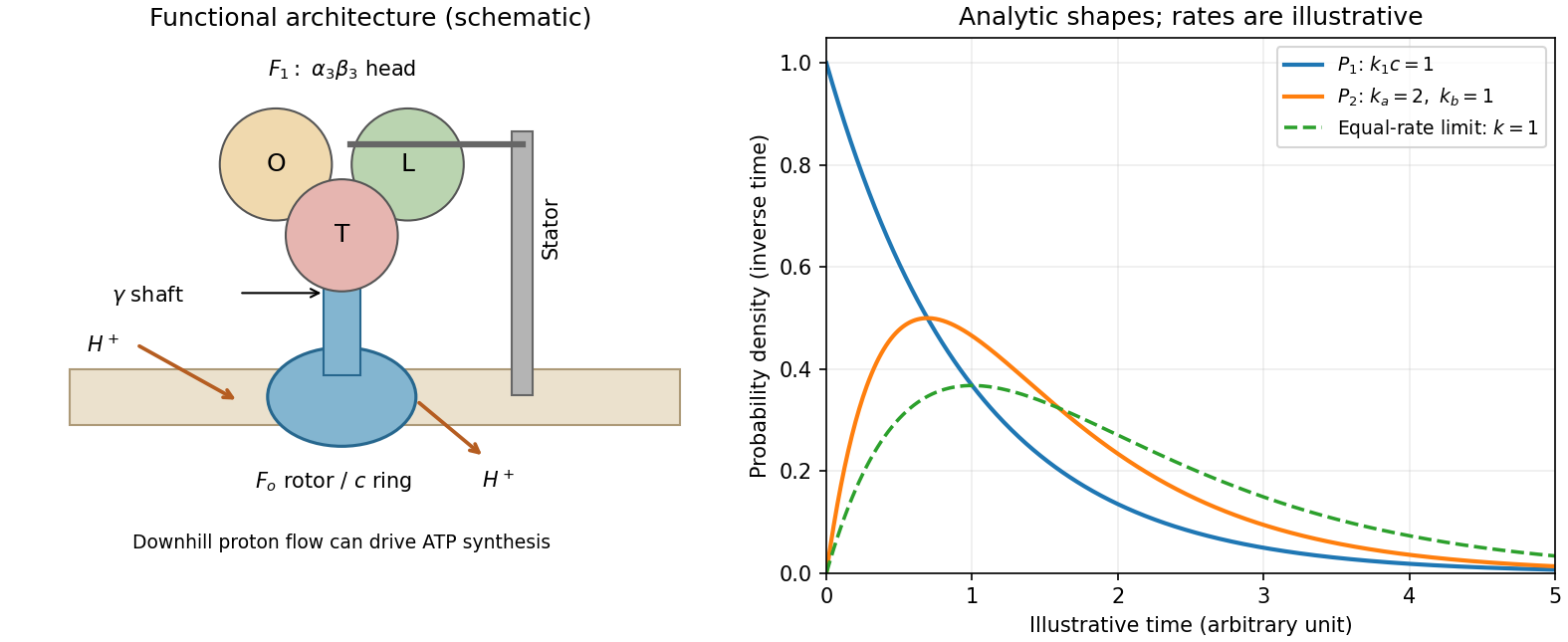
ATP synthase has a membrane-embedded sector, a catalytic head and mechanical connections between them. The sector contains an ion-conducting subunit adjoining a rotating ring of subunits. A central shaft including the subunit connects that ring to . A peripheral stator holds the head fixed relative to the membrane. The head has three catalytic subunits alternating with three subunits, surrounding the asymmetric central shaft; the middle panel of solution labels these relationships.
A transmembrane proton-motive force drives proton movement through offset half-channels and protonation changes around the ring, producing torque. Shaft rotation changes the conformations of the three catalytic sites, cycling their affinities for ADP, inorganic phosphate and ATP. In the binding-change mechanism, mechanical work particularly promotes release of tightly bound ATP; the threefold head couples a full revolution to three catalytic turnovers. The number of protons per revolution depends on the ring stoichiometry. Reversing the available free energy can reverse the motor: isolated hydrolyses ATP and rotates, and the coupled enzyme can pump protons. This structural separation of rotor, stator and catalytic head converts electrochemical free energy into chemical free energy.[ref]
ATP synthase couples downhill proton motion across a cell membrane to synthesis of ATP from ADP and inorganic phosphate. Its membrane-embedded sector contains an subunit with offset proton-access half-channels and a rotating -subunit ring. Reversible protonation of sites on the ring permits rotation relative to the stationary subunit. The central rotor transmits this motion through the shaft to the soluble head. A peripheral stator holds the head relative to the membrane sector. The common bacterial schematic has an head, catalytic sites mainly on the three subunits, and a central rotor; accessory stator components depend on the organism.
The binding-change mechanism cycles the catalytic sites between open, loose-binding and tight-binding conformations. Rotor orientation changes their affinities for ADP, phosphate and ATP; the sites operate out of phase. Tight binding favors formation of bound ATP, and mechanical rotation changes the conformation to permit product release. In the ideal tightly coupled cycle, one revolution gives three catalytic turnovers:
The proton count is not universally fixed: an ideal ring with proton-carrying subunits gives protons per revolution and protons per synthesized ATP, before additional transport costs.
For a proton moving from side 1 to side 2, its molar electrochemical potential change is
The chemical gradient and membrane electric potential difference together supply the proton-motive force. Synthesis requires the proton free-energy release to meet the positive Gibbs free energy of ATP synthesis. The coupling is reversible: isolated supplied with ATP can hydrolyse it and rotate its shaft, while the intact enzyme can use hydrolysis-driven rotation to pump protons against their gradient. The sketch is structural and schematic; it does not reconstruct the absent stepping trace.
Figure 1.
ATP synthase architecture and the two derived dwell-time distributions
. The structural panel shows a membrane rotor, shaft, stator and three catalytic sites. The distribution panel uses explicitly illustrative dimensionless rates, not values read from the absent source stepping plot. Details.
