A finite list of function values does not determine the winding number of the intervening image contour. For example, sample only at , . The polynomials and agree at all four sampled points, because . Joining those values by straight segments draws the same square for both. Yet their true winding numbers are one and five, and their enclosed zero multiplicities differ by four.
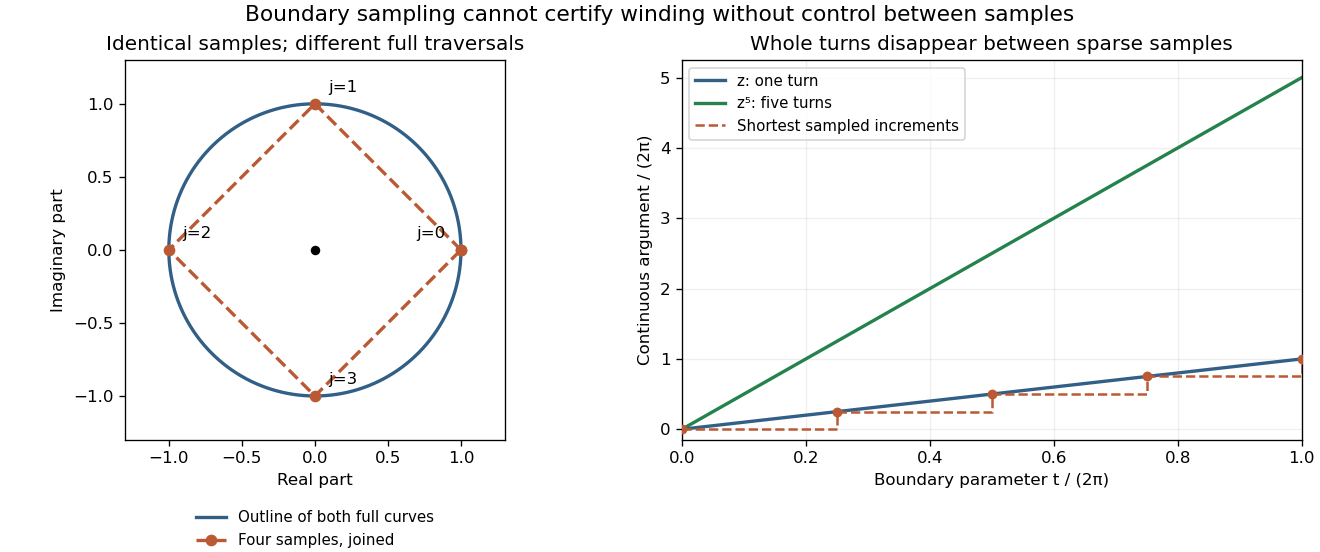
Four identical boundary samples can hide four additional turns
. Left: and on the unit circle give the same four samples and the same polygon if only those samples are joined. The full curves have the same circular outline but different traversal counts. Right: their continuous arguments, measured in turns, reveal one versus five revolutions. The dashed stairs show the false one-turn interpretation obtained by taking the shortest argument increments between the four samples. Details.
Refining samples can help resolve a given example, but an asserted root count needs a bound controlling what happens between them. One sufficient certificate is to enclose the image of each boundary subarc and its interpolating segment in a convex set that excludes zero. Straight interpolation then gives a homotopy avoiding zero, so the polygon and true image contour have the same winding number. A plot that merely looks closed and avoids zero at its sampled points is not that certificate.
Articles by others on the same topic
There are currently no matching articles.