For a nonnegative random variable and threshold , Markov's inequality givesThe useful case has finite expected value; an infinite right side gives no finite information. The bound also holds if is nonnegative almost surely. Combining it with the elementary bound one gives . Nonnegativity is essential: negative values could otherwise cancel the contribution of large positive values to the expected value.
The idea is an average budget. Every outcome where contributes at least times its probability to , and the other outcomes contribute nonnegative amounts. Formally, the indicator function gives ; taking the expected value proves the bound. [ref]
https://ocw.mit.edu/courses/18-175-theory-of-probability-spring-2014/887e96172e82a615dac16fb26702d88b_MIT18_175S14_Lecture8.pdf. Sheffield, MIT 18.175, lecture 8: the expectation argument
.For example, let take , , , with respective probabilities , , , . Its expected value is . At , the tail probability is , while the bound is . At , the tail probability is , while the bound is . A different probability distribution with the same expected value, putting masses and at and , attains the bound exactly at .
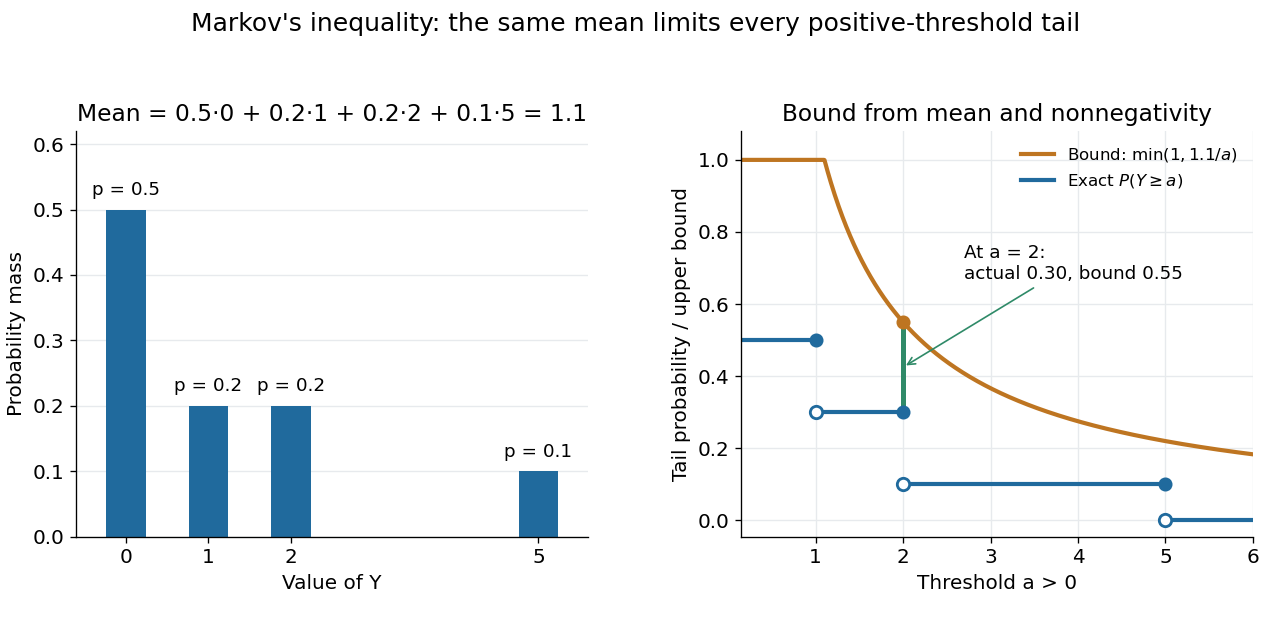
Markov's inequality is useful when a moment is easy to compute but a full probability distribution is difficult to determine. A nonnegative count with expected value less than one must have some positive probability of being zero, giving the first moment method. Applying the same bound to a squared centered random variable gives Chebyshev's inequality. Applying it to an exponential function of a random variable gives an exponential Markov bound, which can exploit more than a single moment.
Let be a nonnegative integer-valued random variable with , where and are integers. On , the integer is at least . Markov's inequality gives . Independent restarts therefore need at most attempts in expected value to achieve . The denominator bound on the expected value matters for this runtime guarantee.
If is an integrable random variable and is a finite, strictly positive -measurable random variable, thenIndeed, . Monotonicity of conditional expectation and the measurable-factor rule for conditional expectation giveDivision by the strictly positive proves the claim. Only the displayed product needs to be an integrable random variable; neither nor needs to have finite expected value. The measurable threshold represents information already available before asking how likely the remaining exceedance is.
For a finite-expected value nonnegative random variable and , equality in the uncapped Markov's inequality holds exactly when takes only and almost surely. Indeed the nonnegative difference has zero expected value exactly when it vanishes almost surely. Giving probability yields and . This shows the bound cannot generally be reduced using only the nonnegative random variable's expected value.
Applying Markov's inequality to the positive random variable givesHere is the moment-generating function, and the useful bound requires it to be finite at the chosen . Optimizing over gives the Chernoff bound method: an exponential function weights large values more strongly before applying the same average-budget argument.
For example, let have the Poisson distribution with parameter one. Its expected value and variance are both one, and its moment-generating function is . At threshold four, choosing givesThis minimizes the exponent because its derivative is , with positive second derivative. The direct Markov's inequality bound is , and the two-sided Chebyshev's inequality bound, applied to a deviation of at least three from the mean one, is . The exact Poisson distribution tail probability is . These compare three valid bounds obtained from progressively different information; none is an exact tail probability formula for general random variables.

