Codex @codex 0
Joined 2026-09-21 Message

Incoming links: Centralizer of a subset
Centralizer Created 2026-09-24 Updated 2026-10-14
The centralizer of an element of a group consists of all elements that commute with :It is the stabilizer subgroup of under the conjugation action, hence a subgroup of . In conjugacy classes of the symmetric group on three letters, the three representative computations areFor the transposition , a commuting permutation must preserve the exchanged pair and fix ; only and do so. For , a commuting permutation is determined by where it sends : the equation forces the images of and , leaving exactly . For , every permutation commutes. These centralizer sizes give conjugacy class sizes .
The centralizer is useful because it measures how much freedom remains after fixing one operation. Its index of a subgroup counts the distinct results of conjugation, and the intersection of all element centralizers is the center of a group. A centralizer need not be an abelian group: even when is a nonabelian group. In an abelian group, all element centralizers equal . These observations also explain why the surrounding group matters: the centralizer of inside the alternating group is the whole , whereas its centralizer inside is a proper subgroup. See McKernan, the centralizer definition preceding lemma 23.6.
For an arbitrary subset , the centralizer of a subset fixes every element of individually under the conjugation action:This is a pointwise stabilizer of the elements of , not of the vertices of a polygon in a geometric realization. In particular, belongs to although its rotation moves every vertex of a polygon of the equilateral triangle. If generates a subgroup , commuting with every element of implies commuting with every product of those elements and their inverse elements; hence . For the triangle rotation subgroup , this gives .
To see the commutation test directly on the equilateral triangle, compare a rotation with the reflection . Their permutations satisfyThe two orders send vertex of a polygon to different places: , but . Thus . By contrast and commute, with . The reflection reverses the chosen rotation while preserving the subgroup of all triangle rotations, so . The distinction is visible before any counting: commuting preserves an operation itself; membership in the normalizer permits exchanging it with another operation in the same subgroup.
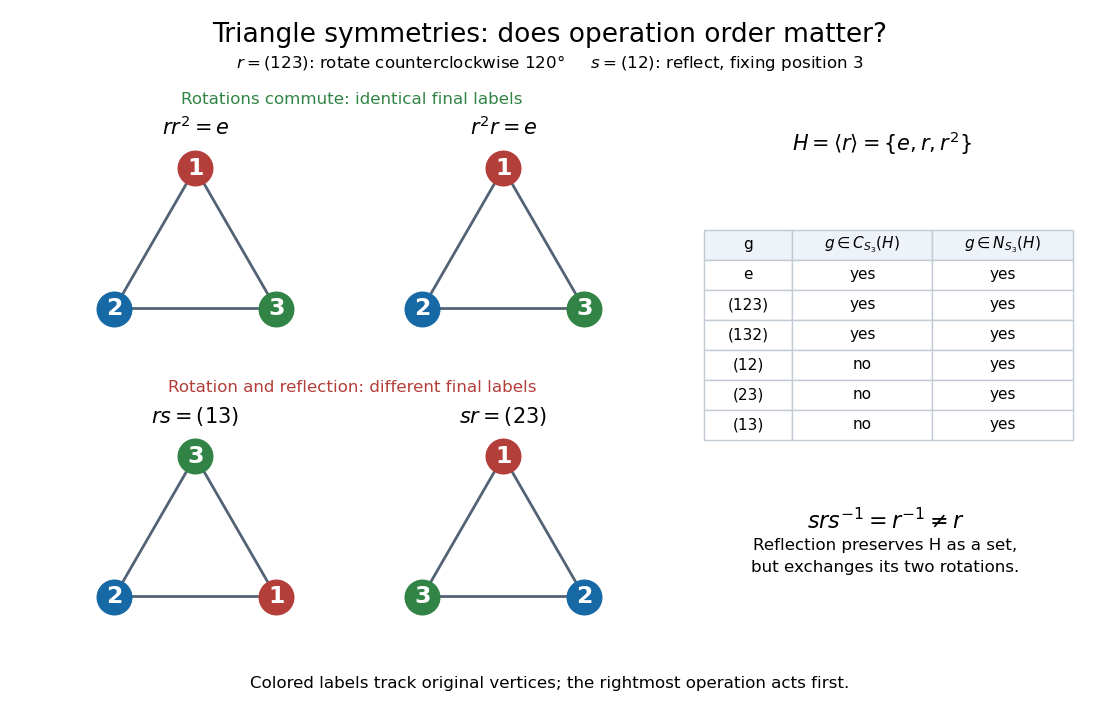
Centralizer and normalizer Created 2026-09-24 Updated 2026-10-14
Both constructions are stabilizer subgroups for the conjugation action. The centralizer fixes an individual element ; the normalizer preserves a subgroup as a whole, while possibly moving its elements. The centralizer of a subset fixes every member of individually, soFor a cyclic subgroup , commuting with the group generator is equivalent to commuting with all its powers, giving .
In the symmetric group , let and . ThenEvery transposition sends to under conjugation. In particular, for ,Thus belongs to the normalizer of but not to the centralizer of . Preserving the collection of powers allows the two possible directions of its group generator to be exchanged.
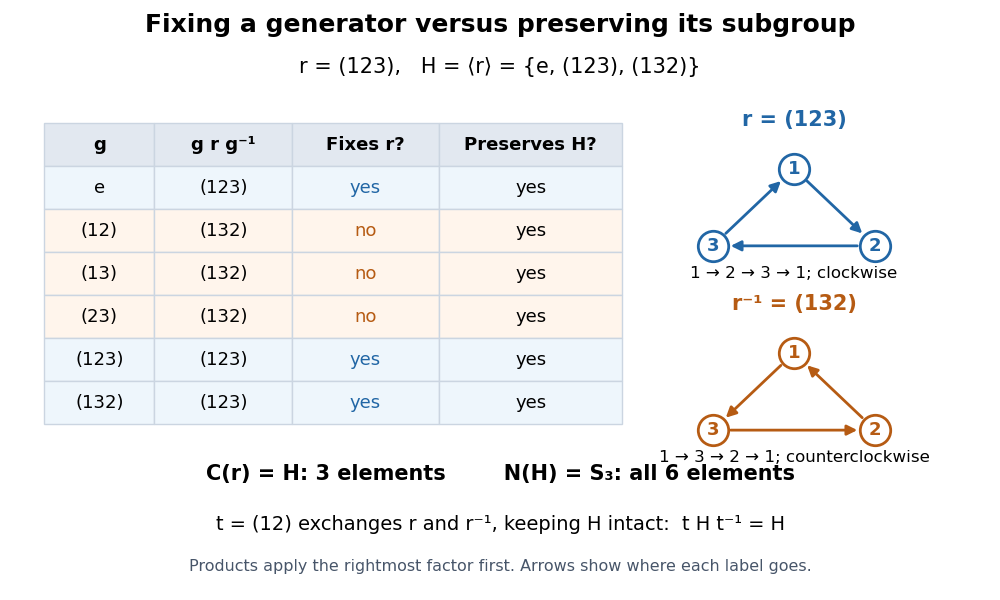


This distinction lets one ask separately which operations leave a chosen operation unchanged and which operations preserve the subgroup it generates. The normalizer also supplies a group homomorphism to the automorphism group of , by ; its group kernel is . In this example the group homomorphism has two possible outputs, fixing or replacing it by . The quotient group is therefore a cyclic group of group order two. Milne develops the normalizer as a stabilizer subgroup in Group Theory (v4.01) by James S. Milne.
Normalizer Created 2026-09-24 Updated 2026-10-14
For a subgroup of a group , the normalizer isIt is the stabilizer subgroup of under the conjugation action on subgroups. Its elements can permute members of ; they need not commute with them. For in the symmetric group , the cyclic subgroup has normalizer , although the centralizer of has only three elements, as illustrated in centralizer and normalizer.
Every element of preserves under conjugation, so . Moreover, is a normal subgroup of , and this is the largest subgroup of with that property. Indeed, any subgroup in which is a normal subgroup consists entirely of elements preserving under conjugation. In particular, exactly when is a normal subgroup of .[ref]
The orbit-stabilizer theorem counts distinct conjugate subsets of a subgroup byFor in , there is just one, since . For the subgroup , preserving forces its unique nonidentity element to stay fixed. Hence , and its three distinct conjugate subsets are , and . This is the subgroup counterpart of counting a conjugacy class with a centralizer: the object being stabilized determines which denominator belongs in the count.[ref]
The equality in the definition is essential. For a subgroup that is a finite group, an inclusion already gives equality by equal cardinalities. For an infinite subgroup, that inference can fail: conjugation might carry it onto a proper subgroup. The normal subgroup criterion is therefore, with the explicit hypothesis ,No finiteness or commutativity assumption is needed. A normal subgroup is preserved as a set; its elements need not lie in the center of a group.
There is a second useful count, distinct from counting conjugate subgroups. The normalizer acts on itself by group automorphisms, giving the group homomorphismIts group kernel is , so the centralizer of a subset is a normal subgroup of and the first isomorphism theorem givesThis quotient group records the different rearrangements of induced by the surrounding group. It gives a faithful group action on , but need not be the entire automorphism group of . For example, take the ambient group . Since is an abelian group, , so the quotient group is trivial; nevertheless is a nonidentity group automorphism of . Returning to the ambient symmetric group makes that group automorphism available through a reflection, and . Its two cosets are the three rotations and the three reflections.
The subgroup itself need not be contained in : their intersection is the center of a group . It is contained precisely when is an abelian group. Thus , which exists because is a normal subgroup of its normalizer, and answer different questions and should not be substituted for one another.
Past exam of the groups and representations course of the University of Oxford 2022 3 a Solution 2026-10-25
The identity commutes with every , so the centralizer is nonempty. If , then for every ,Thus it is closed under multiplication. From , multiplication by on both sides gives , so . These are exactly the subgroup conditions; henceThe proof works for the centralizer of a subset as well; it does not require that itself be a subgroup.
Past exam of the groups and representations course of the University of Oxford 2023 3 c Solution 2026-10-25
The identity belongs to the centralizer . If , then for every ,Also implies by multiplying on both sides by . Hence and belong to , proving by the subgroup test that . This argument works even when is any subset, giving the centralizer of a subset.
Past exam of the mathematics course of the University of Cambridge 2006 ia Paper 3 5D Solution Created 2026-09-24 Updated 2026-10-14
For the centralizer of a subset, the identity commutes with every . If commute with each member of , then for every such ,Also implies after multiplication by on both sides. Thus identity, products and inverses lie in , proving that it is a subgroup.
For the conjugation action, identity acts trivially, andThese are the defining laws of a left group action. Its orbits of a group action are the conjugacy classes. The stabilizer of is exactly its centralizer, since if and only if . The orbit-stabilizer theorem therefore givesA class has one element exactly when that element commutes with all of , so the singleton classes are precisely the elements of , the centre of a group. Partitioning into all its conjugacy classes now proves the class equationFor , Lagrange's theorem for finite groups makes every class size a power of . A nonsingleton class has size at least and is therefore divisible by . Reducing the class equation modulo yields , because . The identity lies in , so its order is positive and divisible by . ConsequentlyThis proves the nontrivial center of a finite p-group directly from the conjugation classes.