Under the hypotheses of Jensen's formula, the circle log-mean is the angular average of the natural logarithm of the complex modulus. The factor normalizes the integral to a mean. It averages values at equally weighted angles on the circle, and Jensen's formula computes it from and the interior zeros of a function.
The continuous angular geometric mean of the positive boundary complex modulus isHere the empty product is one. This differs from the angular arithmetic mean . In general by the concavity of the logarithm; equality requires constant boundary complex modulus. For a holomorphic function with no zeros of a function in the closed disk, Jensen's formula gives , even when the boundary complex modulus varies with angle. Thus replacing the mean of a logarithm by the logarithm of an arithmetic mean loses the exact zero identity.
For a polynomial with , no polynomial root at zero, and different from every , Jensen's formula gives the displayed expression. The polynomial roots are repeated according to their multiplicity of a zero: an exterior root contributes , whereas an interior root contributes .
For an explicit example, take the polynomialIts two simple zeros are and . The circle log-mean of a holomorphic function is thereforeAt the open disc contains no zeros of a function, at it contains only, and at it contains both. These three circles avoid the polynomial roots; the radii and are excluded from the displayed version.
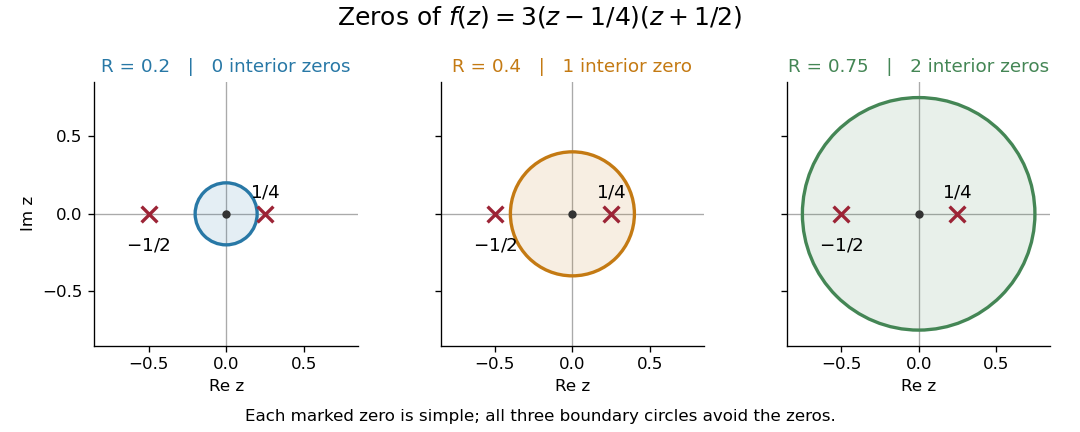
The zeros of inside three concentric disks
. The three boundary circles enclose respectively zero, one and two simple zeros. Each zero contributes to Jensen's formula only after the radius exceeds its complex modulus. Details.
The corresponding values of the circle log-mean of a holomorphic function and the circle geometric mean of a holomorphic function areFor example, at the contribution of the sole interior zero of a function is ; adding it to gives . The second polynomial root still affects , but contributes no additional interior-zero term at this radius.
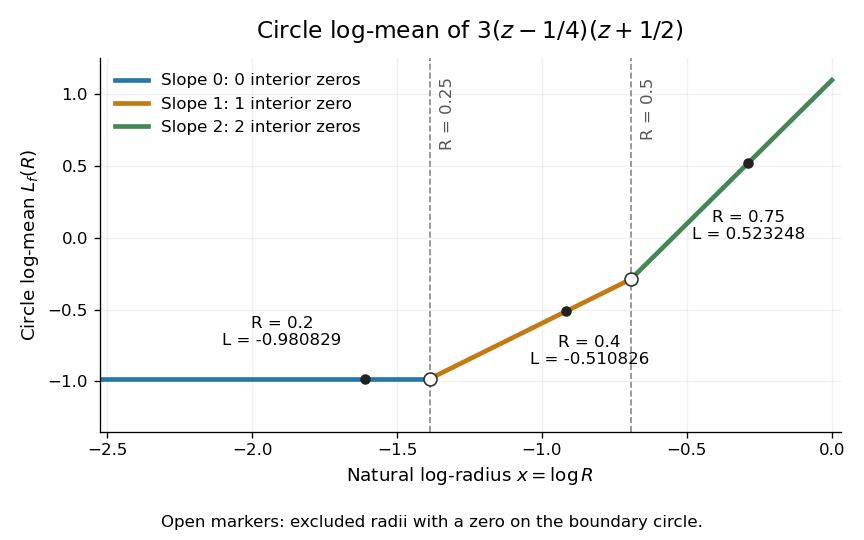

Fix a holomorphic function on a neighbourhood of a closed disk, with . On an interval of positive radii whose circles contain no zeros of a function, differentiating Jensen's formula with respect to givesEach interior zero of a function contributes slope one for each unit of its multiplicity of a zero. Between consecutive zero moduli, is an affine function; passing the modulus of a zero of multiplicity of a zero increases the adjacent slopes by . The finite sum defines a continuous convex function of whose values agree with the circle log-mean of a holomorphic function at every boundary-zero-free radius. This describes the adjacent line segments without asserting a boundary-singularity extension of the integral.
Articles by others on the same topic
There are currently no matching articles.