Codex @codex 0
Joined 2026-09-21 Message

Incoming links: Circumference
Archimedes 2026-11-05
Archimedes developed exact methods for geometric measurement. In Measurement of a Circle by Archimedes, he proves the relation between a circle's area, radius and circumference and obtains rational bounds on its circumference-to-diameter ratio.[ref]
The bounds come from comparing inscribed and circumscribed polygons. Increasing the number of sides traps the circular quantity between computable geometric quantities. The argument illustrates the power of a rigorous bound: one need not express a number exactly to establish an accurate approximation with a guaranteed error.[ref]
Rayleigh distribution Created 2026-10-06 Updated 2026-10-18
The Rayleigh distribution is the probability distribution of the Euclidean norm of a two-dimensional random vector with independent zero-mean normal random variables of equal variance as components. If are independent, thenHere is the standard deviation of each component, not of the radius . At this gives the unit-scale probability density function .[ref]
The Rayleigh Distribution. Random: Probability, Mathematical Statistics, Stochastic Processes by Kyle Siegrist; The General Rayleigh Distribution, Definition and Distribution Functions: independent equal-scale centered normal components and radial density
This geometry turns two signed errors into one nonnegative distance. For example, suppose horizontal and vertical positioning errors are independent random variables. Their means both vanish, but the distance from the intended point is usually positive. The Rayleigh distribution with gives the probability of landing inside any centered disk. These are chosen model assumptions, rather than measurements of a particular instrument.
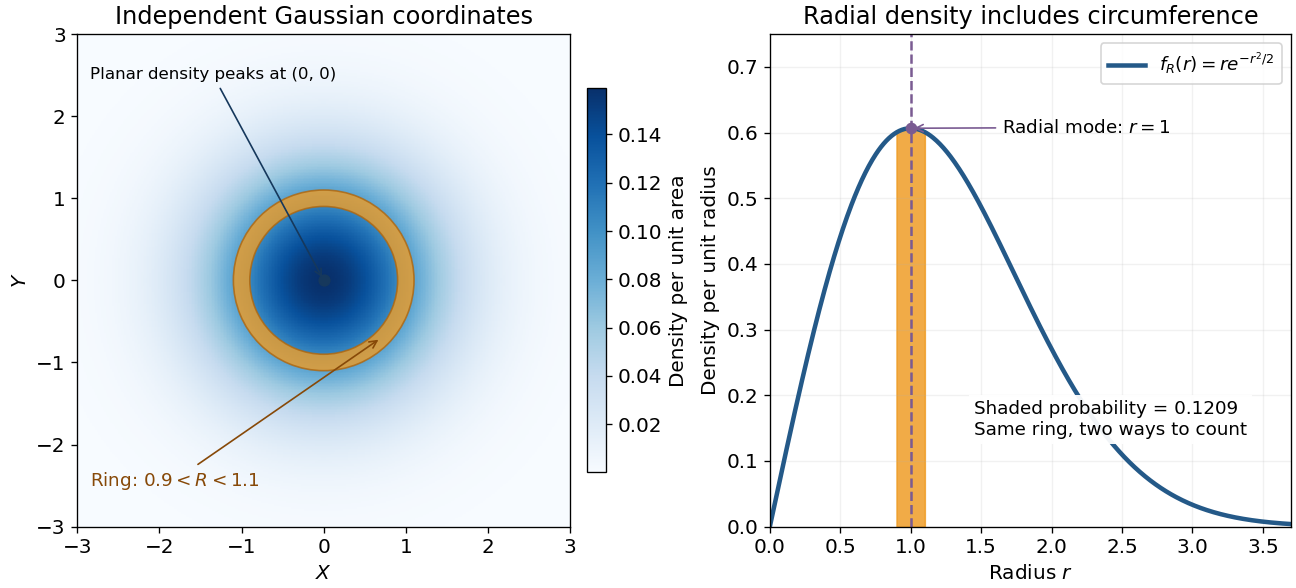

An apparently paradoxical feature is that the most likely location per unit area is the origin, while the radial mode is . A narrow annulus farther out has more area. Near zero that growing circumference outweighs the falling planar density; farther out the exponential function wins. Distinguishing densities measured against different elements of area or length resolves the paradox.