
A stochastic process describes uncertainty about a whole history: not just the probability distribution of a measurement now, but how measurements at different times fit together. It is a family of random variables on one probability space, with index set . Time is the usual index: for successive observations or for continuous time. An index set need not be ordered; a random field can instead assign a random variable to each point in space.
There are two complementary views. Fix a time and is a random variable; fix a sample space outcome and is one sample path. A model specifies the probability distribution of these histories. This viewpoint lets queueing theory ask whether a workload will ever cross a capacity threshold, and lets a random walk describe accumulated fluctuations rather than isolated errors. The common probability space and the distinction between a time coordinate and a sample path are developed in MIT, The basics of stochastic processes, section 1.
A concrete construction starts with a Bernoulli process of independent fair bits . Keeping records the next trial; adding the signs gives a simple random walk on the integer line, and . Every increment of this random walk is , yet the positions are dependent: contains all the previous increments. Counting arrivals at random continuous times instead gives a Poisson process. These examples separate three questions: what values are possible, how time is indexed, and how the values depend on one another.
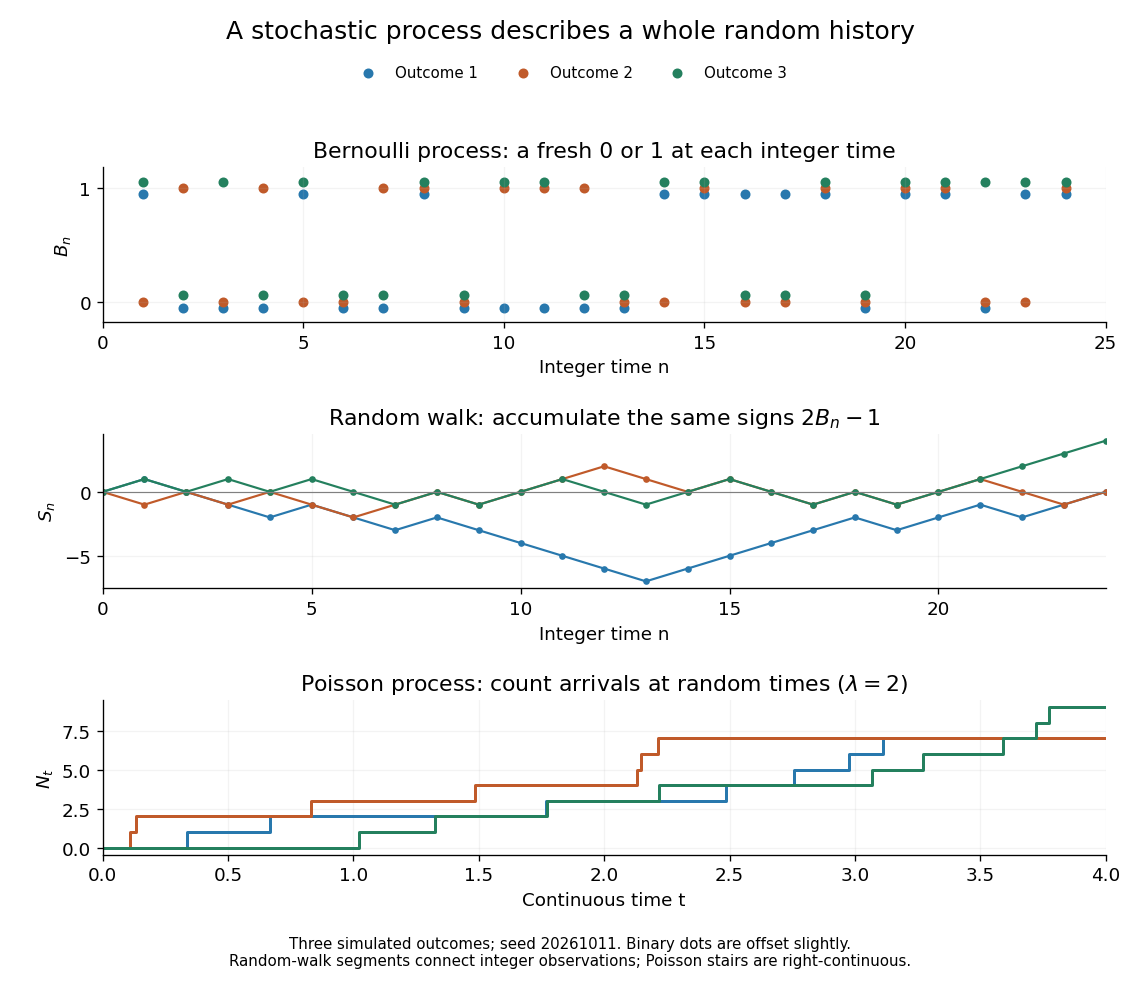
For the fair simple random walk on the integer line, the expected value is and the variance is . At time four, returning to zero requires exactly two positive steps, so . A rate-two Poisson process instead has . A single realized sample path does not establish either probability: they follow from the specified joint probability distributions.
The most revealing feature is often dependence. Two stochastic processes can have identical marginal distributions at every time while one forgets everything at the next step and the other repeats its first value forever. Their finite-dimensional distributions and covariance functions distinguish them. That extra structure is what makes a stochastic process useful for prediction.


New to topics? Read the docs here!