Suppose disjoint nonempty groups have sizes and arithmetic means . The arithmetic mean of all observations isEach group contributes the sum ; add those totals before dividing by the overall count. This is exactly a weighted mean of group means with weights equal to group sizes. [ref]
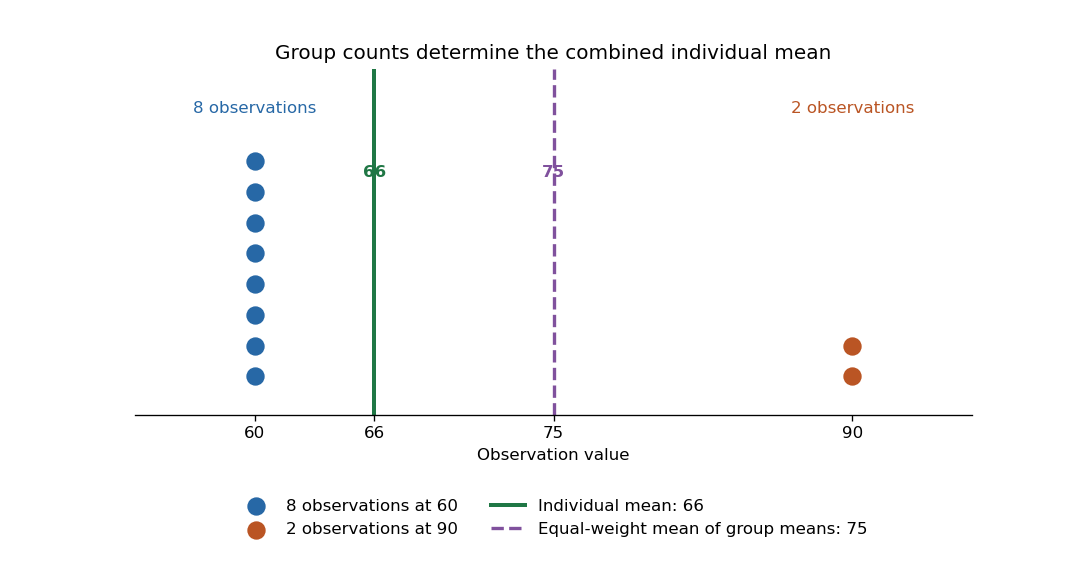
Take a synthetic example with two observations equal to and eight equal to . The two group means are and , and the combined mean is . Giving the two groups equal weights instead produces , which summarizes the two group means with equal influence. To summarize all ten individuals with equal influence, use their group counts.

The group means and counts determine the combined arithmetic mean, but do not generally determine the combined variance. Variation within the groups is additional information.
Articles by others on the same topic
There are currently no matching articles.