Start at one and apply updates, each multiplying the current value by . The final value is : one update gives , two give , ten give approximately , and one hundred give approximately . Increasing the number of steps, while reducing each increment proportionally, approaches Euler's number rather than producing unbounded accumulation.
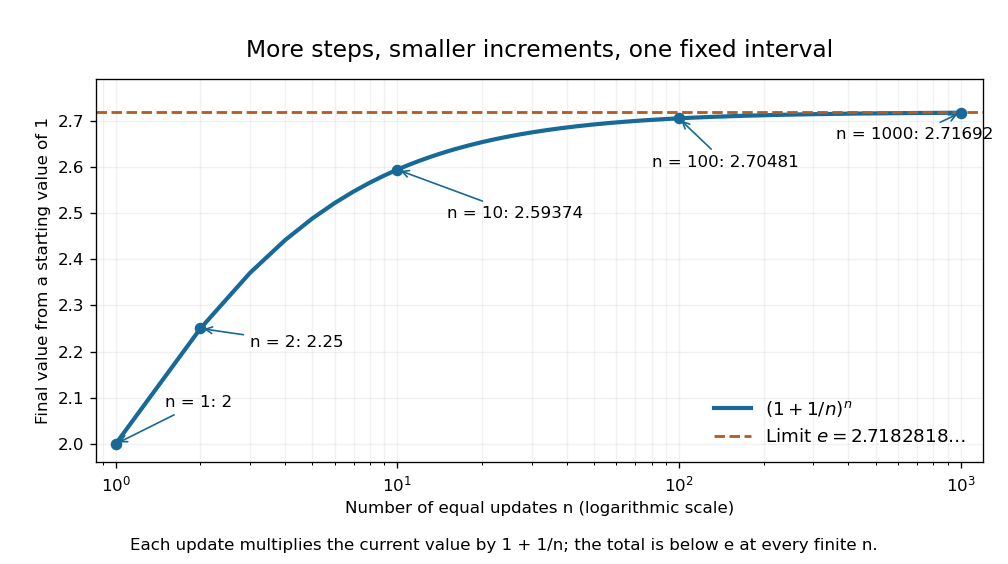

The natural logarithm makes the limit transparent. For , its integral definition gives , by bounding on . With ,The squeeze theorem gives a logarithmic limit of one; continuity of the exponential function gives . This links a discrete multiplicative rule with continuous exponential growth, without assuming that a finite number of steps equals the limiting value.
Articles by others on the same topic
There are currently no matching articles.