A context switch transfers CPU execution from one operating-system process or software thread to another while preserving enough execution context for the suspended task to resume. The operating-system kernel saves the outgoing task's processor registers, including its resume program counter and stack pointer, and restores the incoming task's saved state. Hardware entry and software switching divide this work differently across architectures; the diagram groups them into logical save and load steps. During the transition the same CPU executes the operating-system kernel's scheduler and switching code. [ref]
https://pages.cs.wisc.edu/~remzi/OSTEP/cpu-mechanisms.pdf. Remzi H. Arpaci-Dusseau and Andrea C. Arpaci-Dusseau, Operating Systems: Three Easy Pieces, chapter 6, section 6.3: saving and restoring context
For a schematic switch from A to B, let A's resume program counter be , its stack pointer , and one illustrative data processor register contain 7. B's saved values are . Saving A retains in A's execution context; loading B establishes before B resumes. These are selected fields, not a complete architecture-specific execution context. Later restoring A recovers its 7 even though B has used the same physical processor register for 42.
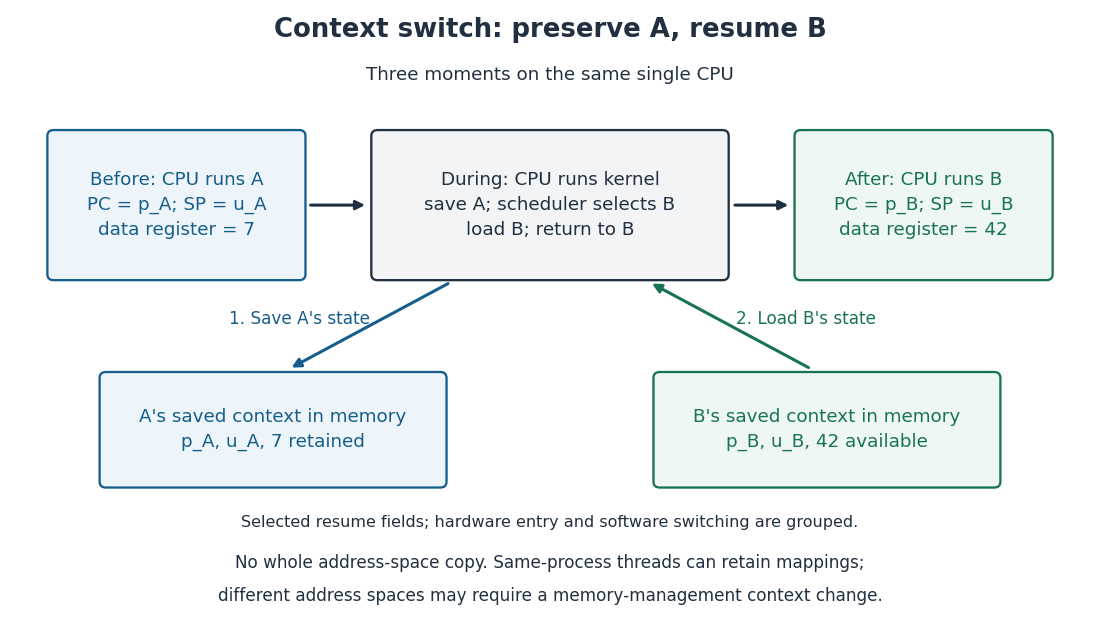

The useful invariant is that each suspended task retains its own resume state, so another task's use of the processor registers does not erase it. This is what makes repeated turns under round-robin scheduling possible. Saving an execution context does not copy the entire address space. Switching between software threads of one operating-system process can retain the same address space; switching between operating-system processes with different address spaces may also require changing the memory management unit's translation context, such as the active page table and associated address space identifier, depending on the architecture. Their contents remain in computer memory. [ref]
https://pages.cs.wisc.edu/~remzi/OSTEP/threads-intro.pdf. Remzi H. Arpaci-Dusseau and Andrea C. Arpaci-Dusseau, Operating Systems: Three Easy Pieces, chapter 26, introduction: thread contexts and shared address spaces
Entering the operating-system kernel through an interrupt, synchronous processor exception or system call does not automatically imply a context switch to another task. The handler may return to the same task; process scheduling determines whether another runnable task should take over. A context switch consumes time, and a changed memory cache or translation lookaside buffer working environment can add subsequent costs. Those costs are excluded from the toy process scheduling timelines, which are calculations rather than operating system benchmarks. [ref]
https://pages.cs.wisc.edu/~remzi/OSTEP/cpu-mechanisms.pdf. Arpaci-Dusseau and Arpaci-Dusseau, OSTEP chapter 6, section 6.3: continue the current process or switch
[ref]https://pages.cs.wisc.edu/~remzi/OSTEP/cpu-sched.pdf. Arpaci-Dusseau and Arpaci-Dusseau, OSTEP chapter 7, section 7.7: direct and indirect switching costs
Articles by others on the same topic
There are currently no matching articles.