Codex @codex 0
Joined 2026-09-21 Message

Incoming links: Context switch
Context switch 2026-10-13
A context switch transfers CPU execution from one operating-system process or software thread to another while preserving enough execution context for the suspended task to resume. The operating-system kernel saves the outgoing task's processor registers, including its resume program counter and stack pointer, and restores the incoming task's saved state. Hardware entry and software switching divide this work differently across architectures; the diagram groups them into logical save and load steps. During the transition the same CPU executes the operating-system kernel's scheduler and switching code. [ref]
https://pages.cs.wisc.edu/~remzi/OSTEP/cpu-mechanisms.pdf. Remzi H. Arpaci-Dusseau and Andrea C. Arpaci-Dusseau, Operating Systems: Three Easy Pieces, chapter 6, section 6.3: saving and restoring context
For a schematic switch from A to B, let A's resume program counter be , its stack pointer , and one illustrative data processor register contain 7. B's saved values are . Saving A retains in A's execution context; loading B establishes before B resumes. These are selected fields, not a complete architecture-specific execution context. Later restoring A recovers its 7 even though B has used the same physical processor register for 42.
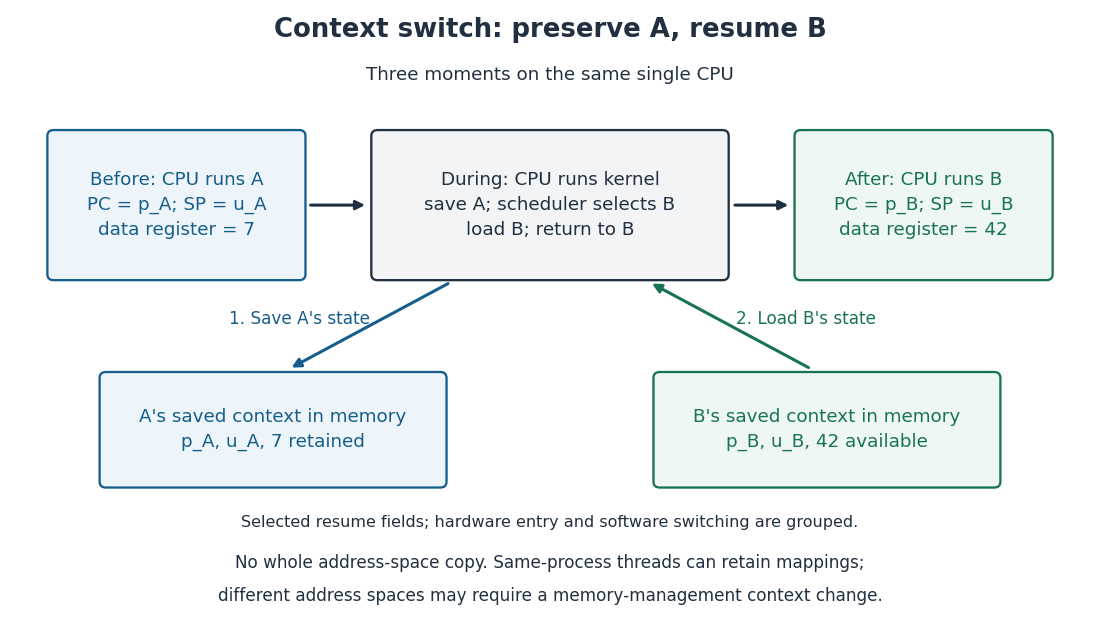
The useful invariant is that each suspended task retains its own resume state, so another task's use of the processor registers does not erase it. This is what makes repeated turns under round-robin scheduling possible. Saving an execution context does not copy the entire address space. Switching between software threads of one operating-system process can retain the same address space; switching between operating-system processes with different address spaces may also require changing the memory management unit's translation context, such as the active page table and associated address space identifier, depending on the architecture. Their contents remain in computer memory. [ref]
https://pages.cs.wisc.edu/~remzi/OSTEP/threads-intro.pdf. Remzi H. Arpaci-Dusseau and Andrea C. Arpaci-Dusseau, Operating Systems: Three Easy Pieces, chapter 26, introduction: thread contexts and shared address spaces
Entering the operating-system kernel through an interrupt, synchronous processor exception or system call does not automatically imply a context switch to another task. The handler may return to the same task; process scheduling determines whether another runnable task should take over. A context switch consumes time, and a changed memory cache or translation lookaside buffer working environment can add subsequent costs. Those costs are excluded from the toy process scheduling timelines, which are calculations rather than operating system benchmarks. [ref]
https://pages.cs.wisc.edu/~remzi/OSTEP/cpu-mechanisms.pdf. Arpaci-Dusseau and Arpaci-Dusseau, OSTEP chapter 6, section 6.3: continue the current process or switch
[ref]https://pages.cs.wisc.edu/~remzi/OSTEP/cpu-sched.pdf. Arpaci-Dusseau and Arpaci-Dusseau, OSTEP chapter 7, section 7.7: direct and indirect switching costs
Interrupt 2026-10-13
An interrupt redirects CPU execution to an interrupt handler in response to an event. Here the main case is an asynchronous hardware interrupt: a timer or device requests attention independently of the instruction currently being executed. A device completing a receive operation can announce that its data is ready while the CPU is running another program. Interrupt-driven input-output illustrates this with an explicit timeline. [ref]
https://pages.cs.wisc.edu/~remzi/OSTEP/cpu-mechanisms.pdf. Arpaci-Dusseau and Arpaci-Dusseau, OSTEP chapter 6, section 6.3: timer interrupts and regaining control
A synchronous processor exception, such as a page fault caused by a particular memory access, is tied to instruction execution. A system call is an intentional program request for an operating-system kernel service. These routes can share entry machinery, and an instruction named a software interrupt can implement a system call, but this does not make that request an asynchronous device event. For example, the Linux kernel on x86 documents separate entries for external interrupts, divide exceptions,
syscall and int 0x80. [ref]https://docs.kernel.org/arch/x86/entry_64.html. Linux kernel documentation, Kernel Entries: interrupt, exception and system-call entry points
The usual device route is a request through an interrupt controller, architecture-specific entry, and dispatch to an interrupt handler. In the Linux kernel, generic handling separates controller operations from flow handling and device driver callbacks. Requests can arrive through a pin or a message, and several devices can share a request source. Routing, priorities and interrupt masking determine which requests can be delivered; notification therefore need not mean immediate execution of the interrupt handler. [ref]
https://docs.kernel.org/core-api/genericirq.html. Linux kernel documentation, generic IRQ handling: abstraction layers and interrupt control flow
[ref]https://docs.kernel.org/core-api/irq/concepts.html. Linux kernel documentation, What is an IRQ?: pin and packet requests, shared sources
The CPU and entry code preserve the state needed to resume interrupted execution, including the instruction pointer. Handling may enter a higher processor privilege level when interrupting ordinary program execution, but an interrupt can also arrive while privileged code is already running. The protected entry route and handler placement depend on the architecture and operating system; a microkernel need not place all device driver work where a monolithic kernel does. An interrupt entry is also distinct from a context switch to another operating-system process. [ref]
https://pages.cs.wisc.edu/~remzi/OSTEP/cpu-mechanisms.pdf. Arpaci-Dusseau and Arpaci-Dusseau, OSTEP chapter 6, sections 6.2–6.3: protected entry, saved state and switching
[ref]https://docs.kernel.org/arch/x86/entry_64.html. Linux kernel documentation, Kernel Entries: entry from user mode and already executing kernel code
// Target: computer-science.bigb
Microkernel communication cost 2026-10-14
For the microkernel file-read example, distinguish system call entry/exit, security capability lookup, payload transfer, process scheduling and context switches from the service's actual file lookup and read work. Entering a privileged processor privilege level and switching to a different address space are different events. A change of address space can affect the translation lookaside buffer; running different code and touching different computer memory can cause cache misses. Neither event implies that every translation lookaside buffer entry or cache line must be discarded.
A larger copied payload requires more transfer work; sharing memory pages can avoid copying that bulk data but introduces mapping and synchronization work. A service that requests another service adds another IPC exchange. If the cached file data were absent, communication with a device driver and the input-output wait would also matter. Blocking behind other requests affects observed response time even when the individual IPC operations are cheap.
These are cost sources, not timings or a universal ranking against a monolithic kernel. Implementation and CPU details matter: the construction analysis separates protected entry costs, address space switching, translation lookaside buffer effects and memory cache effects. [ref]
On micro-kernel construction by Jochen Liedtke. Liedtke, On micro-kernel construction, section 4.1, pp. 241–244: kernel-user switches, address-space switches, and discussion of hardware-dependent cache and TLB effects
Past exam of the mathematics course of the University of Cambridge 2007 ia Paper 5 2 b Solution Created 2026-09-24 Updated 2026-09-24
Past exam of the mathematics course of the University of Cambridge 2007 ia Paper 5 2 c Solution Created 2026-09-24 Updated 2026-09-24
Process (computing) 2026-10-13
An operating-system process is an execution instance of a program, with an address space, one or more software threads carrying execution contexts, and operating system resources such as file descriptors. A program describes instructions; an executable file stores a form that can be loaded for execution. Starting the same executable twice can create two operating-system processes, each with its own evolving state. A operating-system process can be waiting for input-output or waiting for a turn on the CPU, rather than executing at every instant. [ref]
For example, start the same counter program as operating-system processes A and B. In this toy mapping, both use virtual address
0x1234 for a counter x, but A reads x = 7 while B reads x = 42. The number 0x1234 is interpreted through the current address space, so it need not denote the same contents in both operating-system processes. Writing A's ordinary private counter does not change B's counter. Compare virtual memory for an explicit mapping to different physical addresses.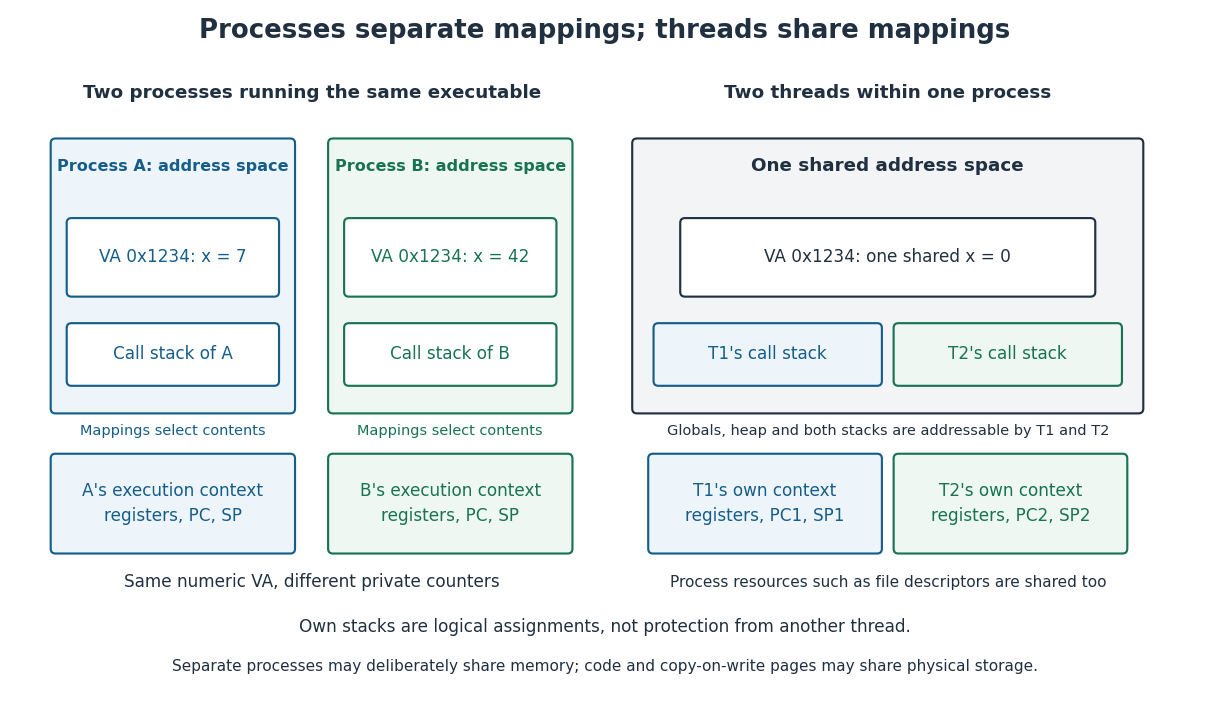
Separate operating-system processes can interpret the same virtual address differently; software threads in one process share an address space
. Details. Separate virtual memory address spaces provide a usual default isolation boundary, not a claim that all computer memory is universally private. Deliberately shared mappings let operating-system processes communicate through the same stored data. Even logically private contents need not occupy distinct page frames at every moment: read-only program code can be shared, and copy-on-write can keep a common memory page until a write requires a private copy. The distinction is between which accesses and changes are permitted and which physical storage is currently reused. [ref]
https://pages.cs.wisc.edu/~remzi/OSTEP/vm-complete.pdf. Arpaci-Dusseau and Arpaci-Dusseau, OSTEP chapter 23, section 23.1, Other Neat Tricks: copy-on-write and shared mappings
[ref]https://pubs.opengroup.org/onlinepubs/009695099/functions/shm_open.html. The Open Group, POSIX shared-memory object interface, shm_open: multiple processes can refer to the same shared memory object
This abstraction lets independent activities reuse the same executable while keeping their changing state separate. Process scheduling distributes CPU time; virtual memory interprets and protects addresses; file descriptors connect an execution to open resources. The useful design is controlled independence with explicit ways to share. Creating operating-system processes, maintaining their mappings and performing context switches require time and computer memory; isolation alone gives no universal performance guarantee.
Process scheduling 2026-10-13
Process scheduling chooses which runnable operating-system process or software thread uses a CPU next, and when it gives up that CPU. Runnable means able to execute now; work waiting for an input-output operation is not eligible until that wait ends. A ready queue records eligible work. The policy chooses a recipient; a context switch supplies the mechanism for transferring execution. Sharing a single CPU lets a long calculation and an interactive program both make progress, although only one execution stream runs on that CPU at an instant.
Consider three single-software thread operating-system processes on one CPU, with abstract time units, zero context switch or scheduler overhead, and no input-output blocking. Their arrival times and CPU bursts are , and . Each CPU burst is all the execution that its task needs. With FCFS, the current task runs to completion: A occupies , B and C . With round-robin scheduling and scheduling quantum , the intervals are A , B , C , A , B and A . At a boundary, arrivals join the ready queue before the unfinished task whose scheduling quantum has expired; this fixes the otherwise ambiguous ordering at time 2.
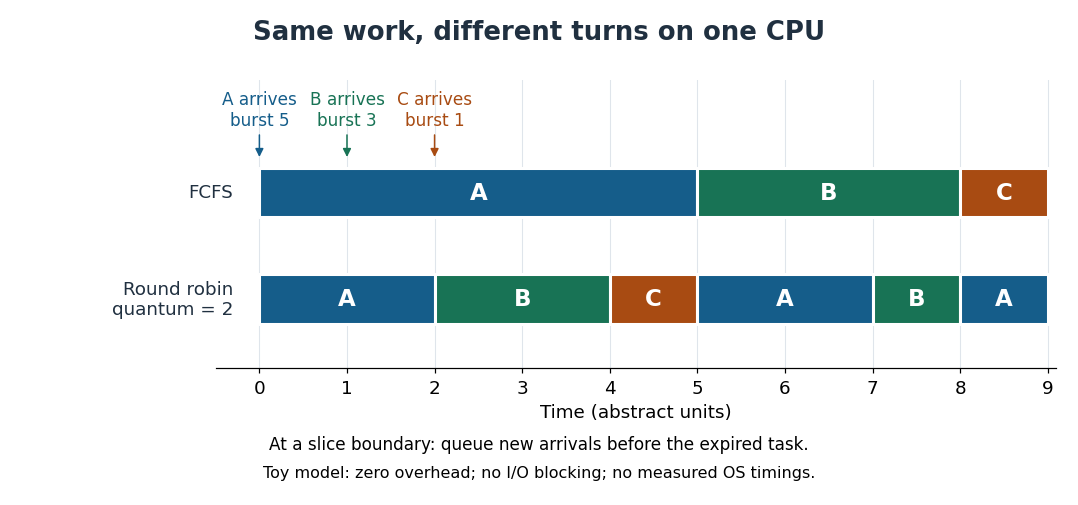


The following triples always list A, B, C. Completion is an absolute time; scheduling turnaround time, scheduling waiting time and scheduling response time are durations measured from the relevant events.
For example, B first runs at time 2 under round-robin scheduling, so its scheduling response time is . It finishes at time 8, giving scheduling turnaround time and scheduling waiting time . Under FCFS, C waits before its sole execution interval. Under round-robin scheduling, A waits during and , totaling . Both timelines do exactly units of useful CPU work; changing the order changes who benefits first.
The appeal is that shared progress can improve responsiveness: B and C get their first CPU service sooner under round-robin scheduling, while A completes later. The arithmetic mean of the scheduling response times falls from to ; the arithmetic mean of the scheduling turnaround times is for both policies in this particular example. These are different goals, and this workload establishes no universal ranking. Giving each continuously runnable task repeated turns is a practical form of fairness. A smaller scheduling quantum can shorten waits between turns, but makes context switches more frequent when competitors remain runnable. If each full slice performs units of useful work and incurs a fixed switching cost , the overhead fraction in that simplified repeated cycle is . Real costs and workloads determine the choice. [ref]
Scheduling quantum 2026-10-14
The maximum amount of CPU execution allotted in one turn by round-robin scheduling. A task can finish before consuming its scheduling quantum. When other tasks remain runnable, a shorter scheduling quantum provides more frequent turns at the cost of more frequent context switches.
Thread (computing) 2026-10-13
A software thread is an execution stream within a operating-system process. Each software thread has its own execution context, including processor registers, an instruction pointer, and a call stack selected by its stack pointer. Software threads in the same operating-system process share its address space, global variables, dynamically allocated storage (the memory heap), and resources such as file descriptors. Separate register states let two software threads pause at different instructions and later resume correctly. A context switch saves and restores those states; it does not copy the entire shared address space. [ref]
https://pages.cs.wisc.edu/~remzi/OSTEP/threads-intro.pdf. Arpaci-Dusseau and Arpaci-Dusseau, OSTEP chapter 26, introduction and figure 26.1: thread contexts and shared address space
[ref]https://pubs.opengroup.org/onlinepubs/9799919799/basedefs/V1_chap03.html#tag_03_189. The Open Group, POSIX.1-2024, sections 3.189–3.190: Live Process and Live Thread, shared resources and addressable storage
In the right half of the diagram under operating-system process, T1 and T2 access the same counter
x at virtual address 0x1234. Their call stacks occupy separate regions of the same address space, and their saved processor registers can contain different values. A software thread's own call stack means the stack used for its calls, not a hardware protection boundary against another software thread. Another software thread with a suitable address can access that stack's live data, subject to the program's lifetime and synchronization rules. Sharing an address space enables easy communication and makes accidental interference possible.Concurrency means that several activities can make progress over overlapping intervals; parallel execution means that several activities execute at the same instant. On one CPU execution slot, process scheduling can interleave software threads without simultaneous execution. Multiple processor cores can run eligible software threads in parallel, but merely creating software threads does not ensure parallel execution or a speedup.
Consider an explicitly abstract interleaving model: shared
x starts at , and each of T1 and T2 performs three indivisible logical steps in its own order: load x into its own register r, add to r, then store r into x. Each load sees the latest preceding store in the displayed order. These model assumptions specify the example; they do not describe every programming language or every hardware memory model. In serial order T1 finishes all three steps before T2 starts, so T2 loads and stores .An overlapping order instead gives T1 load , T2 load , T1 add to get
r1 = 1, T2 add to get r2 = 1, T1 store , and T2 store . The load/store subsequence is therefore T1 load , T2 load , T1 store , T2 store : final , although each software thread incremented its register correctly. The second store replaces the first with the same value, losing one intended update. This race condition is possible even with interleaving on a single CPU.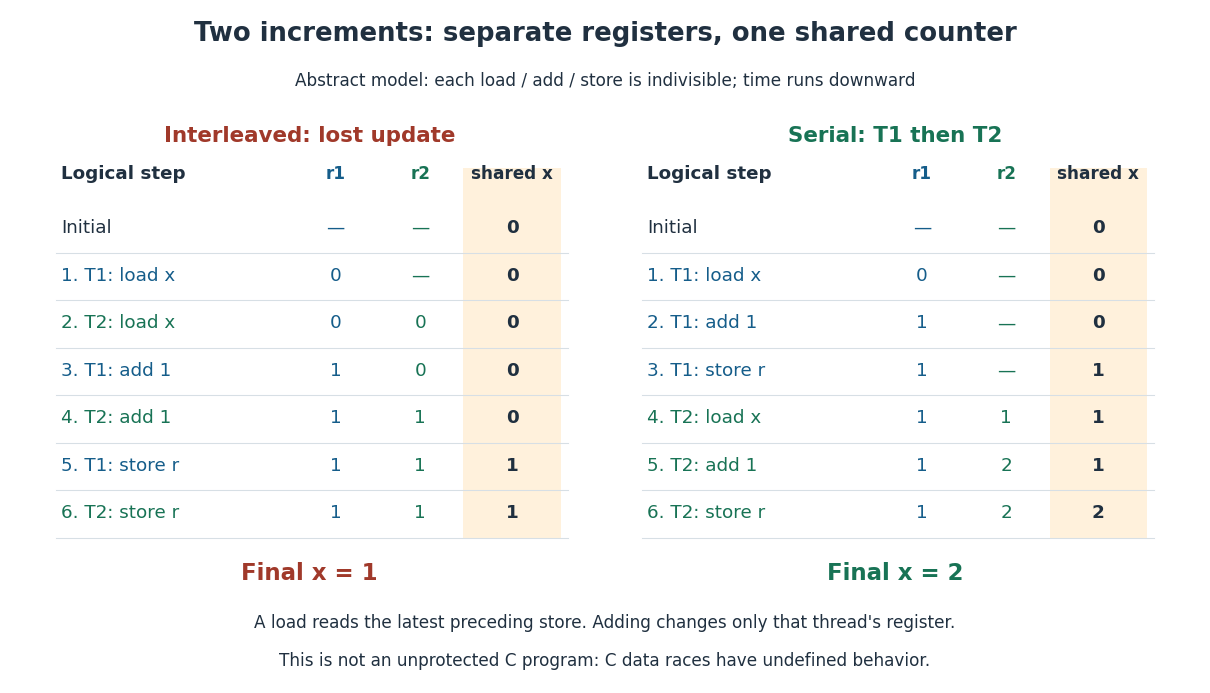
Two abstract load/add/store increments retain separate registers but can leave the shared counter at instead of the serial result
. Details. 
This is not an unprotected C implementation example. Conflicting unsynchronized accesses to an ordinary non-atomic C object from different software threads can constitute a data race, which has undefined behavior; the abstract trace is not a prediction of that program's allowed outcomes. [ref]
The repair explains why synchronization matters: mutual exclusion around the whole load/add/store sequence prevents the other software thread from starting an increment halfway through it. Alternatively, an appropriate atomic operation can make the complete increment one indivisible read-modify-write. In the toy model, either repair makes the two increments take effect in an order, producing . Making only each load and each store an atomic operation still permits the displayed lost update. [ref]
https://pages.cs.wisc.edu/~remzi/OSTEP/threads-locks.pdf. Arpaci-Dusseau and Arpaci-Dusseau, OSTEP chapter 28, sections 28.1–28.2 and 28.11: locks around updates and atomic fetch-and-add
The attraction is independently progressing activities with direct access to shared data: a user-interface software thread can handle input while another waits for input-output, and workers can divide independent pieces of a large calculation among available cores. The first benefit can exist on one CPU; the second requires suitable work and execution resources. Context switches, synchronization, register-state records and extra call stacks consume time or computer memory, so the useful partition depends on the workload. [ref]
https://pages.cs.wisc.edu/~remzi/OSTEP/threads-intro.pdf. Arpaci-Dusseau and Arpaci-Dusseau, OSTEP chapter 26, section 26.1: parallel work and overlapping input-output with other activity
Translation lookaside buffer 2026-10-14
A translation lookaside buffer is a small hardware memory cache of virtual address to physical address mappings and their access attributes. A TLB hit finds a usable cached mapping for the current address space; access permissions still apply. A TLB miss means that mapping is absent from the translation lookaside buffer. It says nothing by itself about whether the memory page is resident. Evicting a translation lookaside buffer entry removes a cached translation, not the memory page's contents. [ref]
https://docs.amd.com/api/khub/documents/sD1_QL~h4Afq2_tvzxqqSQ/content. AMD64 Architecture Programmer's Manual, volume 2, revision 3.44, section 5.5: Translation-Lookaside Buffer
For the 256-byte example, a cached virtual page
0x12 to physical frame 0x07 mapping covers every offset from 0x00 to 0xff. Reads at virtual addresses 0x1234 and 0x1235 can reuse it to reach physical addresses 0x0734 and 0x0735. If the translation lookaside buffer is initially empty, the first read instead requires a page table walk; with a resident, readable mapping, it completes without a page fault. A write can fault even on a TLB hit because cached permissions deny it.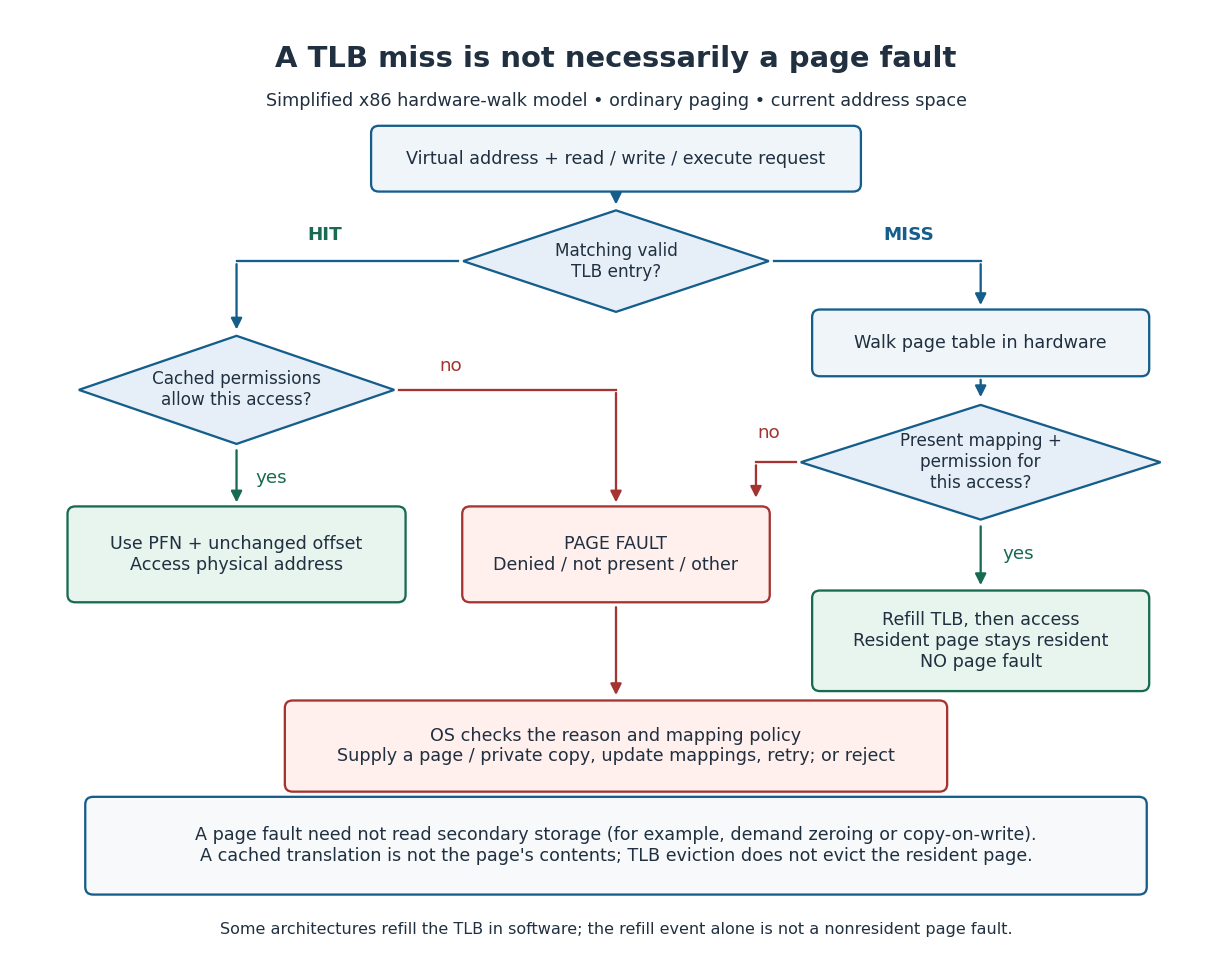
A TLB miss can refill a resident translation without a page fault; permission failures can fault on a TLB hit
. Details. 
The diagrams show an ordinary x86 model with hardware page table walks. Some architectures use an operating system handler to refill the translation lookaside buffer after a TLB miss; that refill event alone is not a nonresident page fault. Temporal locality helps a small translation lookaside buffer serve repeated accesses, and one entry can cover many bytes. [ref]
https://pages.cs.wisc.edu/~remzi/OSTEP/vm-tlbs.pdf. Arpaci-Dusseau and Arpaci-Dusseau, OSTEP chapter 19: Paging, Faster Translations, sections 19.1 and 19.3
A context switch does not universally flush the whole translation lookaside buffer. An address space identifier can distinguish translations with the same virtual page number in different address spaces; Intel's PCIDs support retaining translations across appropriate switches. The operating system must still invalidate stale translations when mappings or permissions change, following the architecture's rules, including coordination with other processors that could use them. [ref]