Consider two real scalar fields with positive , standard kinetic terms, and the displayed scalar potential. At , the circle group rotates one field into the other: this is a global symmetry in field theory, with the same rotation at every point in space. The vacuum manifold is the circle . Choose and differentiate the scalar potential twice:The scalar mass matrix assigns a restoring force to the radial displacement, whereas its tangent is one of the Goldstone directions in the scalar mass matrix. Moving around the circle costs no potential energy; moving between neighbouring points in space can still cost gradient energy. Flat angular potential energy therefore means a soft collective excitation, not that every spatial pattern is free.
A positive source explicitly selects the positive direction. The minimum is , where is the positive solution of . The two eigenvalues of the scalar mass matrix there areFor example, and give , and . The light angular excitation becomes a Goldstone boson as , while the radial mass stays finite. The source changes both the preferred direction and the radius; expanding about the old point at nonzero would miss that shift.
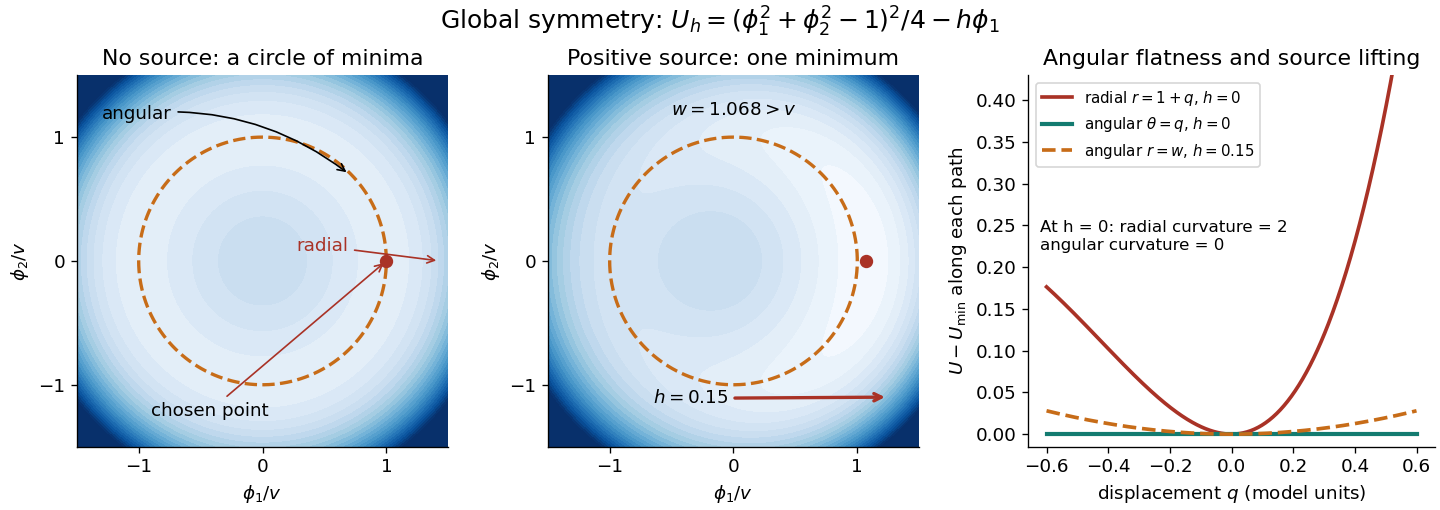
An external source selects an orientation and lifts the angular flat direction
. Original dimensionless scalar potential example with . Dashed circles mark the zero-source vacuum manifold. The right panel follows a radial line or a circular angular path, with potential energy measured from the minimum appropriate to that path. A circular path has zero angular potential energy at ; a straight tangent displacement agrees only to quadratic order. Details.
Articles by others on the same topic
There are currently no matching articles.