A tiny orbital period change accumulates into a larger timing shift. Choose the original model , with and . Expanding the accumulated cycle count gives
Negative means an event of fixed orbital cycle count arrives earlier than a constant-period prediction. After twenty Julian years, the chosen period has decreased by , while the accumulated event shift is about . This is a time shift of periapsis passage; it is different from a rotation of the direction of periapsis.
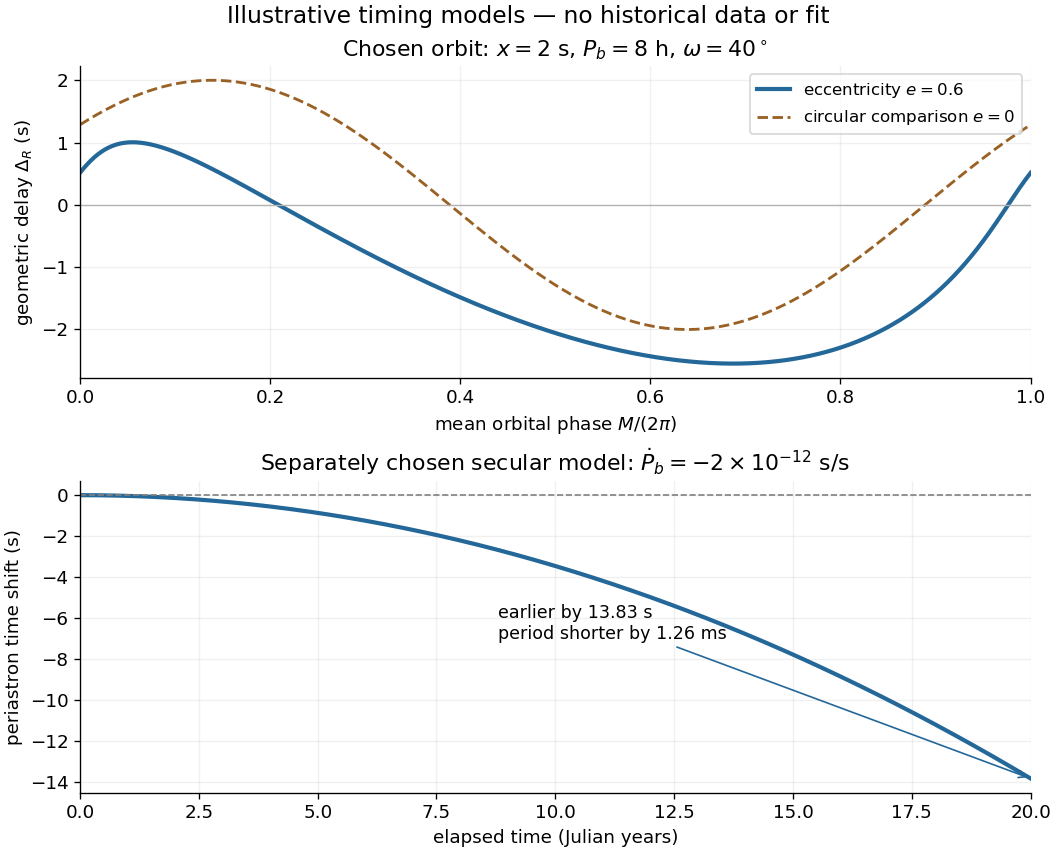
Figure 1.
A chosen eccentric light-travel delay and an accumulated orbital-period change
. Original calculations, not observations or a historical fit. The upper panel solves Kepler's equation for x=2 seconds, an 8 hour orbital period, eccentricity 0.6 and argument of periapsis 40 degrees; the dashed curve sets eccentricity to zero. The lower panel independently chooses a constant period derivative of minus 2 times 10 to the minus 12 seconds per second. It plots the leading event-time shift against a constant-period ephemeris; no masses or radiation mechanism are fitted. Details.

Articles by others on the same topic (0)

There are currently no matching articles.