A binary pulsar is a pulsar in a binary star: the companion's gravity changes the emitting neutron star's motion and hence its pulse arrival times. The companion need not itself be a detectable pulsar. Pulsar timing turns that motion into a measurable orbit, making the system useful for stellar mass determination and tests of general relativity.
Russell Alan Hulse and Joseph Hooton Taylor Jr. discovered this binary pulsar at Arecibo in 1974; their January 1975 paper reports a roughly pulse period and orbital period. Its unseen companion was not detected as a second radio pulsar. Discovery of the orbit preceded the later binary-pulsar orbital decay test.[ref]
Discovery of a Pulsar in a Binary System by Russell Alan Hulse and Joseph Hooton Taylor Jr.. Discovery of a Pulsar in a Binary System, 15 January 1975, L51 opening and section II; L53 section IV
The 1993 Nobel Prize in Physics recognized the discovery.[ref]
All Nobel Prizes in Physics by Nobel Prize Outreach. 1993 entry, joint award and discovery motivation
The surprise was a pulsar whose apparent period would not stay fixed. Russell Alan Hulse's Arecibo search used a multichannel receiver, pulsar dedispersion and computer searches over period and pulse width. Follow-up at higher time resolution retained the changing period, excluding inadequate sampling as its explanation. The observed variation exceeded the expected terrestrial Doppler shift; a predicted reversal from decreasing to increasing period appeared on 16 September 1974.[ref]
The Discovery of the Binary Pulsar by Russell Alan Hulse. The Discovery of the Binary Pulsar, lecture delivered 8 December 1993, pp. 53–58 and 62–65, Figures 3–4 and 8–10
The 1975 analysis fitted an eccentric Kepler orbit to Doppler shifts inferred from about 200 five-minute period measurements over ten days. That discovery fit was not yet the later precision arrival-time experiment.[ref]
Discovery of a Pulsar in a Binary System by Russell Alan Hulse and Joseph Hooton Taylor Jr.. L51–L52, section II, Tables 1–2, Figure 1 and equations 1–4
An orbit explains both signs of the apparent period change without requiring the stellar rotation to alternate between speeding up and slowing down.The semimajor axis of the pulsar's orbit about the binary barycenter, projected along the line of sight and divided by the speed of light. The orbital inclination is zero for a face-on orbit. Thus is a time, often quoted as the numerical number of light-seconds in , not the true binary separation. The relative-orbit semimajor axis is instead ; conservation of momentum gives .
Combining Kepler's third law with that barycenter relation gives the timing form of the binary mass function, also valid for eccentric Kepler orbits:Choose and for an original example: and , where is a solar mass. For a specified pulsar mass , the smallest allowed companion mass occurs at and is approximately . A different assumed changes this bound. One measured does not determine both masses and orbital inclination.
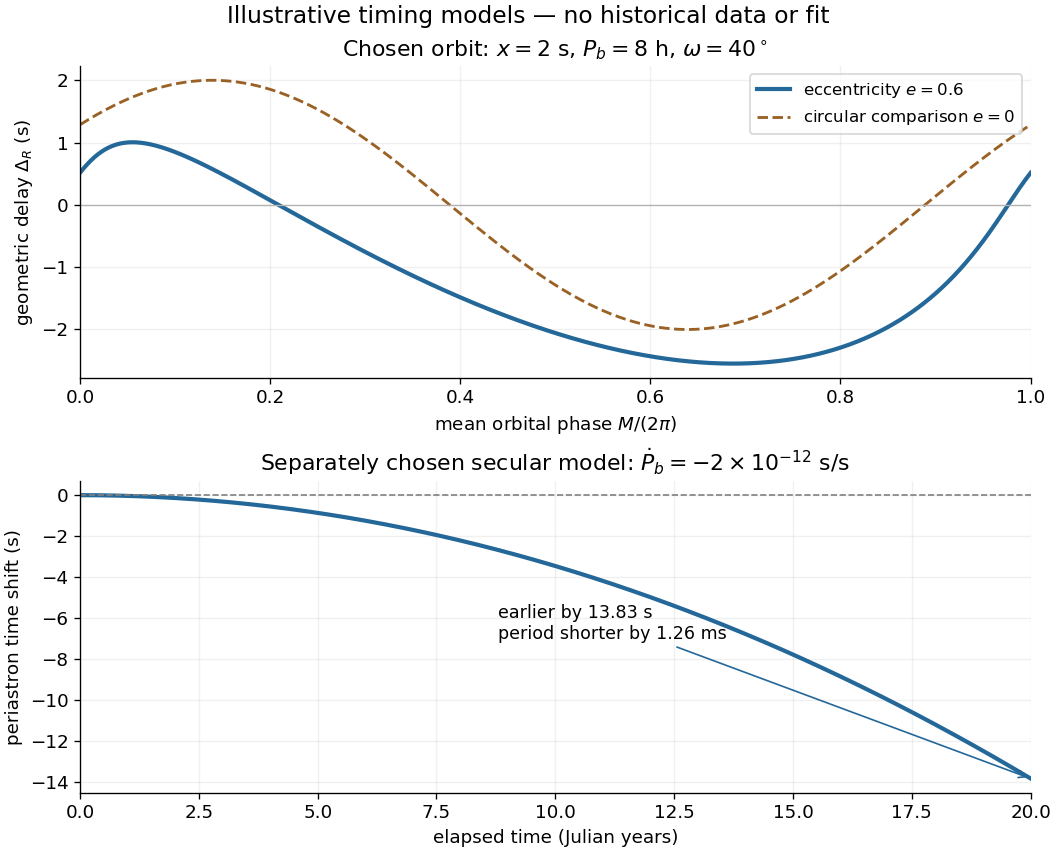
The geometric light-travel contribution from the pulsar's position within the binary orbit. To construct an eccentric Kepler orbit, use eccentric anomaly , orbital eccentricity , mean anomaly , and argument of periapsis . Here is passage through periapsis. Coordinates in the orbital plane are and . Rotate through and project by to obtainThe first equation is Kepler's equation: equal time intervals give equal increments of , not of . Since for , each has a unique on the corresponding unwrapped orbit. A constant delay is absorbed into the arbitrary arrival-time origin. The circular limit is , so its amplitude measures . For , the delay's offset and amplitude also depend on ; its maximum is not generally .
A gradual rotation of the direction of periapsis within the orbital plane. A closed Kepler orbit has fixed argument of periapsis ; relativistic gravity can make advance between successive orbits. The angle change and binary-pulsar orbital decay describe different changes of the orbit.
Decreasing orbital period, distinct from spin slowdown. Joseph Hooton Taylor Jr. inferred masses using binary-pulsar periastron advance and binary-pulsar Einstein delay, then tested the independent period derivative against the general relativity quadrupole formula. Correcting differential Galactic acceleration gave indirect gravitational radiation evidence. This was not a terrestrial strain measurement.[ref]
In particular, the raw measured derivative schematically containsHere is positive when the source's recession accelerates. Its contribution follows by differentiating the leading Doppler effect. A decreasing observed orbital period alone therefore does not identify a unique energy-loss mechanism.
For fixed masses, binary orbital energy is and Kepler's third law gives . Positive outgoing gravitational radiation predicted by the quadrupole formula makes the orbital energy more negative, reducing and . This sign argument explains shrinking orbits, but a quantitative test also needs the predicted magnitude and orbital eccentricity dependence.
A tiny orbital period change accumulates into a larger timing shift. Choose the original model , with and . Expanding the accumulated cycle count givesNegative means an event of fixed orbital cycle count arrives earlier than a constant-period prediction. After twenty Julian years, the chosen period has decreased by , while the accumulated event shift is about . This is a time shift of periapsis passage; it is different from a rotation of the direction of periapsis.
Articles by others on the same topic



A binary pulsar is a type of astronomical object that consists of two stars in a close orbit, one of which is a pulsar. A pulsar is a highly magnetized rotating neutron star that emits beams of electromagnetic radiation, particularly in the radio frequency range, from its magnetic poles. As the star rotates, these beams can sweep across the Earth, producing a regular pulsing effect, similar to that of a lighthouse.