Decreasing orbital period, distinct from spin slowdown. Joseph Hooton Taylor Jr. inferred masses using binary-pulsar periastron advance and binary-pulsar Einstein delay, then tested the independent period derivative against the general relativity quadrupole formula. Correcting differential Galactic acceleration gave indirect gravitational radiation evidence. This was not a terrestrial strain measurement.[ref]
In particular, the raw measured derivative schematically containsHere is positive when the source's recession accelerates. Its contribution follows by differentiating the leading Doppler effect. A decreasing observed orbital period alone therefore does not identify a unique energy-loss mechanism.
For fixed masses, binary orbital energy is and Kepler's third law gives . Positive outgoing gravitational radiation predicted by the quadrupole formula makes the orbital energy more negative, reducing and . This sign argument explains shrinking orbits, but a quantitative test also needs the predicted magnitude and orbital eccentricity dependence.
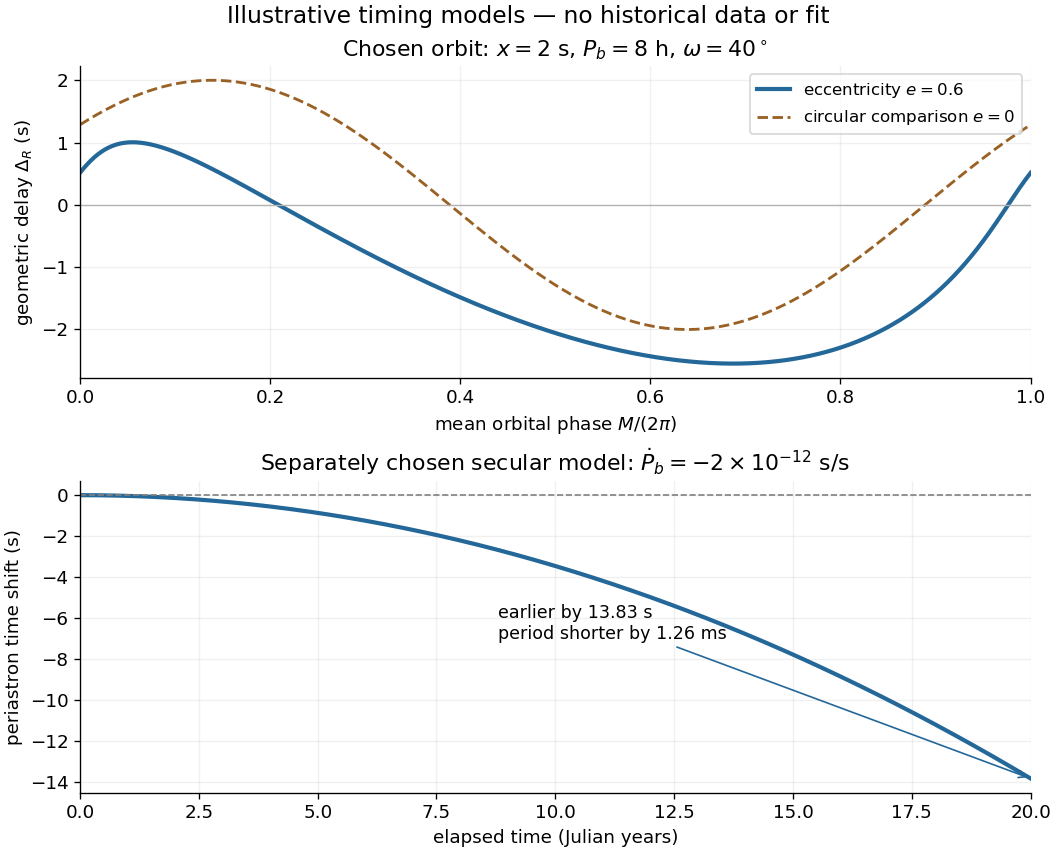
A tiny orbital period change accumulates into a larger timing shift. Choose the original model , with and . Expanding the accumulated cycle count givesNegative means an event of fixed orbital cycle count arrives earlier than a constant-period prediction. After twenty Julian years, the chosen period has decreased by , while the accumulated event shift is about . This is a time shift of periapsis passage; it is different from a rotation of the direction of periapsis.

Articles by others on the same topic
There are currently no matching articles.