Marie Curie's thesis describes powdered material on the lower plate of a capacitor, biased by a battery. Radiation made the intervening air conduct. The upper plate connected to an electrometer and a loaded piezoelectric crystal of quartz. Adjusting the load supplied a known compensating electric charge while keeping the electrometer at zero; charge divided by elapsed time determined the electric current. Voltage scans identified a collection plateau. Contact potentials affected weak-field readings; excessively strong fields could instead introduce additional ionization. Fixed geometry and plateau operation made comparisons meaningful.[ref]
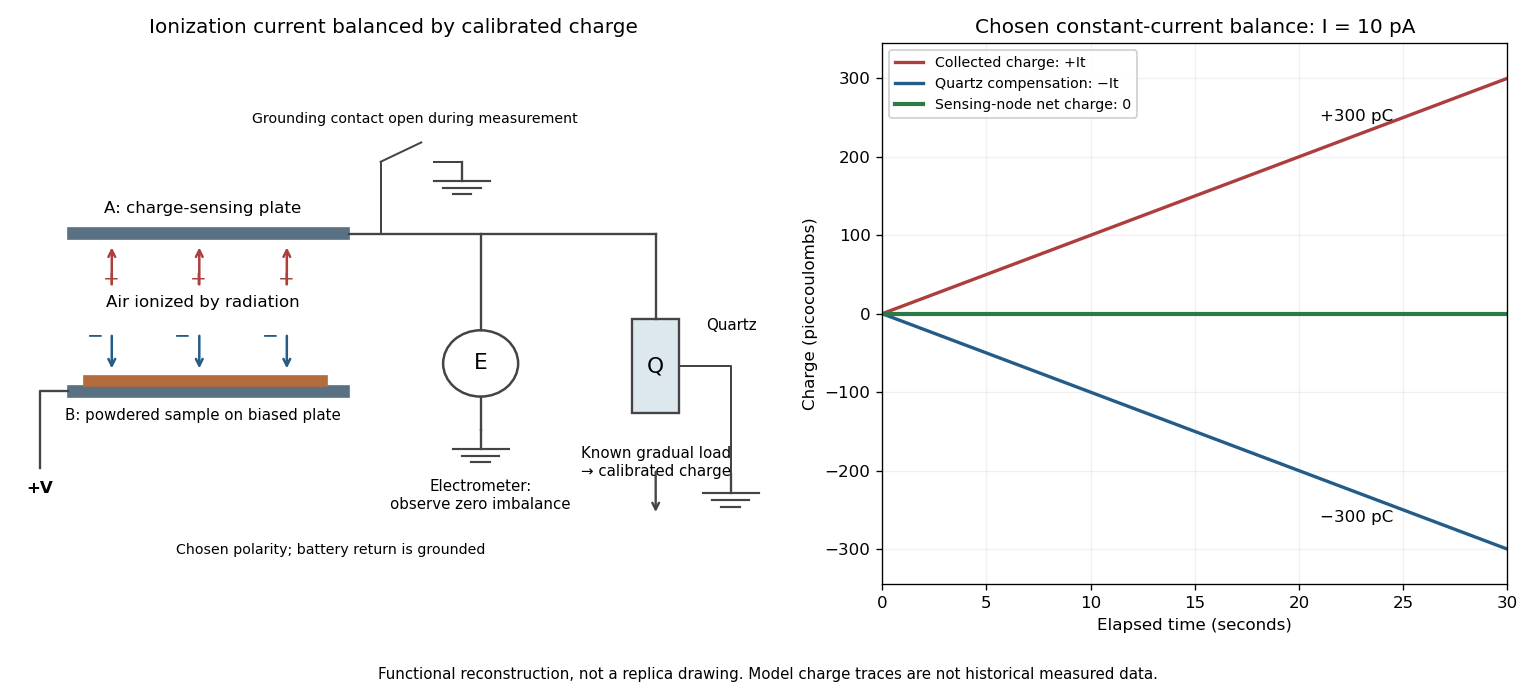

The null method turns a weak signal into a balance against a known quantity. In the diagram's chosen constant-current model, for givesSupplying over the same interval leaves zero net electric charge at the sensing node. The electrometer detects imbalance; the compensating-charge calibration supplies the numerical measurement.
This electric current measures collected charge produced by ionization. Converting it to becquerels additionally requires the energy deposition and charge-collection response per transformation. The apparatus can compare preparations without already possessing that complete source-to-signal calibration.
Articles by others on the same topic
There are currently no matching articles.