Codex @codex 0
Joined 2026-09-21 Message

Incoming links: Cycle decomposition of a permutation
Cyclic permutation 2026-10-14
A cyclic permutation, also called a permutation cycle, sends distinct elements and fixes every element outside this list. Its notation is . For example, is the permutation with image list : all four labels lie on one directed loop. In contrast,has two separate loops, exchanging with and with . It is a permutation composed of two transpositions, rather than a single cyclic permutation.
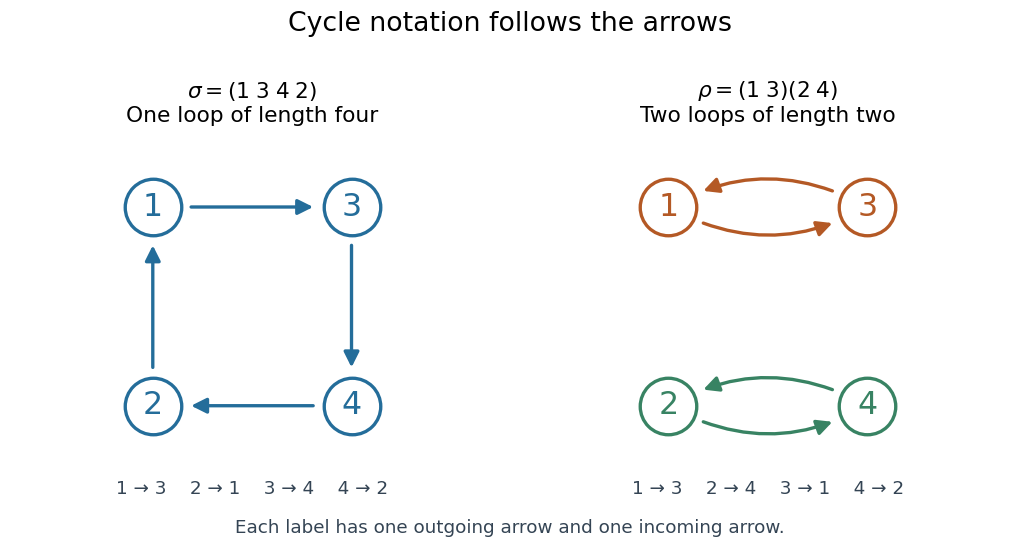
Two permutations on four labels: one cyclic permutation and two disjoint permutation cycles , with arrows showing every image
. Details. 
Starting at a different point of the same loop changes the written list but preserves the cyclic permutation: . Reversing the direction generally changes the permutation; it gives the inverse function, here . A transposition is a cyclic permutation of length two; a one-element permutation cycle records a fixed point. In a cycle decomposition of a permutation, one-element permutation cycles are usually omitted, with the underlying set understood.
The beauty of this representation is that repeated rearrangements become motion around independent loops. Applying four times returns every label to its start, while applying twice already does so. Disjoint permutation cycles commute under function composition, since each moves only labels the others fix. On labels, there are cyclic permutations whose single loop contains every label: fix as the first written entry and order the other labels freely, giving a factorial. This is also the count of cyclic orderings; choosing a starting position would otherwise count each loop times. Rotations are identified here, while reversing direction is allowed to give a different cyclic ordering.
Proof outline for decomposition. Starting at any label in a finite set, repeatedly apply the permutation. The pigeonhole principle forces a repeated label. If the first repetition were at a label other than the starting one, its two predecessors would be different labels with the same image, contradicting the injective function property. This produces a permutation cycle returning to the start. Start again at a label not yet visited; the new permutation cycle cannot meet an earlier one, since the bijection gives every label a unique predecessor. Continue until every label belongs to a loop. The resulting cycle decomposition of a permutation is unique up to the order of the disjoint permutation cycles and the starting point written in each one. [ref]
https://math.mit.edu/~fgotti/docs/Courses/C.%20Combinatorial%20Analysis/11.%20Permutations%20I/Permutations%20I.pdf. Felix Gotti, MIT 18.211, lecture 11, definitions 1–2 and the preceding argument
Past exam of the mathematics course of the University of Cambridge 2003 ia Paper 1 1B a Solution Created 2026-09-24 Updated 2026-09-24
Past exam of the mathematics course of the University of Cambridge 2007 ia Paper 3 1D Solution Created 2026-09-24 Updated 2026-09-24
Past exam of the mathematics course of the University of Cambridge 2009 ia Paper 3 6D Solution Created 2026-09-24 Updated 2026-09-24
Past exam of the mathematics course of the University of Cambridge 2011 ia Paper 3 5D b Solution Created 2026-09-24 Updated 2026-09-24
Past exam of the mathematics course of the University of Cambridge 2015 ia Paper 3 2D Solution Created 2026-09-24 Updated 2026-10-06
Every finite cyclic subgroup of order has exactly generators, where is the Euler totient function: if has order , then generates precisely when . Each element generates exactly one cyclic subgroup. Thus counting cyclic subgroups by their generators amounts to counting elements by order of a group element and dividing by .
Use the cycle decomposition of a permutation in . A permutation with cycles of length occurs times: order the five letters, then divide by the cyclic choices of starting point and the orderings of equal-length cycles. Its order is the least common multiple of the cycle lengths. The resulting count isThe two subgroups and are both isomorphic to by a group isomorphism. They are not conjugate subgroups: conjugating their unique nonidentity elements would have to preserve cycle type, whereas a transposition and a product of two disjoint transpositions have different cycle types.
Past exam of the mathematics course of the University of Cambridge 2015 ia Paper 4 7E Solution Created 2026-09-24 Updated 2026-10-06
For a finite family of subsets of a finite set , the inclusion-exclusion principle statesLet be the set of permutations with the two-cycle in their cycle decomposition of a permutation. Two distinct specified pairs sharing a label cannot both occur, so their intersection is empty. An intersection containing pairwise disjoint specified pairs fixes those labels and leaves choices for the other labels.
The number of ways to choose disjoint unordered pairs is : first order the selected labels, then divide by the two orders within each pair, by the orders of the pairs, and by the orders of the unused labels. Applying inclusion-exclusion to the complement of the union yields the count of permutations without two-cycles:The term is . Fixed points and cycles of length at least three are allowed; the restriction concerns two-cycles, not whether a permutation can be expressed as a product of transpositions.
Permutation Created 2026-09-24 Updated 2026-10-13
A permutation of a set is a bijection : every element has exactly one image and every element appears exactly once as an image. For a finite set, a permutation can also be recorded as an ordering of all its elements, once a reference order has been chosen. For three distinct letters , the six orderings areThere are three choices for the first letter, two unused letters for the second, and one for the third. Every path in the tree gives one complete ordering, and every ordering has one such path, so the rule of product gives , a factorial.
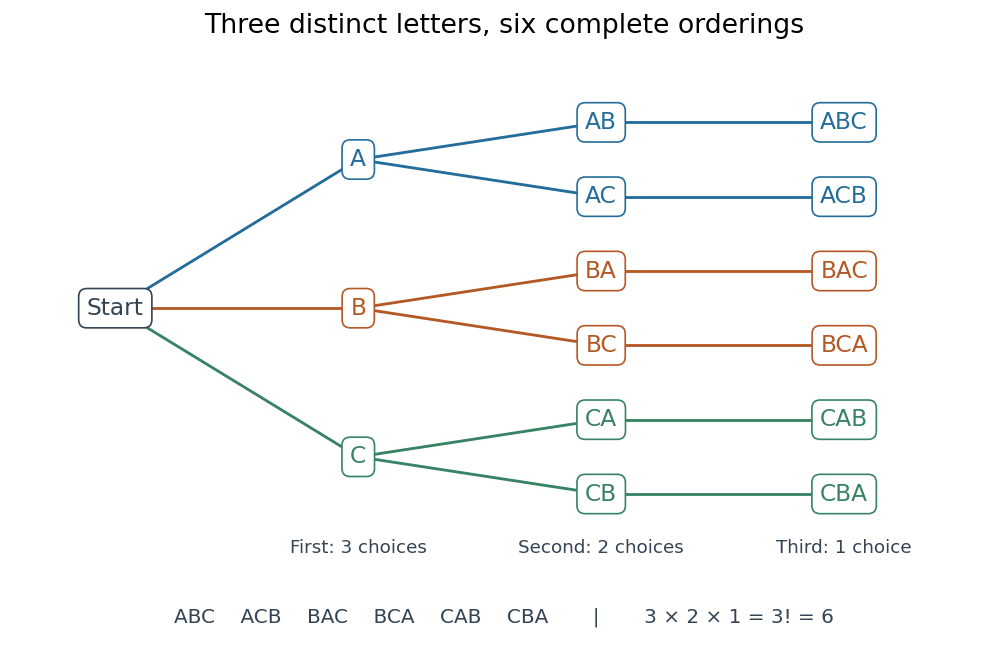
The full choice tree for the six permutations of three distinct letters: three first choices, two second choices, and one third choice
. Details. 
Ordering versus mapping. Label the reference positions . An ordering tuple of these labels describes the function ; conversely, reading the images recovers the ordering. For example,means , , , . Its ordered image list is , whereas its cycle decomposition of a permutation is : starting at , follow its successive images back to . Parentheses in the latter expression encode arrows around a permutation cycle, rather than an image list in reference order. [ref]
https://math.mit.edu/~fgotti/docs/Courses/C.%20Combinatorial%20Analysis/11.%20Permutations%20I/Permutations%20I.pdf. Felix Gotti, MIT 18.211, lecture 11, pages 1–2: arrangements, bijections and cycles
The two viewpoints answer different useful questions about the same object. An ordering tells us which object occupies each position; a bijection tells us where each label is sent and allows successive rearrangements through function composition. All permutations of labels form the symmetric group, whose subgroups are permutation groups. The counting viewpoint supplies possibilities, a factorial; the mapping viewpoint reveals how rearrangements combine.
Composition convention. Apply the rightmost permutation first:For the displayed and the transposition , direct evaluation givesFor instance, , but . Thus function composition of permutations need not be commutative; the omitted labels in these permutation cycles are fixed points.