A cyclic permutation, also called a permutation cycle, sends distinct elements and fixes every element outside this list. Its notation is . For example, is the permutation with image list : all four labels lie on one directed loop. In contrast,has two separate loops, exchanging with and with . It is a permutation composed of two transpositions, rather than a single cyclic permutation.
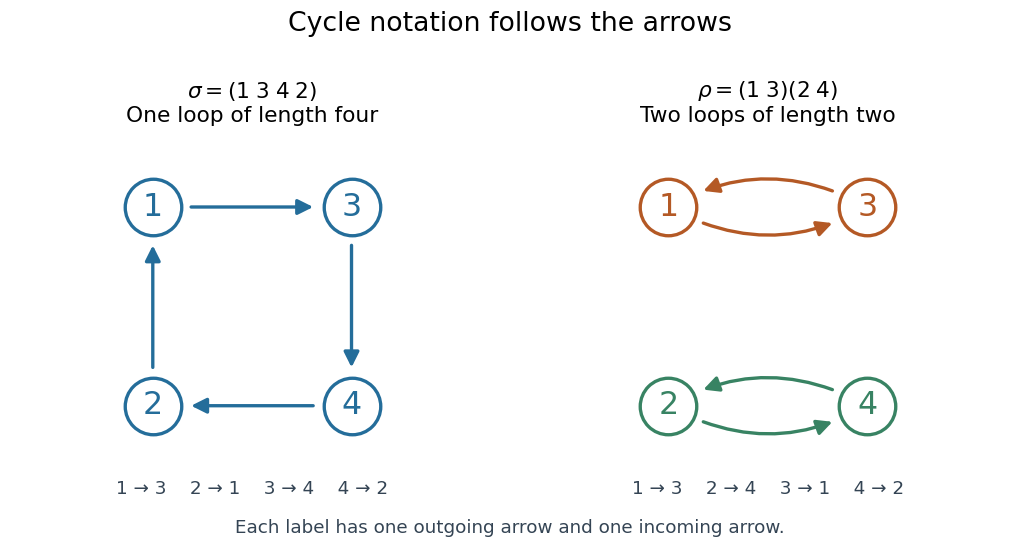
Two permutations on four labels: one cyclic permutation and two disjoint permutation cycles , with arrows showing every image
. Details. Starting at a different point of the same loop changes the written list but preserves the cyclic permutation: . Reversing the direction generally changes the permutation; it gives the inverse function, here . A transposition is a cyclic permutation of length two; a one-element permutation cycle records a fixed point. In a cycle decomposition of a permutation, one-element permutation cycles are usually omitted, with the underlying set understood.
The beauty of this representation is that repeated rearrangements become motion around independent loops. Applying four times returns every label to its start, while applying twice already does so. Disjoint permutation cycles commute under function composition, since each moves only labels the others fix. On labels, there are cyclic permutations whose single loop contains every label: fix as the first written entry and order the other labels freely, giving a factorial. This is also the count of cyclic orderings; choosing a starting position would otherwise count each loop times. Rotations are identified here, while reversing direction is allowed to give a different cyclic ordering.
Proof outline for decomposition. Starting at any label in a finite set, repeatedly apply the permutation. The pigeonhole principle forces a repeated label. If the first repetition were at a label other than the starting one, its two predecessors would be different labels with the same image, contradicting the injective function property. This produces a permutation cycle returning to the start. Start again at a label not yet visited; the new permutation cycle cannot meet an earlier one, since the bijection gives every label a unique predecessor. Continue until every label belongs to a loop. The resulting cycle decomposition of a permutation is unique up to the order of the disjoint permutation cycles and the starting point written in each one. [ref]
https://math.mit.edu/~fgotti/docs/Courses/C.%20Combinatorial%20Analysis/11.%20Permutations%20I/Permutations%20I.pdf. Felix Gotti, MIT 18.211, lecture 11, definitions 1–2 and the preceding argument
Articles by others on the same topic


A cyclic permutation is a specific type of permutation of a set in which the elements are rotated in a circular manner. In a cyclic permutation, every element moves to the position of the next element, and the last element wraps around to the first position. For example, consider the set of elements \([1, 2, 3]\): - A cyclic permutation of this set might be \([2, 3, 1]\).