The finite cyclic group and the Klein four-group are both abelian groups of order four. In , composition is addition modulo four. In , label the elements and add each coordinate modulo two. For example, and .
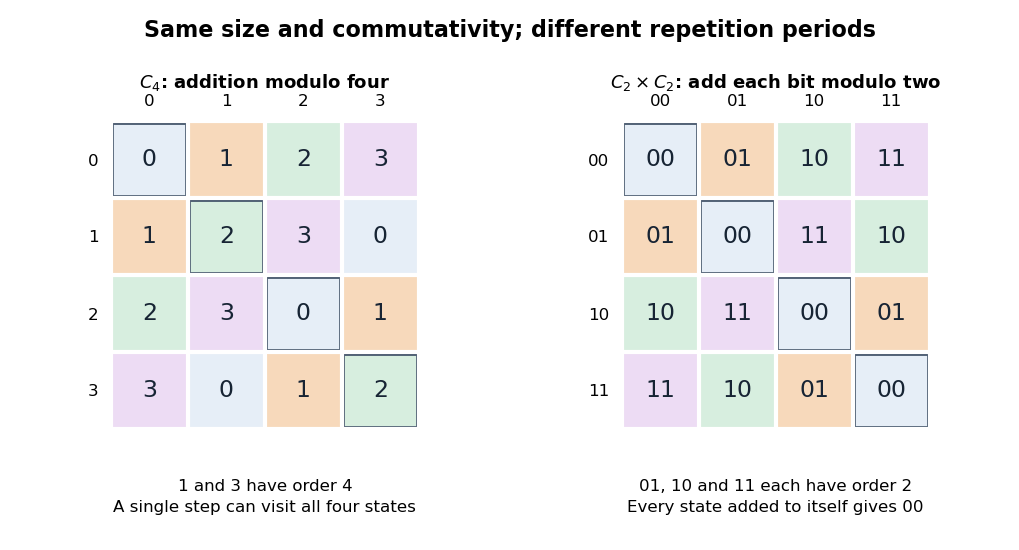
Two abelian groups of order four have different addition tables
. Each cell is the row element plus the column element. Diagonal cells record adding an element to itself. In , only and return to zero after two additions. In the Klein four-group, every diagonal cell is the identity element . The symmetric tables show commutativity, while the different doubling behavior distinguishes the groups. Details.
The order of a group element is preserved by a group isomorphism: an equation holds exactly when its image satisfies the same equation. In , both and have order four. In , each nonidentity element has order two. Hence these groups are not isomorphic, despite having the same order of a finite group. No relabelling can repair this discrepancy.
For a geometric model of , take the symmetries of a non-square rectangle: the identity element, reflection in its horizontal axis, reflection in its vertical axis, and rotation through . The two reflections commute, and their composite is the half-turn. Every nonidentity motion is its own inverse element. This makes the two binary switches concrete: choosing whether to apply each reflection specifies all four motions. The case of abelian groups of prime-square order generalizes this distinction from to any prime .
Articles by others on the same topic
There are currently no matching articles.