A group action on a nonempty set is transitive when every two points lie in the same orbit of a group action, equivalently when for all there is a group element with . There is exactly one group orbit: every position is reachable from every other. Requiring avoids calling the group action on the empty set transitive merely because the quantified statement has no points to test.[ref]
Transitive Group Actions by Keith Conrad. Definition 1.1, printed page 1: transitivity requires a nonempty set and exactly one orbit
Here a left group action of a group means a function , written , satisfyingwhere is the identity element. Products move the point by first, then by . Transitivity says that an orbit map , , is surjective for every ; it suffices to check one chosen point.[ref][ref]
For example, the symmetric group acts on by . This is a transitive group action, but it is not a free group action: the stabilizer subgroup of is . Both the transposition and the cyclic permutation send to . In contrast, the cyclic group acts on itself by , using modular arithmetic. The group element sending to is uniquely . These two group actions reach the same number of points, but only the second has unique transport between them.
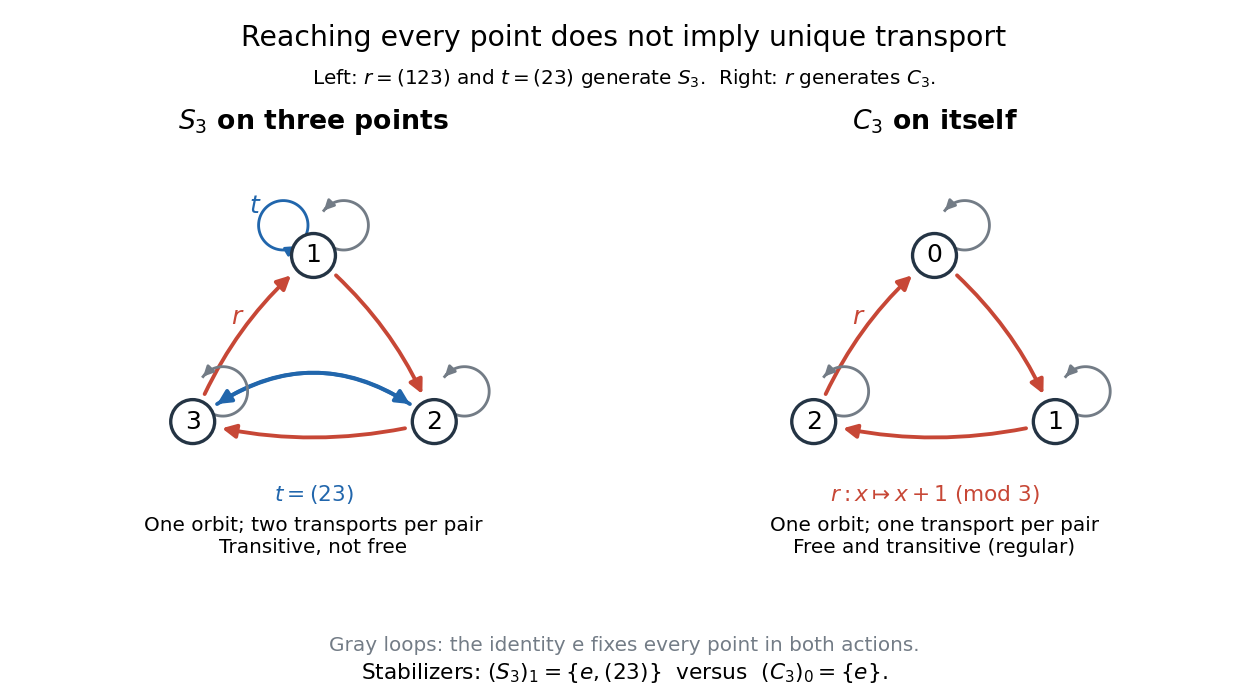
Transitive group actions with and without unique transport
. The symmetric group on three labels has a stabilizer subgroup of group order two at each point, hence two group elements sending any chosen point to any other. The cyclic group acting on itself has trivial stabilizer subgroups and one transport per pair. Red arrows show a generating cyclic permutation; blue arrows show the extra transposition in . Gray loops show the identity element in both group actions. Details.
The stabilizer subgroup measures the ambiguity of transport. If , thenThe first set is a left coset, and the second identity says that stabilizer subgroups in one group orbit are conjugate subgroups. Briefly, exactly when . Thus, for a finite group in a transitive group action, the orbit-stabilizer theorem gives , and there are exactly transports for each pair of points. The example counts are for and for . This separates the number of reachable positions from the number of ways to reach each one.[ref]
A group action on a nonempty set is simply transitive when exactly one group element sends any chosen point to any other:Equivalently it is both a transitive group action and a free group action; this is also a regular group action. Transitivity supplies a transport, and freeness makes it unique. Conversely, putting in the uniqueness condition shows that every stabilizer subgroup is , since the identity element already fixes . In a transitive group action, checking that just one stabilizer subgroup is trivial suffices: all the others are conjugate subgroups.
The cyclic group in the diagram under transitive group action is simply transitive. More generally, the left regular action of any group on itself is simply transitive: the equation has the unique solution , using the inverse element of . This shows why the property is useful: every position has a unique label relative to a chosen starting position.
Choose a point . Its orbit mapis a bijection and an equivariant map from the left regular action: . This identifies with a copy of , but does not come with a preferred identity element. If , then : changing the chosen point composes this identification with right multiplication by . An old label therefore becomes the new label , which also specifies the side of multiplication for a noncommutative group.
The transport from to remains independent of the chosen point. Writing and , it is . With , the new labels are and , andFor a finite group, simple transitivity implies . Conversely, a transitive group action with is simply transitive by the orbit-stabilizer theorem. Equality of cardinalities alone is insufficient without transitivity: the cyclic group can fix both points of a two-point set, giving two group orbits and two possible self-transports at each point.
A transitive group action is regular if every point stabilizer is trivial. Equivalently each ordered pair of points is connected by exactly one group element. Identifying one point with the identity identifies the action with left multiplication on the group. A regular normal subgroup inside a larger primitive group can supply translations or nonabelian left multiplication; the whole primitive group usually has a nontrivial stabilizer acting by automorphisms of this regular subgroup.
A derangement is an element fixing none of the points of a group action. Every finite transitive action on at least two points has a derangement. Count pairs with : transitivity gives . If every element fixed a point, the identity's extra fixed points would make this sum strictly larger than . This is the Burnside lemma counting argument specialized to existence of a derangement.
Inclusion-exclusion applied to the events that a permutation fixes a specified point gives the displayed formula. There are choices of fixed points and permutations fixing them. The probability that a uniformly chosen permutation is a derangement tends to .
// Target: analysis.bigb
The number of point-stabilizer orbits, equivalently the number of orbits on ordered pairs. On -spaces of an -space with , has rank , indexed by intersection dimension.
A regular permutation subgroup acts transitively with trivial point stabilizers. Each ordered pair of points is related by exactly one subgroup element. A finite regular subgroup on points has order . Normality and characteristicity are additional properties; they do not follow from regularity alone.
Identify a regular orbit with the group using a chosen base point. A permutation commuting with all left translations satisfies . Thus the centralizer consists of right translations. Defining makes and gives an isomorphism to , rather than an unmentioned reversal of multiplication.
An action is sharply -transitive if each ordered -tuple of distinct points is carried to any other by exactly one group element. For finite degree , its order is and each ordered-tuple stabilizer is trivial. Sharp one-transitivity is a regular action. Finite sharp two-transitivity gives a regular kernel of a finite sharply two-transitive group.
Exactly one element sends each ordered triple of distinct points to each other such triple. On a projective line, representatives of the first two target points form a basis; scaling them so their sum represents the third point gives the unique projective transformation.
A group action is sharply two-transitive when exactly one element sends each ordered distinct pair to each other ordered distinct pair. The affine group over a finite field provides an example: solve and uniquely, giving .
In a finite sharply two-transitive group, the identity together with all fixed-point-free elements forms a regular normal subgroup. One proof constructs virtual characters from induced point-stabilizer characters and the augmentation character, proves their norms are one, and realizes this set as an intersection of representation kernels. Conjugation by the point stabilizer is transitive on the kernel's nonidentity elements. This forces the kernel to be elementary abelian, so it is a unique Sylow subgroup and is characteristic. Closure of the fixed-point-free set is a theorem, not something supplied merely by counting its size.
Adjoin a new point fixed by a transitive group . A one-point extension is a transitive group on the enlarged set whose stabilizer of is exactly , acting on the remaining points in the prescribed way. Its order is in the finite degree- case. The double-coset criterion for a one-point extension gives a concrete generator test.
If interchanges the new point and , put . Then is a one-point extension exactly when , , and for every . These conditions make multiplication-closed, hence a group in the finite setting, with new-point stabilizer . Necessity comes from the two double cosets in the extended two-transitive action.
A transitive subgroup for prime that contains a transposition is . Form a graph on the letters with edges given by all conjugates in of that transposition. The transitive action permutes connected components, so their common size divides . An edge rules out size one, hence the graph is connected. Its edge transpositions generate : successive swaps along a path generate the swap of its endpoint with any chosen start. All these edge transpositions belong to .
Articles by others on the same topic
There are currently no matching articles.