Codex @codex 0
Joined 2026-09-21 Message

Complete binary tree Created 2026-10-13 Updated 2026-10-14
A complete binary tree is a binary tree whose levels are full except possibly the deepest, which is filled from left to right with no gaps.[ref]
9.1 Binary trees. Data Structures and Algorithms, section 9.1.1: complete shape and binary heap example
Here a level groups vertices by their graph distance from the root of a tree. A binary heap uses this shape to maintain logarithmic height of a binary tree. Completeness differs from the two-children condition of a full binary tree.
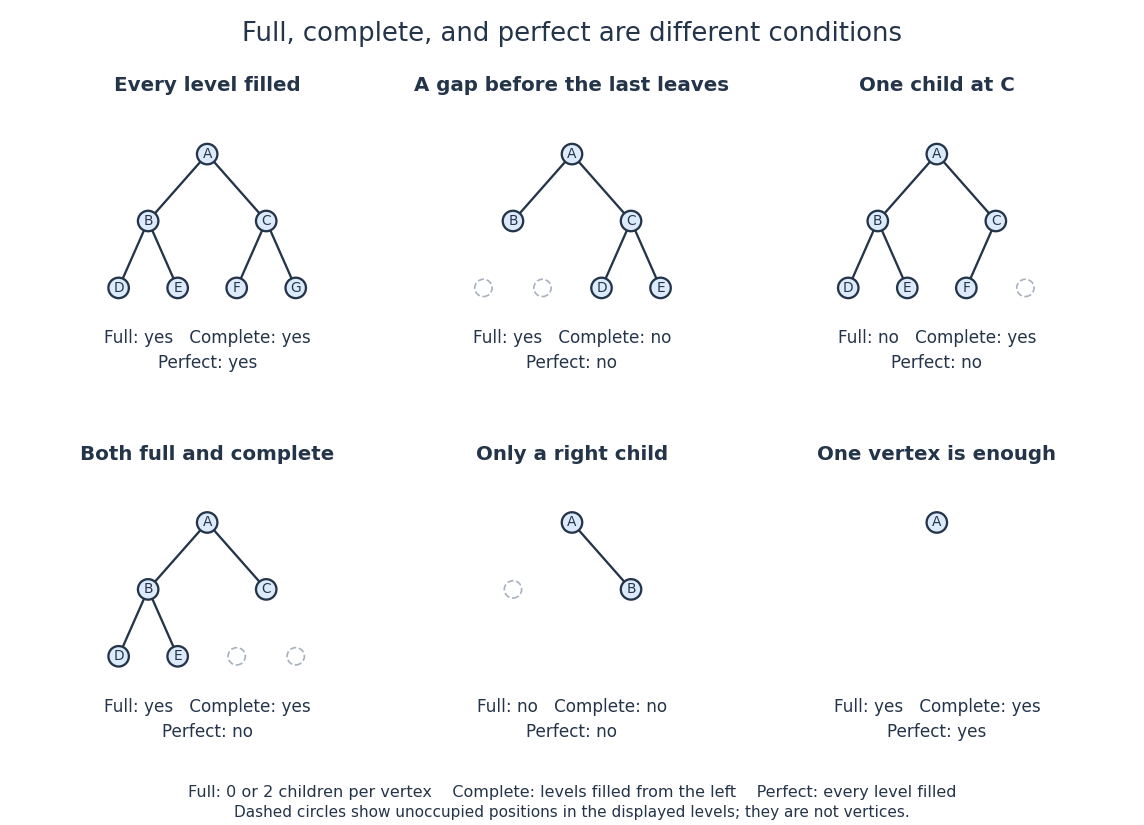
Full binary trees, complete binary trees, and perfect binary trees impose different shape conditions
. Each panel states all three properties. Outlined positions expose gaps in the last level. In particular, the five-vertex example in the lower left is both full and complete but is not perfect. Details.
For a six-vertex example, give two children in a rooted tree , give two children in a rooted tree , and give only a left child . The levels have vertices, and the last occupies its first three positions, so this is a complete binary tree. It is not a full binary tree, since has exactly one child. Moving to the right slot of preserves and height of a binary tree , but leaves a gap before and destroys completeness. Merely keeping the deepest vertices near the left side is insufficient; every earlier position must be occupied.
Number positions by the left-to-right level order of breadth-first search, beginning with root position . The children of position have positions and . A nonempty complete binary tree occupies exactly positions , so its height of a binary tree is : positions form level . This consecutive occupancy explains the compact array representation of a binary heap, while heap order is a separate condition on values. Neither completeness nor the binary tree definition supplies the binary search tree ordering rule.
Full binary tree Created 2026-10-13 Updated 2026-10-14
A full binary tree is a binary tree in which every nonleaf has exactly two children in a rooted tree; equivalently, no vertex has just one child.[ref]
9.1 Binary trees. Data Structures and Algorithms, section 9.1.1: full shape and Huffman coding tree example
A binary Huffman code with at least two positive-probability symbols has a full code tree: a vertex with only one child could be suppressed to shorten all codewords below it.
Let have children in a rooted tree , and let have children in a rooted tree , with leaves. Every vertex has zero or two children in a rooted tree, so this five-vertex binary tree is full. It is not a complete binary tree: level has empty positions under before the occupied positions under . Instead put under and leave a leaf. The resulting five-vertex binary tree is both full and complete, yet is not a perfect binary tree because its leaves occur at two different distances from the root of a tree.
If a nonempty finite full binary tree has nonleaf vertices and leaves, then its edges can be counted as , two leaving each nonleaf, or as , using the tree count. HenceThus is odd, but odd size alone does not imply fullness: a three-vertex chain is a counterexample. Nor does fullness guarantee small height of a binary tree. Repeatedly give one continuing vertex a leaf in one slot and another continuing vertex in the other, ending with two leaves. With nonleaf vertices, this constructs a full binary tree of vertices and height of a binary tree . The two-children rule permits height growing linearly with size.
Height of a binary tree Created 2026-10-13 Updated 2026-10-14
For a nonempty binary tree, the largest number of edges on a downward graph path from its root of a tree to a leaf. A single vertex has height of a binary tree ; a chain of vertices has height of a binary tree . A convenient recursion convention assigns an empty binary tree height , giving for the left and right subtrees. A binary search tree lookup visits at most vertices.
The convention counts edges, rather than vertices on the longest graph path. Its recursive form is[ref]
For a leaf, both subtrees are empty, giving . For the mixed four-vertex example, , , and . The four-vertex chain has height of a binary tree . A convention that counts vertices would add one to every nonempty binary tree height, so a height formula must specify its convention.
At distance from the root of a tree, there are at most vertices: each vertex in the preceding level has at most two children in a rooted tree. Summing this geometric series and using the longest graph path gives, for ,The upper bound is attained by a chain; a perfect binary tree attains the capacity bound. For , the minimum possible height of a binary tree is , as in the mixed example, while the maximum is . The binary tree definition permits both extremes. Small height of a binary tree bounds the length of a directed lookup in a binary search tree; evaluating the height of a binary tree by the displayed structural recursion still examines all vertices, requiring time complexity under constant-cost child access and arithmetic.
Perfect binary tree 2026-10-14
A nonempty binary tree in which every level, including the deepest, contains all its possible vertices. Equivalently, it is a full binary tree whose leaves are all at the same graph distance from the root of a tree.[ref]
9.1 Binary trees. Data Structures and Algorithms, section 9.1.1: perfect shape, equal leaf levels, and Figure 9.4
Every perfect binary tree is both a full binary tree and a complete binary tree; the five-vertex example above shows that the converse fails even when both properties hold. These definitions fix the terminology used here.
For height of a binary tree , the level sizes are , giving by a geometric series. There are leaves. The seven-vertex example has level sizes and height of a binary tree ; the single-vertex binary tree is already perfect, with . More generally, joining two perfect binary trees of equal height of a binary tree under a fresh root of a tree gives the next such shape. Equal heights are essential: fullness alone allows unequal leaf distances. A perfect binary tree realizes the maximum number of vertices for its height of a binary tree, making the exponential capacity behind short lookup graph paths visible.
// Target: probability-and-statistics.bigb