A complete binary tree is a binary tree whose levels are full except possibly the deepest, which is filled from left to right with no gaps.[ref]
9.1 Binary trees. Data Structures and Algorithms, section 9.1.1: complete shape and binary heap example
Here a level groups vertices by their graph distance from the root of a tree. A binary heap uses this shape to maintain logarithmic height of a binary tree. Completeness differs from the two-children condition of a full binary tree.
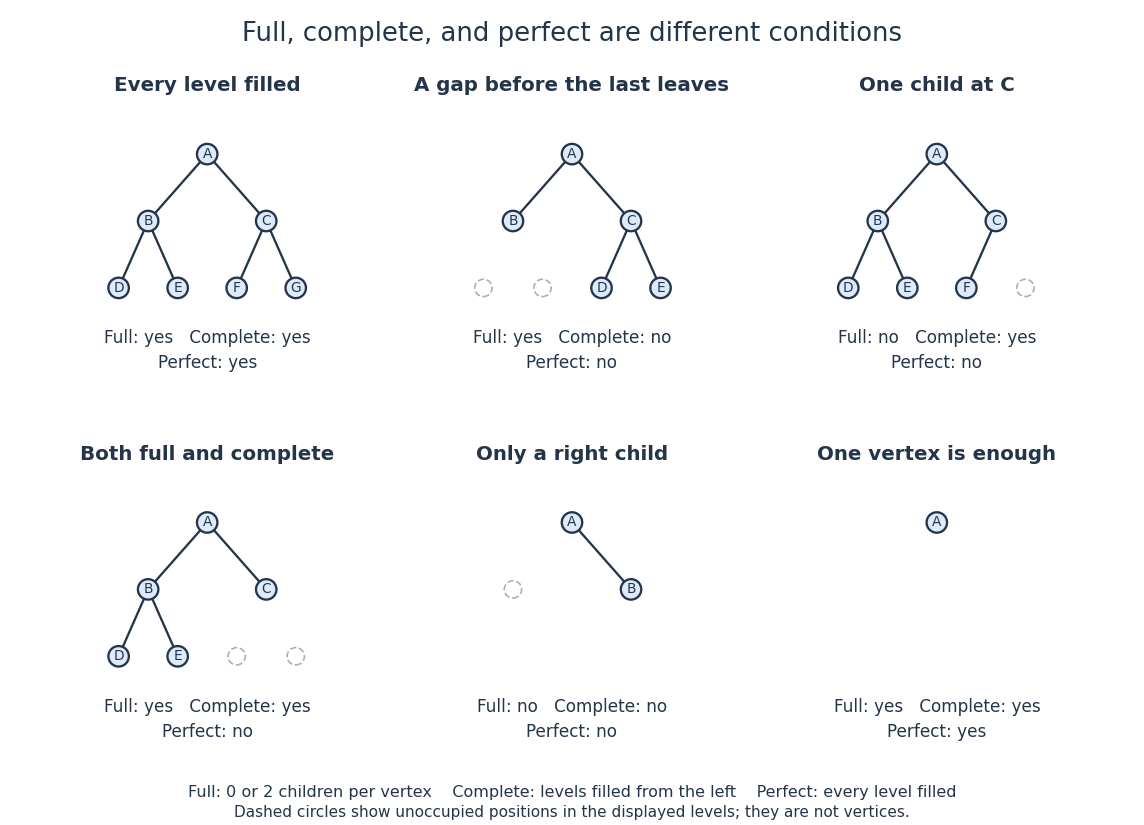
Full binary trees, complete binary trees, and perfect binary trees impose different shape conditions
. Each panel states all three properties. Outlined positions expose gaps in the last level. In particular, the five-vertex example in the lower left is both full and complete but is not perfect. Details.
For a six-vertex example, give two children in a rooted tree , give two children in a rooted tree , and give only a left child . The levels have vertices, and the last occupies its first three positions, so this is a complete binary tree. It is not a full binary tree, since has exactly one child. Moving to the right slot of preserves and height of a binary tree , but leaves a gap before and destroys completeness. Merely keeping the deepest vertices near the left side is insufficient; every earlier position must be occupied.
Number positions by the left-to-right level order of breadth-first search, beginning with root position . The children of position have positions and . A nonempty complete binary tree occupies exactly positions , so its height of a binary tree is : positions form level . This consecutive occupancy explains the compact array representation of a binary heap, while heap order is a separate condition on values. Neither completeness nor the binary tree definition supplies the binary search tree ordering rule.
Articles by others on the same topic
There are currently no matching articles.