A binary heap represents a priority queue as a complete binary tree obeying a heap order. We use the minimum convention: the priority of every parent in a rooted tree is no greater than the priorities of its children in a rooted tree. Equal priorities are allowed. Each stored entry may be a record carrying a priority key; the numerical example below displays only keys. Reversing the inequalities gives the maximum convention.
The complete binary tree can be stored directly in a zero-indexed array : read its levels from top to bottom, left to right. The root of a tree is at index . The possible children in a rooted tree of index are at and , and an index denotes a present entry only when it is less than . For , its parent in a rooted tree is at , using the floor function. Thus the links of the complete binary tree are determined by arithmetic rather than separately stored pointers.
ConsiderThe children in a rooted tree of index have keys ; those of index have keys ; those of index have keys . The six comparisons , , , , , establish the heap order. At index , the parent in a rooted tree is index , carrying key .
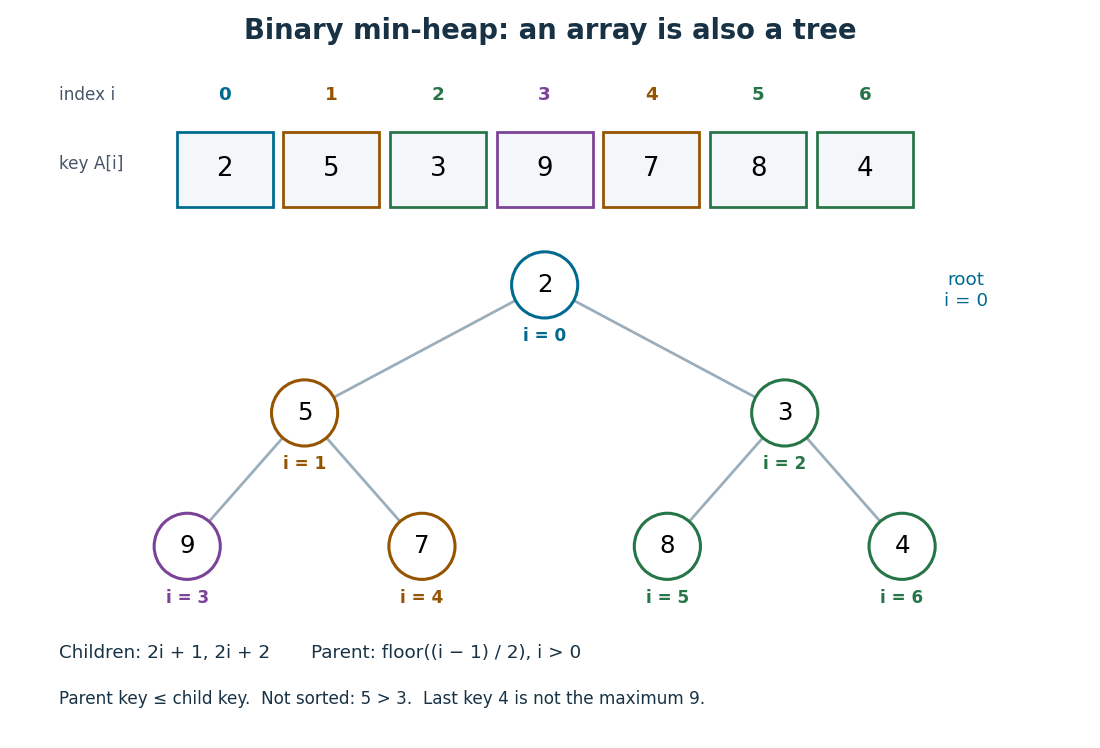

The array is visibly not a sorted array: precedes , and precedes . Nor is the last entry a maximum: it is , whereas the maximum is at index . The heap order compares ancestors and descendants, without imposing an order between separate branches. Nevertheless, following the graph path from the root of a tree to any entry gives a chain of nondecreasing priorities. This short argument proves that
peek can return , a minimum, without inspecting the other entries.Insertion appends an entry to the array, preserving the shape of the complete binary tree, then uses sift up to repair the heap order. Insert key into the displayed binary heap. It is appended at index , and exchanges with indices , , then :The moving key follows ; the keys each move down one level. Only this chain needs repair.
Now apply
extract-min. Save key , move the last key to the root of a tree, and shorten the array to length . Use sift down, always choosing the smaller of the present children in a rooted tree:First exchanges with key at index , since ; then with key at index , since . At index , the possible children in a rooted tree would be indices , both outside the shortened array, so the process stops. The returned key is , and the remaining binary heap is exactly the original one.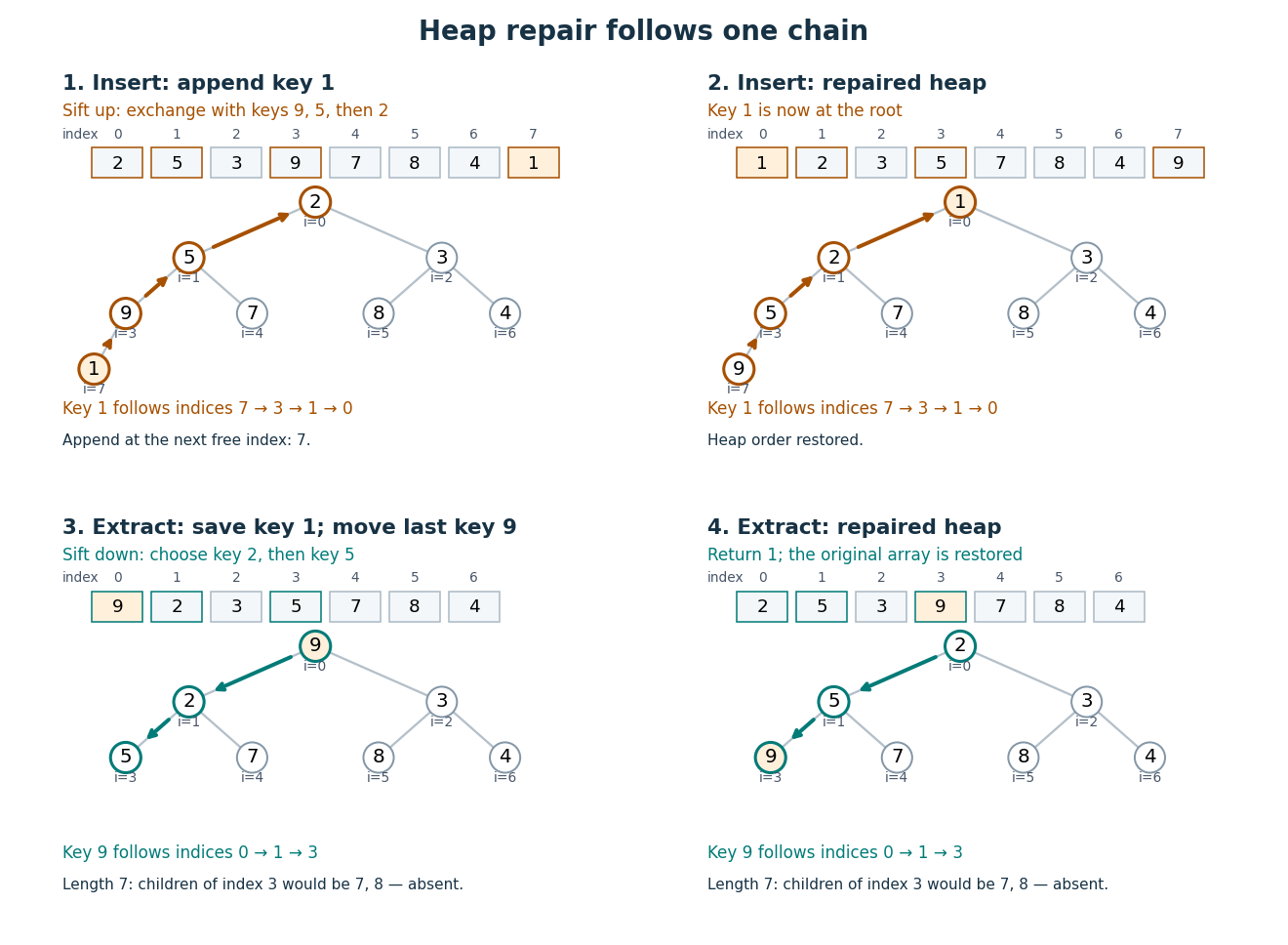

For a nonempty binary heap with entries, the deepest level is , using the floor function and logarithm. Each exchange moves one level and uses only a bounded number of comparisons. The resulting time complexity bounds, expressed in Big O notation, are:
| Operation | Time complexity | Reason |
|---|---|---|
peek | Read the root of a tree. | |
| Insert | for | Append, then sift up through at most the levels of the complete binary tree. |
extract-min | for | Move the last entry, then sift down through at most those levels. |
| Build from an arbitrary array | Apply sift down from the last index with children in a rooted tree back to index . |
These bounds assume constant-cost indexed access, key comparisons and exchanges, and available array capacity for insertion. Allocating and copying a larger array is a separate cost. Empty and one-entry cases take constant work.
To build a binary heap, begin at index and work backwards. Entries without children in a rooted tree already obey the heap order. Each sift down, also called heapify down, starts with every present smaller rooted tree below it already repaired. Most entries are close to the bottom and can move very little; successively longer repair distances occur for geometrically fewer entries. Summing these distances gives work, rather than charging to every entry. MIT's notes give this bottom-up construction and contrast it with repeated insertion.[ref]
https://ocw.mit.edu/courses/6-006-introduction-to-algorithms-spring-2020/40d4851e550507ca14dc778b9b2266cc_MIT6_006S20_lec8.pdf. MIT 6.006, lecture 8: implicit indices, heap repair and linear build, pp. 3–6
The Dijkstra algorithm additionally needs to decrease the priority of an existing vertex when its tentative distance improves. Given its current index, lowering the key followed by sift up takes time for . An indexed binary heap maintains a separate map from item identity to its current index and updates that map after every exchange. For vertices numbered in a fixed range, the map can be another array, giving constant-time index lookup. An ordinary unindexed binary heap supplies no such guarantee: locating an arbitrary item can require scanning entries. Item identity and priority must remain distinct, especially when several vertices have equal tentative distances.
The attractive compromise is local organization with global usefulness. A binary heap maintains only the heap order, yet every
extract-min gives the next smallest key. Repeated extraction of the original example gives , so a priority queue also supplies a sorting algorithm without storing a sorted array between extractions. Articles by others on the same topic
There are currently no matching articles.