Why not accept every delayed pulse? A longer window captures more genuine neutron capture signals, but also admits more accidental coincidences. Consider an original model with a capture waiting time following an exponential distribution of mean . Assume detection after a prompt signal accepts , with perfect time measurement and no lower cut. Integrating the normalized density givesThis assumes that moderation, competing capture channels, boundaries and electronic recovery can be represented or neglected in a single effective waiting-time model. It is not a fitted historical capture law.
Let independent prompt-like and delayed-like background streams have Poisson process rates and . The accidental coincidence pair rate in a directed window of full width is . Electronics producing at most one accepted delayed match per prompt instead give . These definitions coincide to first order when . Correlated backgrounds, such as one external neutron producing both a prompt recoil and a later capture, require separate controls; an independent-stream estimate cannot remove them.
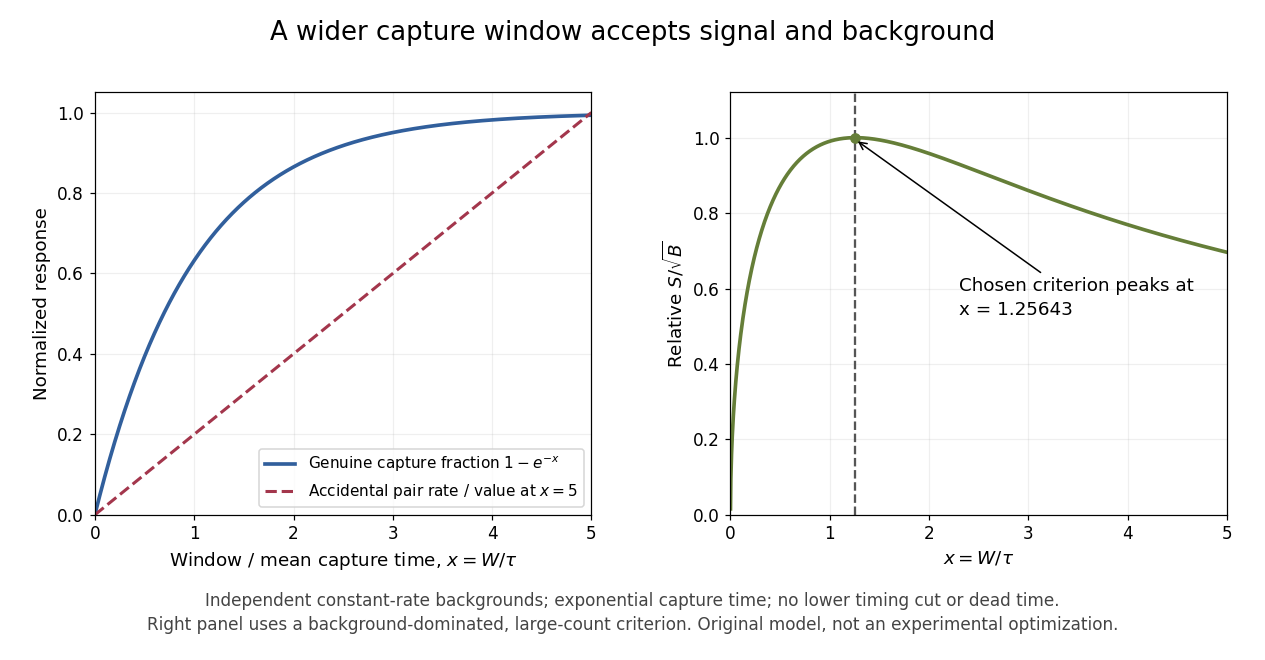

For chosen and , the accepted fraction is . With chosen and , the pair rate is , while the at-most-one rate is approximately . These are teaching parameters, not reported Savannah River rates. A measured uncorrelated background can be tested using displaced time windows; a reactor-off measurement addresses a different question and cannot by itself characterize every reactor-correlated background.
If genuine pairs arrive at rate before the timing cut, an exposure gives and expected accidental pairs . In a background-dominated large-count approximation, maximizing reduces to maximizing for . Differentiation gives the positive stationary solution , or . The endpoint solves the rearranged equation but is outside the domain of this derivative calculation; tends to zero at both positive-domain extremes.
Thus the chosen gives for this particular criterion, accepting about of genuine delayed signals. This differs from maximizing signal counts alone, which would favor longer windows. Small samples, appreciable signal fluctuations, unknown background, dead time and multiple-candidate vetoes require a fuller likelihood model. The calculation isolates a tradeoff rather than prescribing an experimental cut.
Articles by others on the same topic
There are currently no matching articles.