In the reaction displayed here, an electron antineutrino interacts with a proton to produce a Positron and a neutron. It turns an otherwise hard-to-observe incident particle into two products with different detection signatures. A prompt Positron signal followed by neutron capture can identify a candidate much more selectively than a single energy deposit. Inverse beta decay is a weak interaction; the incident electron antineutrino is detected through its reaction products.
The neutron and Positron together have more rest mass than the initial proton, so a finite incident energy is necessary even before recoil is considered. In the proton's rest frame, use four-momentum conservation and a negligible neutrino mass. The initial squared center-of-mass energy is ; the least final squared center-of-mass energy is . Equating them gives the threshold above. At threshold the final particles share one center-of-mass velocity; they are not both at rest in the laboratory.
Writing , the result separates intoThe positive second term is the laboratory recoil correction. With rounded rest energies , and , the calculated threshold is about . These rounded inputs follow the recommended particle masses.[ref]
Fundamental Physical Constants — Complete Listing by National Institute of Standards and Technology and others. 2022 CODATA adjustment, proton, neutron and electron mass-energy equivalents in MeV
As a further ideal energy balance, suppose the Positron stops and annihilates with an Electron, and all prompt annihilation gamma rays are contained. Its prompt visible energy is . Neglecting neutron recoil gives . Escaping gamma rays, detector response and recoil change that measured sum. The delayed capture signal is a separate energy deposit, not an extra contribution to the incident electron antineutrino's prompt energy reconstruction.
Clyde Cowan, Frederick Reines and collaborators tested whether a particle produced by a nuclear reactor could interact again after leaving its source. At Savannah River, water targets containing cadmium chloride lay between liquid scintillators. Opposite detectors recorded prompt positron annihilation gamma rays; Neutron moderation preceded delayed neutron capture signals in cadmium. The arrangement used two target layers and three scintillator layers, with the middle scintillator shared.[ref]
The Neutrino: From Poltergeist to Particle by Frederick Reines. Printed pp. 210–212, Figs. 4–5; individual Washington reproduction
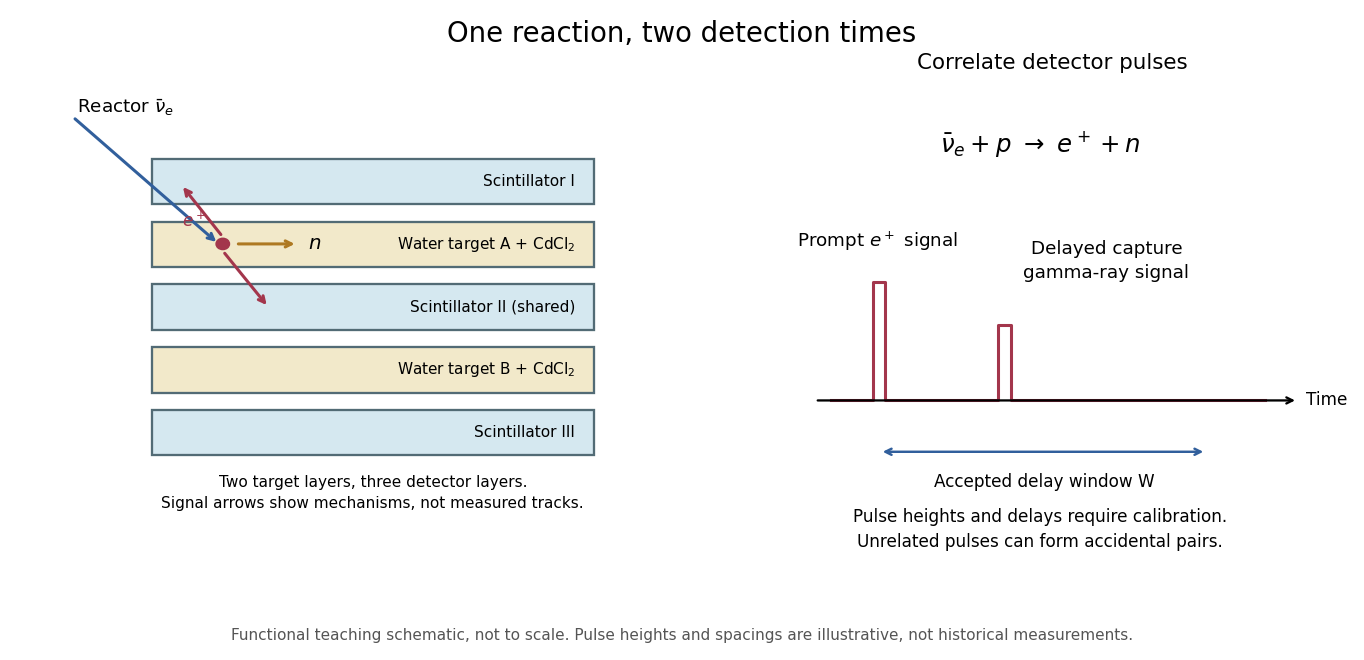
Separate prompt and delayed readouts of an antineutrino interaction
. Details. The original functional diagram separates the two signal mechanisms and their timing. It omits dimensions and phototube counts, and is not a reproduction of a historical drawing. The measured objects are detector pulses; identifying their common cause also requires calibration and background tests.
The 1956 paper describes positron-source and neutron-source calibrations, pulse-height gates and photographic pulse records. Diluting the target with heavy water halved the proton density and reactor signal while preserving neutron-detection efficiency. Changing the cadmium concentration altered capture timing; removing it removed the reactor signal. Added shielding tested competing external radiation. These interventions tested the reaction's ingredients, beyond simply observing a reactor-dependent count rate.[ref]
Detection of the Free Neutrino: a Confirmation by Clyde Cowan and others. pp. 103–104, detector analysis and Experimental Results, tests 2–5
Why not accept every delayed pulse? A longer window captures more genuine neutron capture signals, but also admits more accidental coincidences. Consider an original model with a capture waiting time following an exponential distribution of mean . Assume detection after a prompt signal accepts , with perfect time measurement and no lower cut. Integrating the normalized density givesThis assumes that moderation, competing capture channels, boundaries and electronic recovery can be represented or neglected in a single effective waiting-time model. It is not a fitted historical capture law.
Let independent prompt-like and delayed-like background streams have Poisson process rates and . The accidental coincidence pair rate in a directed window of full width is . Electronics producing at most one accepted delayed match per prompt instead give . These definitions coincide to first order when . Correlated backgrounds, such as one external neutron producing both a prompt recoil and a later capture, require separate controls; an independent-stream estimate cannot remove them.
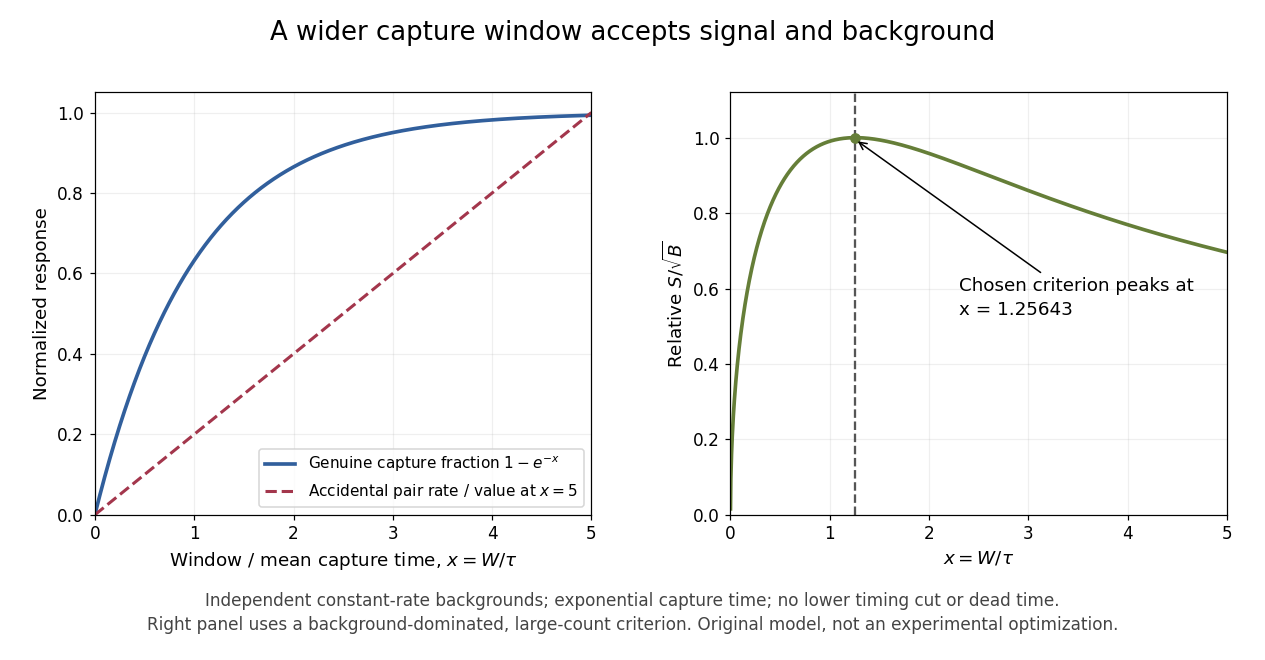
For chosen and , the accepted fraction is . With chosen and , the pair rate is , while the at-most-one rate is approximately . These are teaching parameters, not reported Savannah River rates. A measured uncorrelated background can be tested using displaced time windows; a reactor-off measurement addresses a different question and cannot by itself characterize every reactor-correlated background.
If genuine pairs arrive at rate before the timing cut, an exposure gives and expected accidental pairs . In a background-dominated large-count approximation, maximizing reduces to maximizing for . Differentiation gives the positive stationary solution , or . The endpoint solves the rearranged equation but is outside the domain of this derivative calculation; tends to zero at both positive-domain extremes.
Thus the chosen gives for this particular criterion, accepting about of genuine delayed signals. This differs from maximizing signal counts alone, which would favor longer windows. Small samples, appreciable signal fluctuations, unknown background, dead time and multiple-candidate vetoes require a fuller likelihood model. The calculation isolates a tradeoff rather than prescribing an experimental cut.
Articles by others on the same topic



Inverse beta decay is a process that occurs in certain types of interactions in particle physics, specifically in the context of weak interactions involving neutrinos. In this process, a neutrino interacts with a neutron, resulting in the transformation of the neutron into a proton while effectively producing an electron (or positron, depending on the type of neutrino) in the process.