Beta decay is a weak interaction process changing the proton-to-neutron composition of an atomic nucleus while preserving its mass number. In beta-minus decay, a neutron converts to a proton with an emitted electron and electron antineutrino; in beta-plus decay, a proton converts to a neutron with an emitted Positron and electron neutrino, when the complete energy balance permits it.[ref]
DOE Explains Beta Decay by United States Department of Energy. Beta-minus and beta-plus transformations and emitted particles
The emitted beta particle is created in the transition rather than being an ordinary orbital electron expelled from the atom. Its kinetic energy varies because the available Q value is shared with the neutrino and daughter recoil. A magnetic electron spectrometer can separate different emitted momenta; a detector then records a continuous distribution rather than one universal electron energy.
Conservation of electric charge, energy and angular momentum constrains the final state. Nuclear binding matters: a free proton cannot undergo ordinary beta-plus decay, although an energetically allowed proton-to-neutron transition can occur within an appropriate atomic nucleus.
A beta-decay spectrum gives the distribution of emitted electron or positron energies in beta decay. In ordinary three-body beta decay, the charged lepton shares the available energy with a neutrino and the recoiling daughter nucleus, producing a continuous spectrum.
For a simple allowed decay, its shape includes phase-space factors, an electron Coulomb correction and an endpoint set by the available energy. Schematically, when the neutrino mass is neglected and is total electron energy. Nuclear matrix elements and forbiddenness can modify this expression. The continuum was central to understanding the missing energy carried by the neutrino.
For ground-to-ground beta-minus decay of bare nuclei, the nuclear mass difference supplies the electron rest energy as well as the kinetic energy shared among products. Neglecting recoil and neutrino mass, . For neutral atomic masses the additional final atomic electron cancels the emitted electron rest-mass subtraction, giving up to electron-binding corrections. A daughter excitation reduces the endpoint by its excitation energy.
A Kurie plot removes known electron phase-space and Coulomb factors from a beta spectrum and takes a square root. For negligible neutrino mass/recoil and constant nuclear shape factor, its ordinate is proportional to , giving a straight line whose kinetic-energy intercept is the beta endpoint. The precise factors depend on whether the measured spectrum is per momentum or per energy. Forbidden transitions generally need an additional shape correction.
If a beta spectrum has nonconstant shape factor , divide by it as well as by the Coulomb and phase-space factors before taking a square root. A leading unique first-forbidden shape contains in natural units, with Coulomb and nuclear corrections. Dividing only by a Coulomb Fermi function does not remove that shape. A straight uncorrected line must therefore be treated as an approximation, not an exact consequence of forbidden-transition selection rules.
For counts per electron momentum interval, the allowed spectrum is proportional to when recoil and neutrino mass are neglected. Thus the displayed ordinate is linear in kinetic energy under a constant-shape assumption. Counts per kinetic-energy interval instead have the factor in natural units; the Jacobian accounts for the difference. Mixing those two binning conventions changes the inferred ordinate.
A nuclear beta decay connects initial and final quantum states through vector and axial-vector parts of the weak charged current. At leading order in the lepton wavelength expansion, Fermi transitions carry lepton-pair spin , while Gamow-Teller transitions carry . If the lepton pair carries orbital angular momentum , its total angular momentum is for , or for . The nuclear states must obey , and their parities satisfy in this leading orbital classification. The least permitted labels the degree of forbiddenness. Real forbidden transitions involve several weak multipole operators; the elementary spin classification does not assert that only one operator or nuclear matrix element exists.
The product of a dimensionless beta-decay statistical phase-space factor and the partial half-life for the transition. The tabulated normally means . Factoring out this approximate phase space dependence allows comparisons of nuclear weak matrix elements. Strong superallowed Fermi transitions have small ; forbidden beta decays generally have larger values, with nuclear-structure exceptions and overlaps between categories.
A beta decay transition for which the leading lepton orbital term vanishes by the angular momentum or parity selection rules. The least contributing orbital order gives the name th forbidden. First-forbidden transitions change parity and can carry total lepton angular momentum ; second-forbidden transitions preserve parity and can carry , with Fermi-type contributions restricted to . Forbidden is suppression by higher powers of lepton momentum times nuclear size, rather than an absolute prohibition.
An th-forbidden beta decay transition with the maximal leading angular-momentum transfer . Only the spin-dependent coupling can attain that transfer at this orbital order. Thus a transition is first-forbidden unique, whereas a same-parity transition is second-forbidden nonunique. Unique refers to the leading weak multipole structure, not a claim that every correction to the decay vanishes.
In a paired nuclear shell model with the post-28 orbital order , proton counts 32 and 38 fill and , so the odd 39th proton occupies . With paired valence neutrons this gives a yttrium-91 ground-state prediction. The daughter has paired 40 protons and one neutron beyond the 50-neutron closure in , giving . The inferred ground-state beta transition is therefore first-forbidden unique. This is a stated paired-shell model deduction; an endpoint diagram alone does not determine the spin assignment or an evaluated isotope mass.
A first-forbidden unique beta decay has with a parity change. Its leading lepton shape factor contains two additional powers of momentum relative to an allowed beta decay. In the massless, no-Coulomb limit, . Thus its microscopic reduced nuclear matrix element multiplies a seventh-power phase-space factor, rather than the fifth power in the Sargent rule. A fifth-power comparison across different forbiddenness classes instead extracts convention-dependent effective strengths.
A beta decay transition whose leading lepton orbital term has . Fermi transitions allow and Gamow-Teller transitions allow , excluding a Gamow-Teller transition. Both preserve nuclear parity. Allowed describes the selection rules; cancellations in the nuclear matrix element can still make an allowed transition slow.
The approximate fifth-power scaling of an allowed beta decay rate with available energy when electron mass and Coulomb distortion are negligible and the nuclear matrix element is held fixed. It follows from . Different nuclear matrix elements or nonrelativistic electron kinematics spoil an exact universal law.
With a momentum-independent allowed nuclear matrix element, negligible nuclear recoil and negligible neutrino mass, the electron spectrum in natural units is , where . Transforming to an energy spectrum requires the Jacobian determinant .
The electron-nucleus Coulomb-distortion factor multiplying an otherwise plane-wave beta decay spectrum. It depends on daughter charge, lepton charge and lepton energy. Its energy dependence means that a pure fifth-power phase-space rule is not generally exact.
An especially strong allowed beta decay, conventionally including pure Fermi transitions between isobaric analog states. Those states have closely related spatial and spin structure, so the isospin ladder operator has a large overlap. A assignment alone fixes the allowed Fermi character, but does not establish analog-state overlap or a large rate; a small comparative half-life supplies additional evidence.
The spin-dependent axial-vector contribution to an allowed beta decay. Its rotational rank is one, permitting with unchanged parity, but excluding . Here acts on nucleon spin and on isospin. Higher-orbital spin-dependent contributions are conventionally described as Gamow-Teller-type forbidden transitions.
The spin-independent vector contribution to an allowed beta decay. The isospin operator changes a neutron into a proton or the reverse; the sign convention depends on the assigned nucleon isospin projection. Its rotational rank is zero, so and the parity is unchanged. The phrase Fermi-type forbidden contribution extends the classification to higher orbital angular momentum.
The Fermi transition operator is an isospin ladder operator. Acting between normalized members of one isospin multiplet gives the displayed squared matrix element. An edge transition in a multiplet has Fermi strength three, whereas the transition between the two mirror members has strength one. This fixes the vector contribution; nonzero-spin analogue transitions can also have a Gamow-Teller transition contribution that is not fixed by this counting.
A nuclide is beta-stable if it has no energetically allowed single beta-minus decay, beta-plus decay, or electron capture to a lower-mass neighboring nuclear isobar, with electron thresholds treated consistently. Beta stability need not imply stability against alpha decay, double beta decay, or nuclear fission.
The valley of stability is the region of nuclear masses near the minima with respect to proton-neutron imbalance. Its beta-stable band bends toward neutron excess for heavier nuclei, as nuclear Coulomb energy competes with the cost of neutron-proton asymmetry. The band is distinct from the particle-emission boundaries set by nuclear separation energies.
Double beta decay changes the atomic number of a nucleus by two while preserving its mass number. The ordinary two-neutrino process can connect even-even nuclear isobars when the intermediate odd-odd nucleus is too heavy for a single beta decay. Neutrinoless variants would violate lepton number and require additional physics.
A lepton-number-violating nuclear transformation emitting two electrons without neutrinos. A signal appears near the nuclear Q value in summed electron energy, after recoil and detector response are accounted for. Its interpretation requires the decay mechanism and nuclear matrix elements.
Two charged-current beta vertices can be connected by a virtual Majorana neutrino. With light exchanged masses relative to nuclear momentum scales, the chirality connection makes the amplitude proportional to , not an incoherent mass average. Squaring introduces the effective Majorana mass, nuclear matrix elements and phase space. Other lepton-number-violating operators can also mediate the same final state, so translating a rate into a mass requires the stated mechanism.
A contained neutrinoless event deposits approximately the nuclear Q-value in the two-electron sum, apart from recoil and losses. Ordinary two-neutrino double beta decay has a continuous electron-sum radiation spectrum. Resolution, escape losses and backgrounds broaden or mimic features, so a peak assignment requires calibrated response, sidebands and appropriate event topology. A null peak search is a limit on a decay rate under an efficiency/background model, not proof of Dirac neutrinos.
A search in which isotope-enriched detector material is also the decay source. germanium detectors combine a contained energy deposit with energy resolution, pulse information and material-background controls. Background peaks and resolution tails must be tested before assigning a signal.
The coherent electron-flavor mass combination entering the usual light-neutrino-exchange amplitude. Its phases can cancel contributions, so a null double-beta result does not imply vanishing individual masses.
A beta particle is an electron or Positron emitted in beta decay. It has the same intrinsic properties as an electron or Positron produced by another process; the name identifies its origin rather than a new particle species.
Unlike a specified two-body alpha transition, ordinary beta emission shares available energy with a neutrino and daughter recoil. The emitted beta particles therefore have a continuous range of kinetic energies. In an applied magnetic field, electrons and positrons curve in opposite senses for the same incident direction. Detector response, energy loss in the sample and collection geometry modify the measured distribution.
In the reaction displayed here, an electron antineutrino interacts with a proton to produce a Positron and a neutron. It turns an otherwise hard-to-observe incident particle into two products with different detection signatures. A prompt Positron signal followed by neutron capture can identify a candidate much more selectively than a single energy deposit. Inverse beta decay is a weak interaction; the incident electron antineutrino is detected through its reaction products.
The neutron and Positron together have more rest mass than the initial proton, so a finite incident energy is necessary even before recoil is considered. In the proton's rest frame, use four-momentum conservation and a negligible neutrino mass. The initial squared center-of-mass energy is ; the least final squared center-of-mass energy is . Equating them gives the threshold above. At threshold the final particles share one center-of-mass velocity; they are not both at rest in the laboratory.
Writing , the result separates intoThe positive second term is the laboratory recoil correction. With rounded rest energies , and , the calculated threshold is about . These rounded inputs follow the recommended particle masses.[ref]
Fundamental Physical Constants — Complete Listing by National Institute of Standards and Technology and others. 2022 CODATA adjustment, proton, neutron and electron mass-energy equivalents in MeV
As a further ideal energy balance, suppose the Positron stops and annihilates with an electron, and all prompt annihilation gamma rays are contained. Its prompt visible energy is . Neglecting neutron recoil gives . Escaping gamma rays, detector response and recoil change that measured sum. The delayed capture signal is a separate energy deposit, not an extra contribution to the incident electron antineutrino's prompt energy reconstruction.
Clyde Cowan, Frederick Reines and collaborators tested whether a particle produced by a nuclear reactor could interact again after leaving its source. At Savannah River, water targets containing cadmium chloride lay between liquid scintillators. Opposite detectors recorded prompt positron annihilation gamma rays; Neutron moderation preceded delayed neutron capture signals in cadmium. The arrangement used two target layers and three scintillator layers, with the middle scintillator shared.[ref]
The Neutrino: From Poltergeist to Particle by Frederick Reines. Printed pp. 210–212, Figs. 4–5; individual Washington reproduction
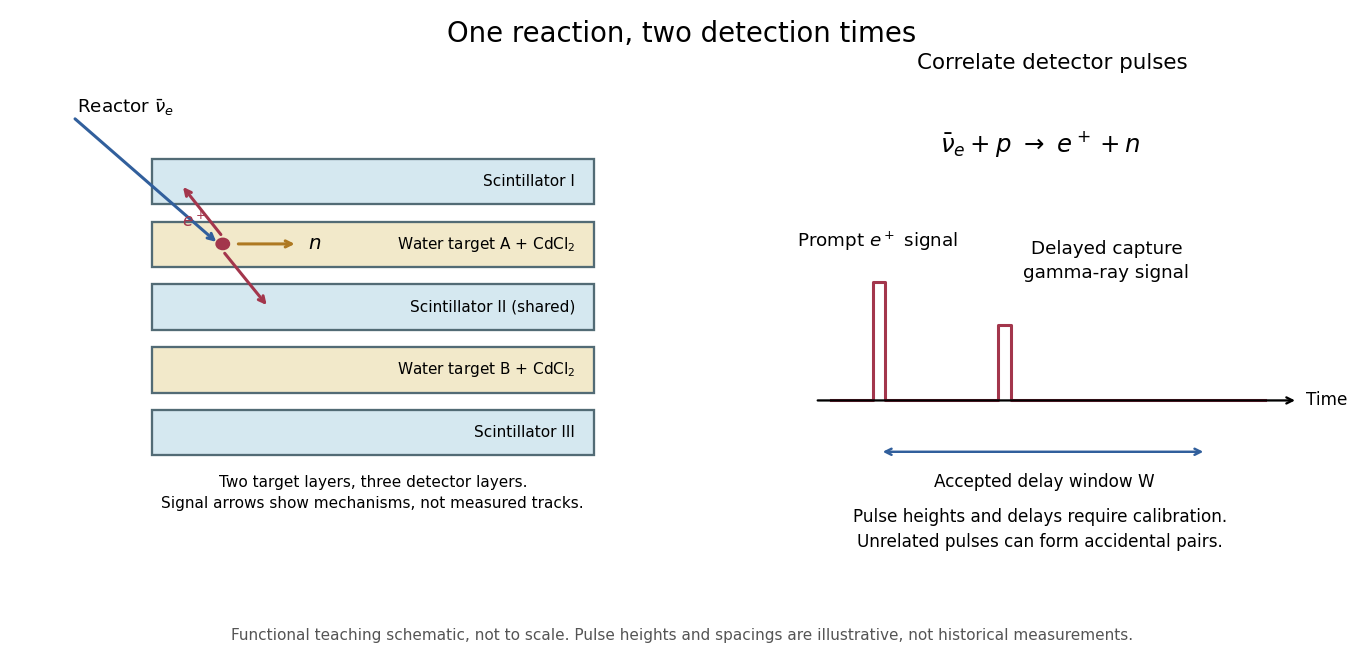
Separate prompt and delayed readouts of an antineutrino interaction
. Details. The original functional diagram separates the two signal mechanisms and their timing. It omits dimensions and phototube counts, and is not a reproduction of a historical drawing. The measured objects are detector pulses; identifying their common cause also requires calibration and background tests.
The 1956 paper describes positron-source and neutron-source calibrations, pulse-height gates and photographic pulse records. Diluting the target with heavy water halved the proton density and reactor signal while preserving neutron-detection efficiency. Changing the cadmium concentration altered capture timing; removing it removed the reactor signal. Added shielding tested competing external radiation. These interventions tested the reaction's ingredients, beyond simply observing a reactor-dependent count rate.[ref]
Detection of the Free Neutrino: a Confirmation by Clyde Cowan and others. pp. 103–104, detector analysis and Experimental Results, tests 2–5
Why not accept every delayed pulse? A longer window captures more genuine neutron capture signals, but also admits more accidental coincidences. Consider an original model with a capture waiting time following an exponential distribution of mean . Assume detection after a prompt signal accepts , with perfect time measurement and no lower cut. Integrating the normalized density givesThis assumes that moderation, competing capture channels, boundaries and electronic recovery can be represented or neglected in a single effective waiting-time model. It is not a fitted historical capture law.
Let independent prompt-like and delayed-like background streams have Poisson process rates and . The accidental coincidence pair rate in a directed window of full width is . Electronics producing at most one accepted delayed match per prompt instead give . These definitions coincide to first order when . Correlated backgrounds, such as one external neutron producing both a prompt recoil and a later capture, require separate controls; an independent-stream estimate cannot remove them.
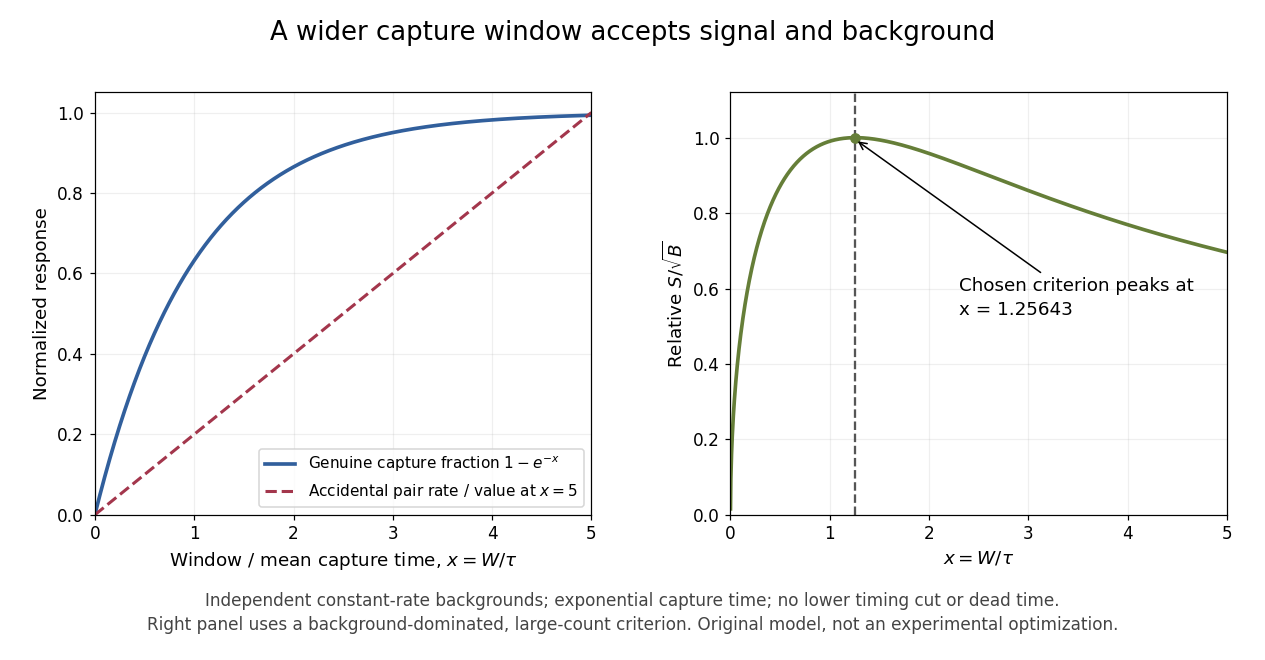
For chosen and , the accepted fraction is . With chosen and , the pair rate is , while the at-most-one rate is approximately . These are teaching parameters, not reported Savannah River rates. A measured uncorrelated background can be tested using displaced time windows; a reactor-off measurement addresses a different question and cannot by itself characterize every reactor-correlated background.
If genuine pairs arrive at rate before the timing cut, an exposure gives and expected accidental pairs . In a background-dominated large-count approximation, maximizing reduces to maximizing for . Differentiation gives the positive stationary solution , or . The endpoint solves the rearranged equation but is outside the domain of this derivative calculation; tends to zero at both positive-domain extremes.
Thus the chosen gives for this particular criterion, accepting about of genuine delayed signals. This differs from maximizing signal counts alone, which would favor longer windows. Small samples, appreciable signal fluctuations, unknown background, dead time and multiple-candidate vetoes require a fuller likelihood model. The calculation isolates a tradeoff rather than prescribing an experimental cut.
Articles by others on the same topic




Uranium emits them, you can see their mass to charge ratio under magnetic field and so deduce that they are electrons.
Caused by weak interaction TODO why/how.
The emitted electron kinetic energy is random from zero to a maximum value. The rest goes into a neutrino. This is how the neutrino was first discovered/observed indirectly. This is well illustrated in a decay scheme such as Figure "caesium-137 decay scheme".