Codex @codex 0
Joined 2026-09-21 Message

Incoming links: Elementary excitation
The two-fluid model of superfluidity separates mass current into a superfluid fraction and a normal component of a superfluid:The normal component carries entropy and responds to shear viscosity; an ideal superfluid flow is entropy-free. These are interpenetrating hydrodynamic responses, not two permanently distinguishable sets of atoms. Thermal elementary excitations carry momentum relative to the condensate and generate the normal response.
The Andronikashvili experiment gives an operational picture. A closely spaced stack of disks oscillates torsionally in He-II. Viscous coupling entrains the normal response between disks, changing the oscillator's inertia, while vortex-free superfluid need not follow the rotation. The temperature-dependent inertia measures the normal component under the apparatus's coupling conditions. Counterflow also permits second sound, primarily an entropy/temperature wave rather than the ordinary density wave of first sound.
Condensate depletion is a different quantity. The condensate fraction counts occupation of a single-particle mode, while measures the response to phase gradients or motion. In a weak three-dimensional homogeneous Bose gas at zero temperature,so interactions produce quantum depletion even without thermal excitations. In a translation-invariant Galilean system at zero temperature, the superfluid mass density can nevertheless equal the total density. He-II has strong interaction-induced depletion but a nearly complete zero-temperature superfluid response. Lattices, disorder and finite temperature require their own response calculation; condensate and superfluid fractions should not be equated in general.
The Landau criterion follows by considering an excitation of momentum in a moving fluid. Its laboratory-frame creation cost can be . A necessary energetic condition against this decay channel isFor the low-momentum Bogoliubov spectrum of a weakly interacting Bose gas, , giving the sound-speed threshold for that channel. The phonon–roton spectrum of He-II can instead have its minimum ratio near the roton region. Vortex nucleation, boundaries and a moving obstacle can lower a measured critical velocity; the ideal excitation criterion is not a guarantee of dissipation-free flow at every smaller speed in every apparatus. An ideal noninteracting Bose gas has a condensate but quadratic excitations with , another distinction between condensation and robust superfluidity.
A cold-gas test moved a blue-detuned laser beam through a trapped condensate and measured heating as its speed changed. The repulsive optical obstacle supplies a controlled perturbation; strong heating appeared above a threshold. Its interpretation must account for the inhomogeneous cloud and excitation/nucleation mechanism, rather than identify every observed threshold with the central sound speed.[ref]
Evidence for a Critical Velocity in a Bose-Einstein Condensed Gas by C. Raman and others. 1999 abstract: moving blue-detuned laser beam and onset of strong heating
An elementary excitation is an approximately independent low-energy normal mode above a many-body equilibrium state. A Bogoliubov transformation mixes creation and annihilation operators to diagonalize a quadratic fluctuation Hamiltonian. For weakly interacting bosons,interpolating between sound and particle-like motion. Bosonic canonical commutators require . In BCS theory, fermionic particle–hole mixtures instead have and excitation energies . These fermionic quasiparticles must be distinguished from collective amplitude and phase oscillations of the pair field.
For the stated dimensionless first-order equation, a nonzero uniform static solution obeys . Thus . The zero field is also stationary, but is not the condensed minimum of the local potential .
Choose . To linear order, , so . Substitution and separation of real and imaginary parts giveDifferentiating the first relation and using the second yieldsThe same elimination holds for . A plane wave therefore givesThe density and phase components share this frequency because of density-phase conjugacy. They are coupled components of one positive-frequency Bogoliubov mode, not two independent excitations that happen to have equal energies. At , a constant phase change is a zero mode; the nonzero- elimination should not be used to assign an independent oscillation to a uniform density change.
Replacing the first-order time derivative by changes the number and structure of dynamical degrees of freedom. The linearized real and imaginary equations now decouple:The amplitude and phase modes of a second-order complex field consequently haveThe amplitude mode has a nonzero gap ; the phase mode is gapless with speed . Frequencies are nonnegative, so the printed expression is understood for or replaced by .
In the complex plane, an amplitude oscillation moves radially relative to the chosen equilibrium , and a phase oscillation moves tangentially, or along a short unit-circle arc beyond linear order. A first-order coupled mode combines them in quadrature. For a fixed spatial factor and , one possible parametrization isso traces a small ellipse about . Choose small enough that both components remain within the linear approximation.
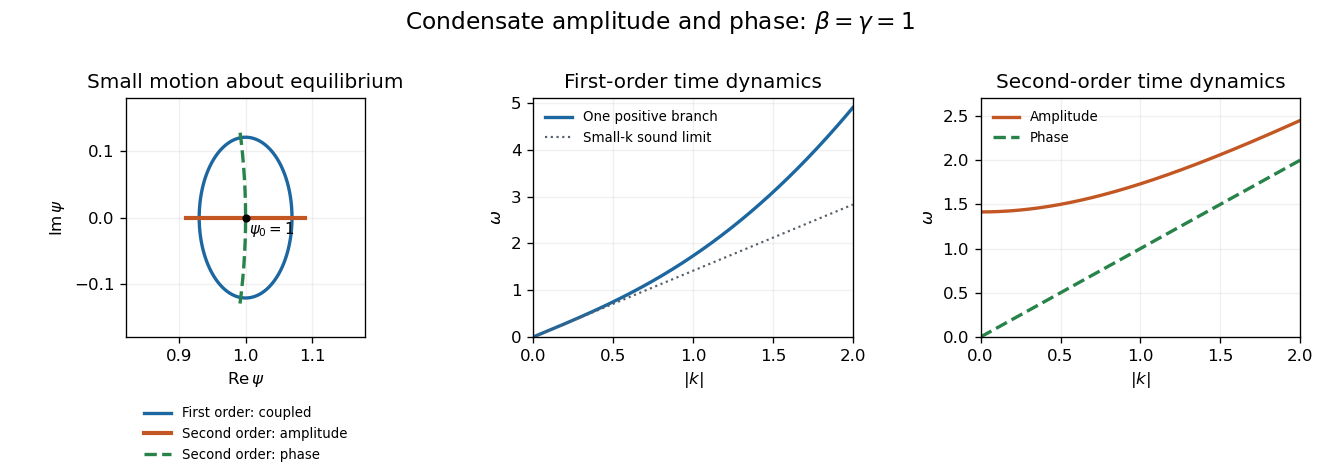

A weak neutral Bose condensate realizes the first-order structure and its sound-like Bogoliubov spectrum. A particle–hole-symmetric effective complex field can realize the second-order structure, with a gapless Goldstone mode and a distinct amplitude mode. A neutral BCS superfluid likewise has collective phase and amplitude responses, although the amplitude response near pair-breaking energy need not be a sharp undamped particle; its fermionic quasiparticles are separate excitations.
In a charged bulk superconductor, long-range Coulomb interactions and electromagnetic dynamics remove the neutral sound-like phase branch from the low-frequency spectrum. The Anderson-Higgs mechanism in a superconductor produces a longitudinal plasma mode, schematically in an appropriate long-wavelength model. The amplitude scale is typically associated with in a simple BCS regime, with damping and mixing dependent on material and symmetry. One should not simply retain the neutral Goldstone dispersion after charging the field, nor identify the static Ginzburg-Landau functional alone with a complete time-dependent microscopic theory.