A factor base is a finite set of small prime numbers over which selected auxiliary integers are completely factored. Some methods also record a sign coordinate for , which is not a prime number. A positive integer supported entirely on the chosen factor base gives an exponent vector; reducing that vector modulo two records which prime exponents are odd integers. The product is a square of a number precisely when every prime exponent is an even integer.
For the original toy , use factor base and the two relationsThe residues have exponent vectors and in the order . Adding the two vectors modulo two gives , so multiplying the residues gives . Consequentlyand and . Neither individual residue was a square; combining the relations made all exponents even.
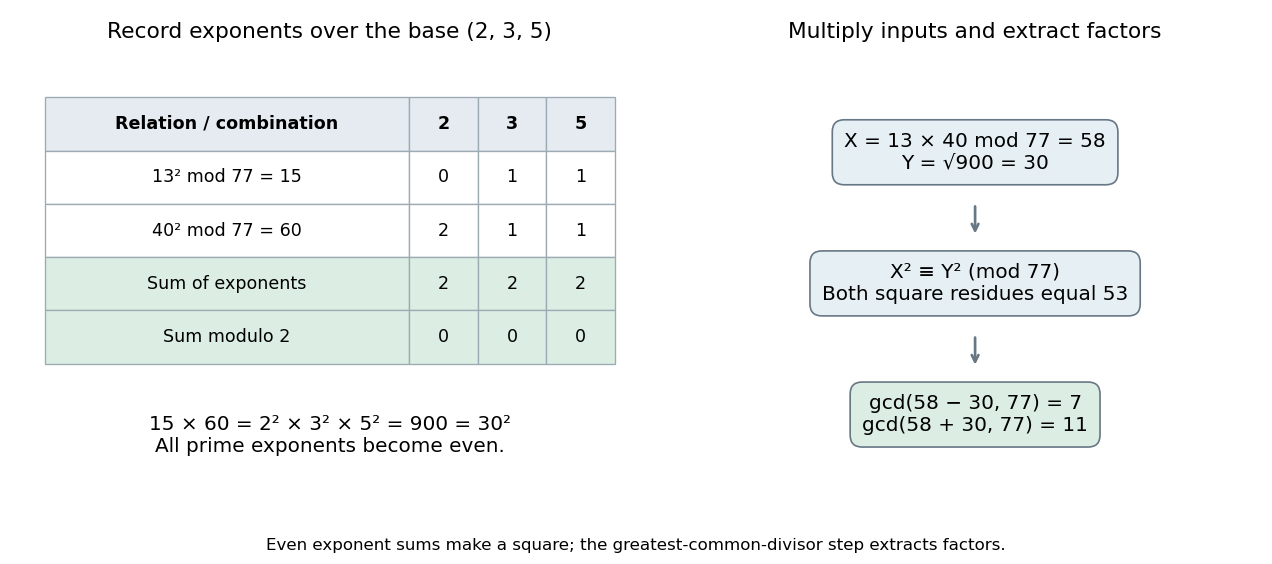

In a larger collection, choose relations with positive residues . If a nonempty selection has an even sum in every exponent coordinate, setThen . Finding such a selection is a linear dependence problem over the finite field : the indicator vector of the chosen relations belongs to the kernel of a linear map given by the parity matrix. This is why a problem about prime factors recruits linear algebra. The final congruence of squares may still be trivial, so another selection can be needed. [ref]
https://crypto.stanford.edu/pbc/notes/crypto/factoring.html. Ben Lynn, Factoring and Discrete Logarithms, Dixon's Algorithm: exponent matrix and kernel
.There is a tradeoff: a small factor base gives a smaller parity matrix, but fewer auxiliary integers factor completely over it. A larger factor base accepts more relations but makes the linear algebra larger. Negative auxiliary values need an additional sign coordinate, and a selected product needs even sign parity as well as even prime exponents. Pomerance's account explains this balance and the historical development of combining smooth relations; the toy example omits algorithm-specific sieving and running-time claims. [ref]
https://math.dartmouth.edu/~carlp/PDF/paper109.pdf. Carl Pomerance, A Tale of Two Sieves (1996), pp. 1475–1476: exponent parity, factor bases and signs
. Articles by others on the same topic
There are currently no matching articles.