A figurate number is an integer illustrated by a regular geometric arrangement of points. Triangular numbers and square numbers are basic examples: growing a prescribed shape turns a counting problem into a sequence of integers.
A triangular number counts rows of objects, with a nonnegative integer:The first values are . The empty arrangement contributes zero, by the empty sum convention. Adding one more row gives the triangular number recurrence for . The row lengths form an arithmetic progression, while their running totals are triangular numbers.
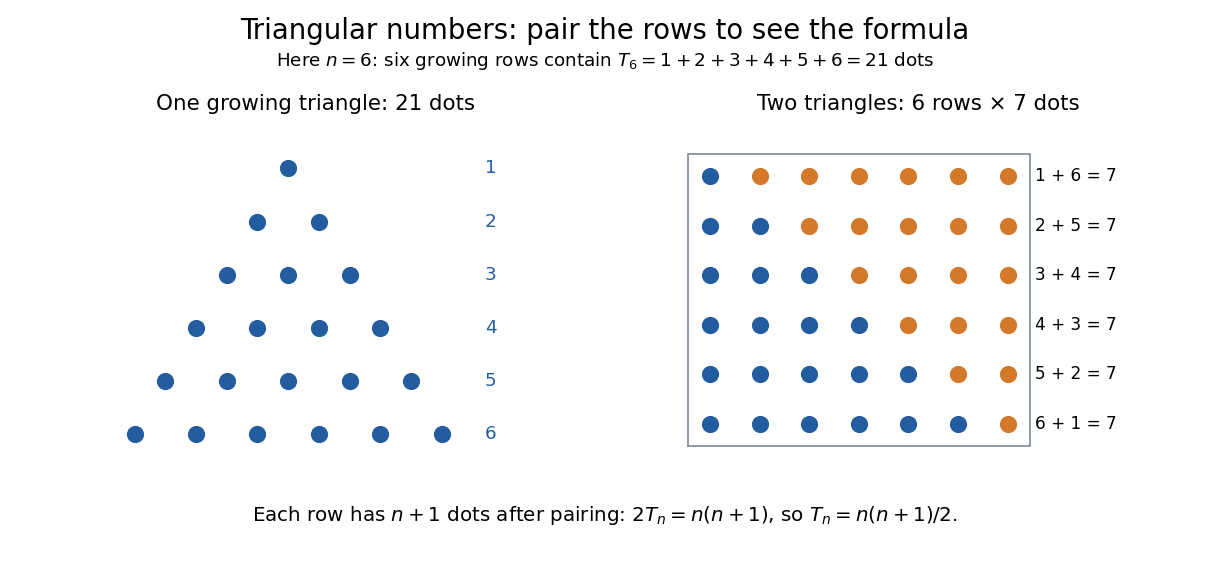
Pair the rows with a reversed copy: . There are such pairs, so two copies contain dots. Dividing by two proves the formula. This rectangle picture explains the factor one-half without requiring a formula for a long summation. For example, one hundred rows contain dots.
The same count appears whenever every pair of different objects must be considered once. Five participants make ten possible handshakes; five sensors have ten different pairwise comparisons; a complete graph on five vertices has ten edges. These are the triangular number pair-counting identity, with one fewer row than objects. The distinction prevents a common error: counts all pairs from six objects, whereas five objects give .
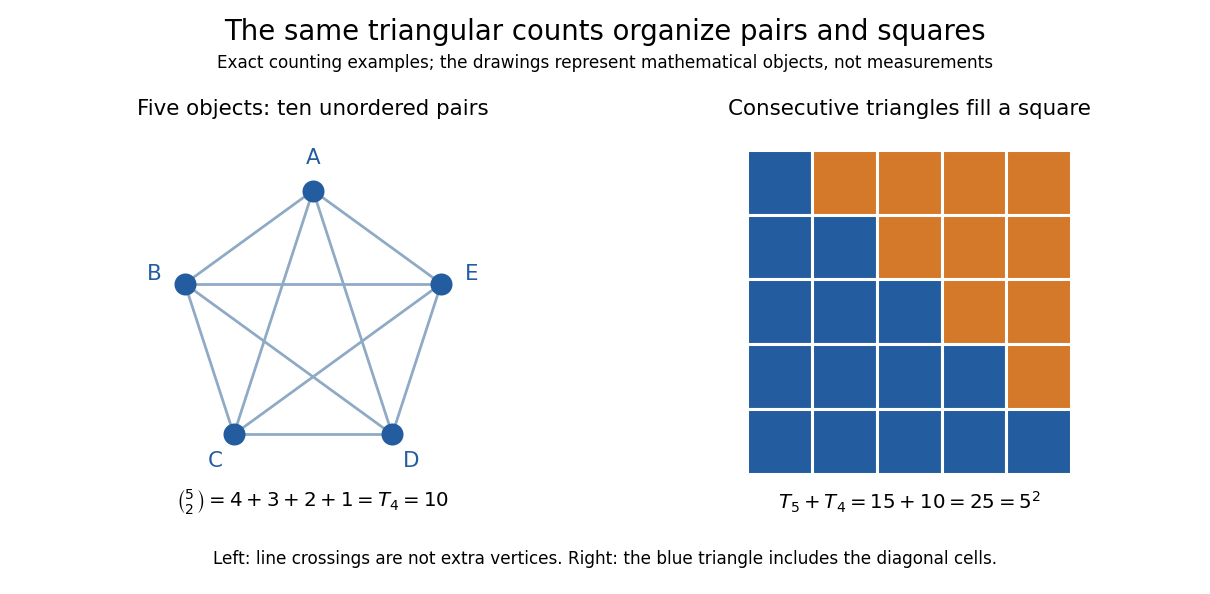
The triangular number square-complement identity says that two neighboring triangular numbers fill a square. Combining that identity with the one-row difference makes the difference of squares equal to . It leads to Nicomachus's theorem: the sum of the first cubes of numbers is the square of a number . A change in the way one groups objects exposes a relation between summation, multiplication and geometry.
This geometric view is already visible in Nicomachus's Introduction to Arithmetic by Nicomachus (Hahn teacher edition): Book II, Chapter 8 describes growing triangular rows, Chapter 12 combines successive triangular counts into squares, and Chapter 20 groups successive odd integers into cubes of numbers.[ref]
Introduction to Arithmetic by Nicomachus (Hahn teacher edition). Book II, Chapters 8, 12 and 20, printed pp. 63–64, 70 and 75
The linked edition uses Martin Luther D'Ooge's translation, revised with modern teaching material by Nathanael Hahn. Our empty-row index is a modern convention; the historical passage starts from unity and calls three the first actual triangle.For a positive integer , adding the row of length to the previous arrangement gives . Thus the first differences of the triangular numbers are . The triangular number recurrence provides incremental computation: after , adding seven gives .
For distinct objects, the number of unordered pairs of different objects isOrdering the objects gives pairs with the first object, new pairs with the second, and so on down to one. Alternatively, ordered pairs count every unordered pair twice. The binomial coefficient therefore counts the edges of a complete graph on vertices. This is also consistent with the handshaking lemma: each vertex has degree of a vertex , and the degree sum counts every edge twice.
For ,An -by- array of cells has cells. One side of the diagonal, including the diagonal itself, contains cells; the other contains . For , the two counts are fifteen and ten, giving twenty-five. The identity is stated in Introduction to Arithmetic by Nicomachus (Hahn teacher edition) (Book II, Chapter 12, §§1–2, printed p. 70).
A nonnegative integer is a triangular number exactly when is a perfect square. Its square root is then an odd integer, and the row index isCompleting the square in proves necessity; reversing the calculation proves sufficiency. For example, , giving . In contrast, lies strictly between and , so twenty is not a triangular number. The criterion turns an apparently open-ended search through a sequence into one exact perfect square check.
A squared triangular number is the square of a number , where is a triangular number. Beginning at , the values are . Nicomachus's theorem gives them a second description as cumulative sums of cubes of numbers.
For every nonnegative integer ,For example, . A short proof uses the triangular number recurrence and the triangular number square-complement identity:Summing this difference of squares identity gives a telescoping sum; all intermediate squared triangular numbers cancel. Nicomachus describes a related grouping of the odd integers: take one, then the next two, then the next three, producing , which are . This historical grouping is recorded in Introduction to Arithmetic by Nicomachus (Hahn teacher edition) (Book II, Chapter 20, §5, printed p. 75).
A square triangular number is simultaneously a triangular number and a perfect square. For example, . This differs from a squared triangular number: is not itself triangular, by the recognition criterion for triangular numbers. Writing gives , a Pell equation that explains why this intersection of two counting patterns has additional arithmetic structure.
Articles by others on the same topic



Figurate numbers are a category of numbers that can be represented as a regular geometric figure. More specifically, they are numbers that can be arranged in a specific geometric shape, and each type of figurate number corresponds to a different shape. Here are some common types of figurate numbers: 1. **Triangular Numbers**: These can be arranged in the shape of an equilateral triangle.