For a finite set and open sets for , the setsform a basis of a topology for the product topology. The empty set intersection is . Each basic open set is a cylinder set; all coordinates outside are free. Arbitrary open sets are unions of these basic tests and need not themselves depend on one fixed finite collection of coordinates.[ref]
Point-Set Topology, Chapter 2: Continuous functions. Proposition 2.2.1, Definition 2.2.2 and Remark 2.2.8: finite-coordinate basis and general open subsets
Why finitely many? Any topology making the projection maps continuous must contain their preimages of open sets, and hence finite set intersections of those preimages. Taking arbitrary unions supplies exactly the product topology. Intersecting two basic cylinder sets still restricts only the finite union of their coordinate sets.
On two copies of the real line with their usual topologies, let and . The coordinate projection maps giveThe first two open sets are unbounded strips; their set intersection is an open rectangle. The point passes both coordinate tests, whereas fails the first because the endpoint is excluded.
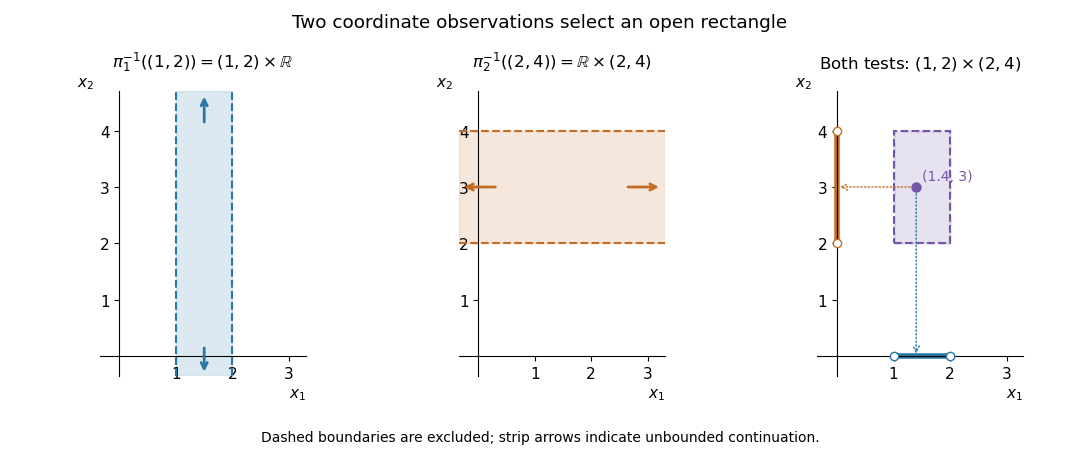
An open rectangle is the intersection of two coordinate-projection strips
. Dashed boundaries and hollow endpoints are excluded. Arrows at the ends of the strips indicate that the strips continue indefinitely. The final panel projects the interior point onto the two tested intervals. Details.
Every point of an open set in the Euclidean plane has such an open rectangle around it inside that open set. Conversely, every open rectangle contains a small Euclidean ball around each of its points. Thus the product topology here is the usual metric topology of the Euclidean plane. With finitely many factors all coordinates may be restricted; on an infinite Cartesian product a basic cylinder set must leave all but finitely many factors free.
Articles by others on the same topic
There are currently no matching articles.