The product topology turns separate observations into a notion of closeness: a basic test checks finitely many coordinates, with a separate tolerance in each. For an index set and topological spaces , the underlying Cartesian product and its coordinate projection maps areThe product topology is the coarsest topology making every a continuous map.[ref]
Point-Set Topology, Chapter 2: Continuous functions. Definition 2.2.4 and Proposition 2.2.5: coordinate projections and the coarsest topology making them continuous
The Cartesian product specifies which points exist; the product topology specifies their neighborhoods. Finite observations motivate its finite-coordinate basis for the product topology, while convergence in a product space and continuity into a product space explain why it is useful. The compactness result for this construction is Tychonoff's theorem.
A product topology on locally compact factors is locally compact if all but finitely many factors are compact. At a point, choose a compact neighborhood in each of the finitely many exceptional factors and take the full compact space in every other coordinate. Tychonoff's theorem makes their product compact, and the product contains an open basic neighborhood because only finitely many coordinates were restricted. In contrast is not locally compact: a basic neighborhood has a free coordinate projecting onto all of the noncompact real line, so no compact set can contain it.
A product projection takes a tuple to its coordinate with the chosen index. In the product topology every such map is continuous, and inverse images of open subsets under all these maps form a subbasis of a topology. A map into the product is continuous exactly when its compositions with all product projections are continuous.
Every open subset of a product of two topological spaces is a rectangle exactly when at least one factor has the indiscrete topology. For necessity, if both factors have nonempty proper open sets , , then is open, projects onto both full factors, and omits every point of . A rectangle with both full projections would be the whole product, a contradiction. For sufficiency, if is indiscrete, every basic open rectangle is or empty; an arbitrary union is . The same argument works when is indiscrete. Empty factors cause no exception because their topology is indiscrete.
For nonempty topological spaces , their product topology is Hausdorff exactly when both factors are Hausdorff spaces. Distinct pairs differ in some coordinate, and disjoint open neighbourhoods in that factor give disjoint open rectangles in the Cartesian product. Conversely, fixing gives a homeomorphism from onto the topological subspace ; similarly for . The Hausdorff condition passes to topological subspaces. Nonemptiness matters: an empty set product is Hausdorff regardless of the other factor.
For a finite set and open sets for , the setsform a basis of a topology for the product topology. The empty set intersection is . Each basic open set is a cylinder set; all coordinates outside are free. Arbitrary open sets are unions of these basic tests and need not themselves depend on one fixed finite collection of coordinates.[ref]
Point-Set Topology, Chapter 2: Continuous functions. Proposition 2.2.1, Definition 2.2.2 and Remark 2.2.8: finite-coordinate basis and general open subsets
Why finitely many? Any topology making the projection maps continuous must contain their preimages of open sets, and hence finite set intersections of those preimages. Taking arbitrary unions supplies exactly the product topology. Intersecting two basic cylinder sets still restricts only the finite union of their coordinate sets.
On two copies of the real line with their usual topologies, let and . The coordinate projection maps giveThe first two open sets are unbounded strips; their set intersection is an open rectangle. The point passes both coordinate tests, whereas fails the first because the endpoint is excluded.
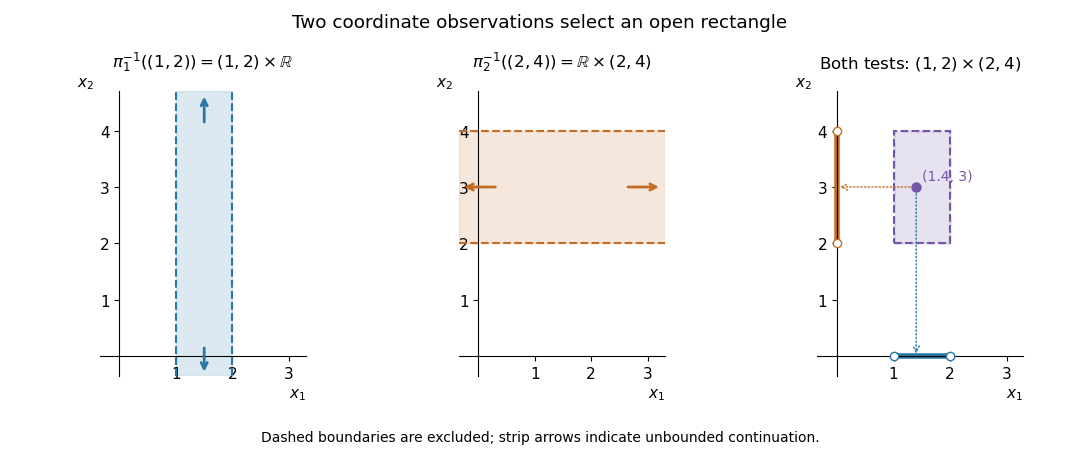
An open rectangle is the intersection of two coordinate-projection strips
. Dashed boundaries and hollow endpoints are excluded. Arrows at the ends of the strips indicate that the strips continue indefinitely. The final panel projects the interior point onto the two tested intervals. Details.Every point of an open set in the Euclidean plane has such an open rectangle around it inside that open set. Conversely, every open rectangle contains a small Euclidean ball around each of its points. Thus the product topology here is the usual metric topology of the Euclidean plane. With finitely many factors all coordinates may be restricted; on an infinite Cartesian product a basic cylinder set must leave all but finitely many factors free.
For arbitrary topological spaces , an index set , a sequence , and a point in that Cartesian product, convergence in a product space to in the product topology is equivalent to coordinatewise convergence in every factor. No countability or Hausdorff assumption on the factors is needed. For a product space of copies of the real line, regarding each point as a function identifies this with pointwise convergence.
Proof outline: the forward implication follows because each projection map is continuous. Conversely, given a basic neighborhood of , each of its finitely many coordinate tests holds for all . Taking makes all tests hold simultaneously; if is empty, any threshold works. This proves eventual membership in every neighborhood, rather than only in a sampled collection of cylinders. The same equivalence holds for nets: a directed set supplies a common upper bound for finitely many thresholds. Sequences alone need not characterize the whole topology of an arbitrary product space.
Let and give each factor of the usual topology of the real line. The familiar standard basis vectors extend to unit sequences with when and zero otherwise. Their finite linear combinations are exactly the finitely supported sequences, rather than all of .
For every fixed coordinate , for all . Therefore in the product topology. More directly, any basic cylinder set containing zero contains every with : all of its tested coordinates are then zero. The moving unit entry escapes every fixed finite collection of observations.
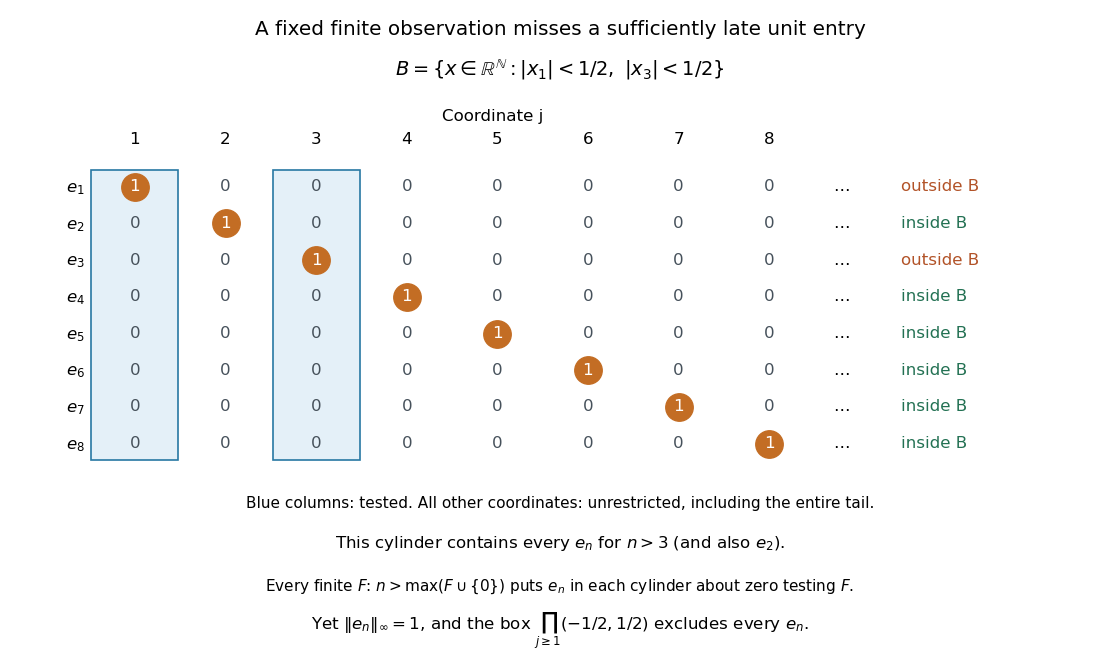
In the l-infinity sequence space of bounded real sequences, however,Thus the same sequence does not converge to zero in the supremum norm. Here the comparison is between the subspace topology inherited from the product topology and the norm topology on . The supremum norm is not a finite-valued norm on all of , which also contains unbounded sequences. In the box topology on , the neighborhood of zero excludes every , so is not a convergent sequence with limit zero there either.
The box topology on has a basis of a topology consisting of all Cartesian products with every an open set in ; infinitely many coordinates may be restricted. It contains the product topology and agrees with it for finite .[ref]
18.901, Fall 2024 lecture notes. Lecture 12, Exercise 12.1.2(1)-(2), printed page 43: box basis, comparison with the product topology, and finite-factor equality
For copies of the usual real line, the box topology is strictly finer when . The box is not an open set in the product topology: a basic cylinder set containing zero leaves some coordinate unrestricted, so it contains . This is a construction for every finite coordinate set, not evidence from testing a finite prefix.
For a topological space and topological spaces , a function is continuous into the product topology exactly when every coordinate function is continuous.[ref]
18.901, Fall 2024 lecture notes. Lecture 5, Proposition 5.3.2, printed page 21: continuity into a product is equivalent to continuity of all component functions
Proof outline: one direction uses function composition with the continuous projection maps. For the other, the preimage of a basic cylinder set isa finite set intersection of open sets in . This gives continuity on every basic test. It explains, for example, why from the real line to is continuous in the product topology: each coordinate is a polynomial function. The general coordinate criterion fails for the box topology, where infinitely many preimages can be required at once. For example, has continuous coordinate functions, but the preimage of the box is , which is not an open set in the real line.
A function on a Cartesian product is a cylinder function if it depends on only finitely many coordinates. With finite discrete coordinate spaces it is a continuous function in the product topology. These functions determine finite-dimensional laws and provide a natural domain for local generators of interacting particle systems.
The diagonal map sends to . It is an embedding of a topological space onto its diagonal subset, because either coordinate projection is its inverse on the image. For a closed oriented manifold, that subset has a fundamental class, whose Poincare dual is the cohomology class of the diagonal.
The image of the diagonal map in . For a manifold, the diagonal subset is an embedded submanifold diffeomorphic to .
Cantor space is the binary sequence space with the product topology of discrete two-point factors. Here the Bernoulli-space synonym refers to this topology, without selecting a particular probability measure. The metric induces the topology. A diagonal subsequence argument gives compactness. Fixing a finite prefix gives a clopen cylinder set. The map is a homeomorphism to the usual Cantor set.
On this sum is a metric, since each summand obeys the triangle inequality and a zero sum forces coordinatewise equality. A prefix cylinder set fixing the first coordinates contains the open ball of radius about each of its points and has diameter at most . These bounds show that the metric topology equals the prefix cylinder set topology, the usual Cantor space topology.
A binary tree of finite strings is a set of finite binary strings closed under taking prefixes. The empty tree is allowed; a nonempty such tree contains the empty string. Finite nodes may have no infinite extensions. Such presentations describe closed subsets of Cantor space through their infinite paths.
A binary tree of finite strings is computable when membership of a finite binary string is decidable. An infinite computable tree need not have any computable infinite path. Removing all nodes without infinite extensions need not preserve decidability.
For an effective enumeration of unary partial computable functions, admit a length- string if it disagrees with every binary value of observed within steps for . The bounded halting predicate makes membership decidable, and the tests are prefix compatible. Its paths are exactly the binary diagonally noncomputable functions. The path space is nonempty and perfect because infinitely many indices of divergent programs leave arbitrarily late bits free; no path is computable. Dead ends in this decidable presentation are essential.
For a nonempty decidable binary tree of finite strings with no terminal nodes, begin at the empty string and repeatedly choose the first immediate successor that belongs to the tree. Each finite decision terminates and some successor always exists. This produces a total computable function giving an infinite path. In particular, a nonempty decidable tree in which every node has two incompatible extensions cannot have only noncomputable paths.
An infinite path is a binary function all of whose finite prefixes belong to the tree. Its path space is closed in Cantor space, since failure is witnessed by one finite prefix outside .
A nonempty path space is perfect if it has no isolated points: for every path and every finite prefix of it there is a different path sharing that prefix. This property of the closed subset of Cantor space does not imply that its particular finite-string presentation has no dead ends. Requiring every finite node to extend to incompatible nodes is the stronger pruned-tree convention for a perfect tree.
Every open set in Cantor space is a countable disjoint union of prefix cylinder sets. Select all finite words whose cylinder lies in the open set but whose immediate predecessor's cylinder does not. These words are prefix-free, so their cylinders are disjoint. Every point of the open set has a shortest qualifying prefix. The whole space is represented by the empty prefix.
A continuous function on Cantor space is uniformly continuous. Replacing it by one constant on each length- prefix cylinder set changes it by at most its oscillation on sets of diameter . This tends uniformly to zero. Each approximant is a finite linear combination of continuous indicator functions, proving density in the supremum norm.
A cylinder set in a product of spaces restricts a finite collection of coordinates and leaves all other coordinates free. It has the form , where is the coordinate projection onto the finite subproduct. Taking to be a product of open sets gives the basic open cylinders for the product topology. In a finite-alphabet full shift, specifying exact letters at finitely many coordinates gives a clopen set.
A product space is the Cartesian product equipped with the product topology, the coarsest topology making every coordinate projection map continuous.
An arbitrary product of compact spaces is compact in the product topology. The theorem is equivalent to the axiom of choice.
The product topology of two compact spaces is compact, without a Hausdorff condition. Refine an open cover locally by basis rectangles. For fixed , compactness of selects finitely many rectangles whose second factors cover . Their first factors have an open finite intersection containing , and the finitely many original covering members cover . Use compactness of to choose finitely many covering . The associated finitely many original members form a finite subcover of . Repeating the argument proves the finite-factor case of Tychonoff's theorem.
A product of at most continuum many separable spaces is separable. More generally, if each factor has a dense subset of cardinality at most an infinite cardinal and there are at most factors, then the product has a dense subset of cardinality at most .
Articles by others on the same topic



Product topology is a way of defining a topology on the Cartesian product of a collection of topological spaces. It provides a natural way to combine spaces into a larger topological space while preserving the properties of the individual spaces.