For a simple symmetric random walk starting at zero, let be its first hitting time of . The infinite mean first passage of a simple symmetric random walk shows that almost surely but . Since , assuming a finite expected value for would let Wald's equation assert , a contradiction. The formal expression is not an allowed use of the theorem.[ref]
Compare . From every surviving position in , three consecutive positive increments force absorption within three steps. Each fresh block has probability of this event, so and . This establishes finiteness before invoking the theorem. If is the average remaining time from position , the law of total expectation givesso . Symmetry gives equal exit probabilities at and , and , as Wald's equation predicts. This is a small gambler's ruin problem with two absorbing barriers.
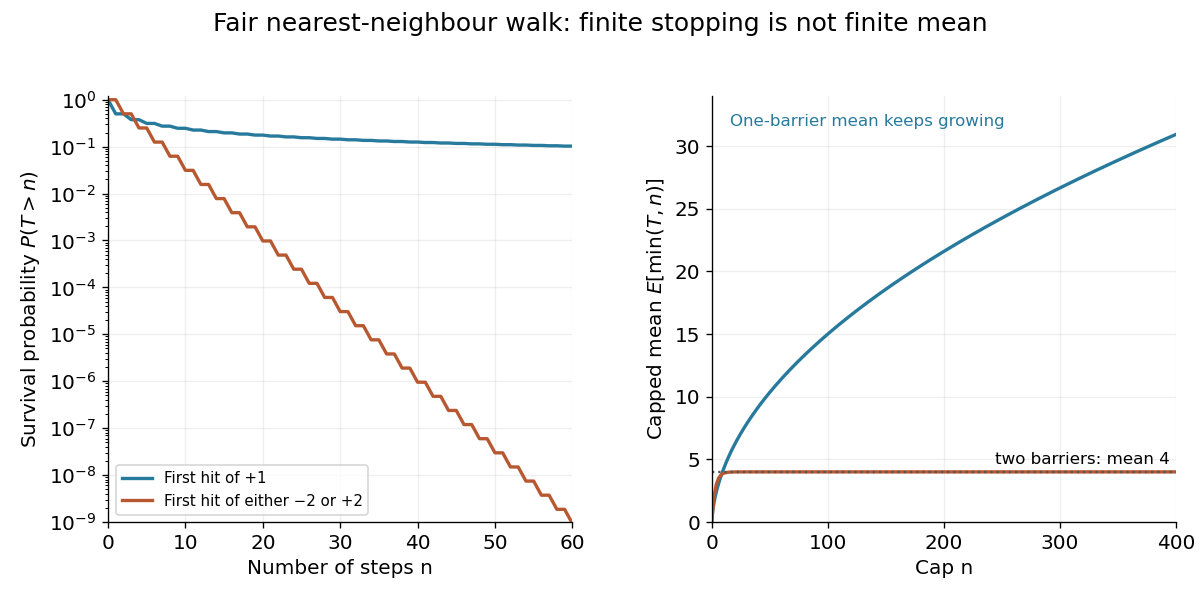

Even for , each bounded stopping time satisfies . The stopped process tends to almost surely, but its expected value does not tend to . Rare long negative excursions retain the balancing contribution. The existing stopped-walk martingale with almost sure but not L1 convergence explains the related failure of uniform integrability; almost sure convergence alone does not permit exchanging a limit and an expected value.
Articles by others on the same topic
There are currently no matching articles.