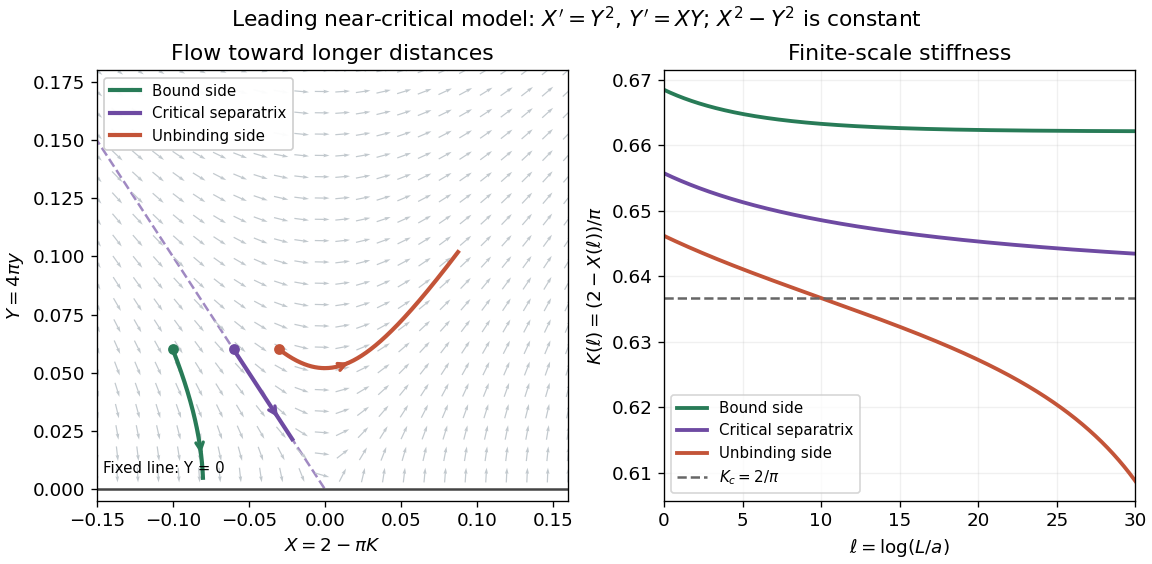
An experiment of size stops the renormalization-group flow at a finite . In the leading scaled model take the original initial conditions and . The invariant is respectively . The first approaches , hence ; the second follows the critical separatrix; the third eventually leaves the small-vortex fugacity regime. These are chosen model trajectories, with no fitted experimental parameters.
On the critical separatrix, implies , henceEven a critical finite sample therefore has a phase stiffness above its asymptotic jump value, with a slow logarithmic correction in . Slightly above the transition, a sample with can resemble the algebraic phase before the flow reaches unbound vortices. A trap additionally varies the local density and phase stiffness; neither its whole-cloud coherence nor a finite observation window automatically measures the homogeneous thermodynamic limit.

Articles by others on the same topic
There are currently no matching articles.