Consider the chosen finite minimization problemOnly adjacent integers are neighbors. At each interior state propose left or right with probability each; at an endpoint propose its sole neighbor with probability and itself with probability . This proposal distribution is symmetric, including at the endpoints. The local minimum at is relative to these allowed moves; is the unique global minimum.
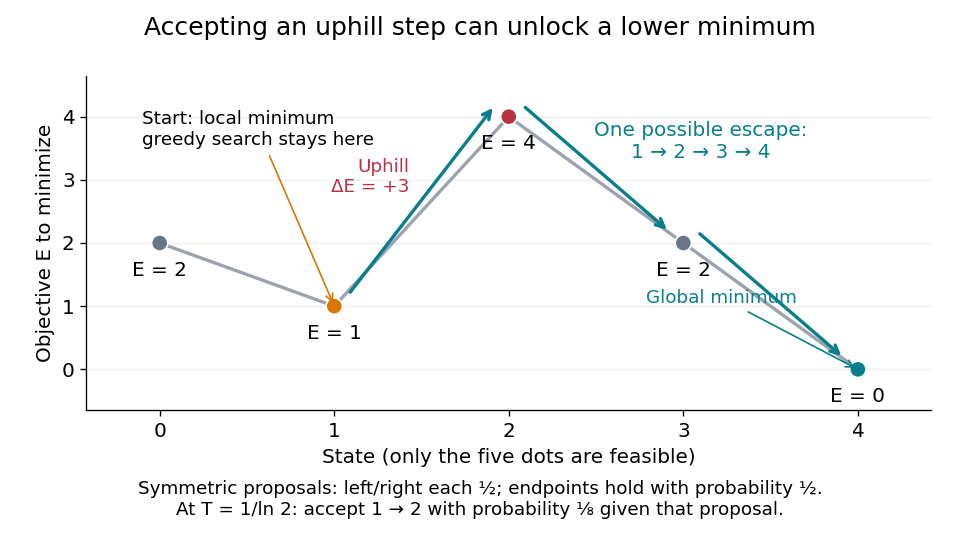

At , improving-only local search rejects both neighbors because and exceed . For simulated annealing, choose , using the natural logarithm. Conditional on proposing from , the acceptance probability isThe one-step transition probability is instead . Both subsequent rightward proposals are downhill, so the conditional probability of the precise next three states being , given and fixed , isThis is one possible escape route, not the probability of eventually reaching . Rejections, excursions toward , and repeated attempts give many other sample paths. The calculation establishes possibility, without claiming a general performance advantage from a selected sample path.
For comparison, halving makes the uphill acceptance probability ; doubling it makes that probability . Cooling makes it harder to leave this local minimum, even though the stationary distribution increasingly favors the global minimum. That tension is the central scheduling problem.
Articles by others on the same topic
There are currently no matching articles.