The Floquet growth rate measures the exponential trend of a periodic linear differential equation over many coefficient periods. A Floquet multiplier measures the factor per period ; the corresponding rate per unit time iswhere is a Floquet exponent. Taking the real part removes the ambiguity in the complex logarithm.
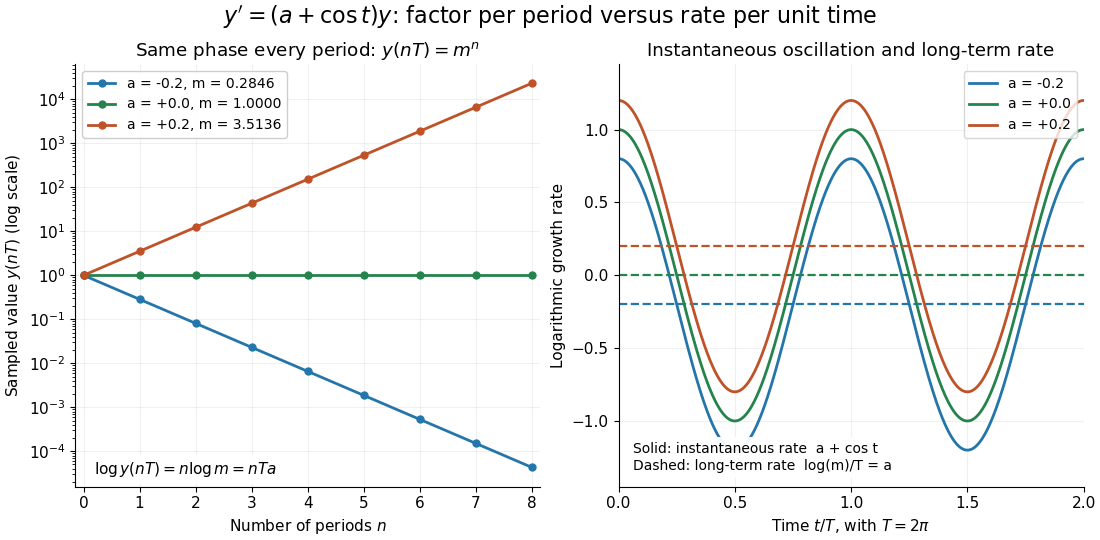
For the scalar example under periodic solution, and the Floquet growth rate is , independently of . Indeed,The instantaneous logarithmic derivative keeps oscillating even though its average over complete periods is exactly . Sampling at the same phase in each period removes the modulation altogether: .

For the general finite-dimensional homogeneous linear differential equation , assume that is continuous on the real line and -periodic, with . Normalize its fundamental matrix by and set . The maximal asymptotic exponential rate, using any induced matrix norm, isHere is the spectral radius, are the Floquet multipliers, and invertibility gives . This concerns growth of the solution operator; it does not say that every initial condition attains the maximum.[ref]
To prove the formula, write with . Periodicity and uniqueness giveBoth and have uniformly bounded matrix norms on a period. Consequently differs from by at most fixed multiplicative factors. The spectral radius formula gives , proving the claimed limit without choosing a matrix logarithm.
For a particular nonzero initial condition , decompose into the generalized eigenspaces of over the complex numbers. The rate of is the largest among components that are nonzero. Generic data have a component in the dominant generalized eigenspaces and attain ; data contained in the sum of the subdominant generalized eigenspaces have a smaller rate. For example, with , the maximal rate is , while decays at rate . These invariant subspaces describe initial data at phase zero. Their transported versions can vary with time and satisfy .
A negative Floquet growth rate allows temporary amplification. For the constant non-normal matrixthe initial condition has Euclidean norm , which rises from to about at before eventually decaying. Its exponential rate is still : the Jordan block contributes a polynomial factor, whose logarithm divided by tends to zero. At a unit-modulus Floquet multiplier, such polynomial growth can even be unbounded with zero exponential rate; gives . Thus zero Floquet growth rate alone proves neither boundedness nor a periodic solution.
Articles by others on the same topic
There are currently no matching articles.