For a continuous periodic coefficient matrix , a fundamental matrix for , normalized by , obeys . The invertible matrix has a complex matrix logarithm; set and . Since commutes with , direct substitution gives and proves the factorization. A real logarithm is not required for this complex representation.
The eigenvalues of are Floquet multipliers. All solutions are bounded for forward time when every multiplier has modulus at most one and those on the unit circle have no nontrivial Jordan blocks. In a real undamped second-order scalar equation with no first-derivative term, the monodromy determinant is one. Distinct conjugate unit-modulus multipliers give bounded solutions; a nontrivial Jordan block at multiplier or gives an unbounded second solution even when one periodic or antiperiodic solution exists.
For a Floquet multiplier of a period- linear variational equation, a Floquet exponent is any logarithmic rate satisfying the displayed relation. Its real part is uniquely , while its imaginary part is defined modulo . Negative transverse real parts give local attraction to a periodic orbit; the autonomous phase direction has multiplier one and exponent zero. Constant-coefficient amplitude equations supply exponents directly as the eigenvalues of their Jacobian matrix.
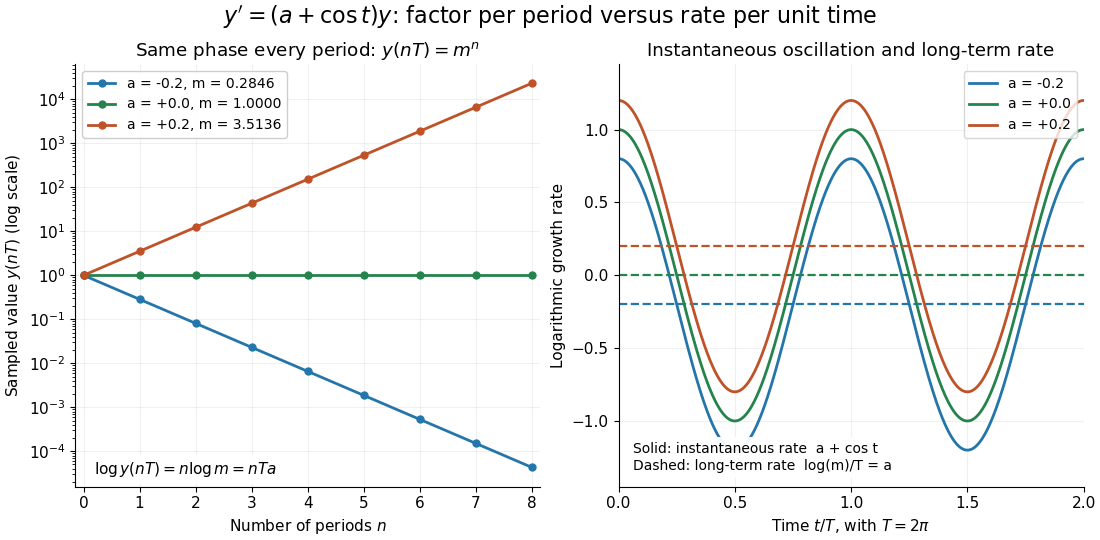
The Floquet growth rate measures the exponential trend of a periodic linear differential equation over many coefficient periods. A Floquet multiplier measures the factor per period ; the corresponding rate per unit time iswhere is a Floquet exponent. Taking the real part removes the ambiguity in the complex logarithm.
For the scalar example under periodic solution, and the Floquet growth rate is , independently of . Indeed,The instantaneous logarithmic derivative keeps oscillating even though its average over complete periods is exactly . Sampling at the same phase in each period removes the modulation altogether: .
For the general finite-dimensional homogeneous linear differential equation , assume that is continuous on the real line and -periodic, with . Normalize its fundamental matrix by and set . The maximal asymptotic exponential rate, using any induced matrix norm, isHere is the spectral radius, are the Floquet multipliers, and invertibility gives . This concerns growth of the solution operator; it does not say that every initial condition attains the maximum.[ref]
To prove the formula, write with . Periodicity and uniqueness giveBoth and have uniformly bounded matrix norms on a period. Consequently differs from by at most fixed multiplicative factors. The spectral radius formula gives , proving the claimed limit without choosing a matrix logarithm.
For a particular nonzero initial condition , decompose into the generalized eigenspaces of over the complex numbers. The rate of is the largest among components that are nonzero. Generic data have a component in the dominant generalized eigenspaces and attain ; data contained in the sum of the subdominant generalized eigenspaces have a smaller rate. For example, with , the maximal rate is , while decays at rate . These invariant subspaces describe initial data at phase zero. Their transported versions can vary with time and satisfy .
A negative Floquet growth rate allows temporary amplification. For the constant non-normal matrixthe initial condition has Euclidean norm , which rises from to about at before eventually decaying. Its exponential rate is still : the Jordan block contributes a polynomial factor, whose logarithm divided by tends to zero. At a unit-modulus Floquet multiplier, such polynomial growth can even be unbounded with zero exponential rate; gives . Thus zero Floquet growth rate alone proves neither boundedness nor a periodic solution.
For the homogeneous linear differential equation with continuous coefficient matrix of period , the monodromy matrix of a periodic linear system is the one-period map from to . If is any fundamental matrix,Its eigenvalues are the Floquet multipliers. Multipliers are nonzero, since a fundamental matrix is invertible. Changing the starting phase conjugates , so the Floquet multipliers and Jordan blocks are independent of that choice.[ref]
This turns a continuous-time problem into repeated matrix multiplication:If , the associated solution of a differential equation obeys at every time, not merely at the sampled times. In particular, gives a nonzero -periodic solution, and every nonzero -periodic solution arises this way. If , the state changes sign after one period and repeats after two. A unit-modulus Floquet multiplier different from need not give repetition after one period, and a generalized eigenvector in a nontrivial Jordan block need not even give bounded motion.
For the scalar example under periodic solution, is the one-by-one matrix . Numerically solving a matrix problem uses the same idea: integrate one initial value problem for each column of through one period, then compute the eigenvalues of . This is useful when an explicit solution of a differential equation is unavailable: one period determines the Floquet growth rate over arbitrarily many periods.
For piecewise constant coefficients, which are also covered by the one-period construction, is the time-ordered product of the segment matrix exponentials, with the earliest segment on the right. For example, take period and alternateSince ,Replacing the coefficient by its mean would instead give and the incorrect rate . The matrices do not commute. The scalar mean-coefficient formula therefore cannot simply be transferred to matrix systems. Nevertheless the Liouville formula for a fundamental matrix gives the correct determinant even in the noncommuting case:In the example, this is ; it fixes the product of the Floquet multipliers, rather than either multiplier separately.
In Sur les équations différentielles linéaires à coefficients périodiques (1883), Gaston Floquet calls a function satisfying periodic of the second kind, and distinguishes the genuinely periodic function obtained when . This historical terminology captures precisely the difference between repetition of the coefficient and repetition of the state.[ref]
Sur les équations différentielles linéaires à coefficients périodiques by Gaston Floquet (1883). Printed p. 48, definition of a function periodic of the second kind and its multiplier; p. 49, transformation of a fundamental solution system after one period

