In 1961, Peter Alden Franken, Alan Hill, C. Wilbur Peters and Gabriel Weinreich focused a pulsed ruby laser through a red optical filter into quartz. The filter suppressed xenon-flash background. A quartz-prism spectrograph used red-insensitive Eastman Type 103 plates. A single shot recorded a feature near from input. Removing the quartz or substituting glass removed the feature; changing polarization of waves and orientation followed their predicted pattern. These controls supported second-harmonic generation; photographic density gave an estimated yield.[ref]
Generation of Optical Harmonics by Peter Alden Franken and others. pp. 118–119, Table I, Fig. 1 and controls
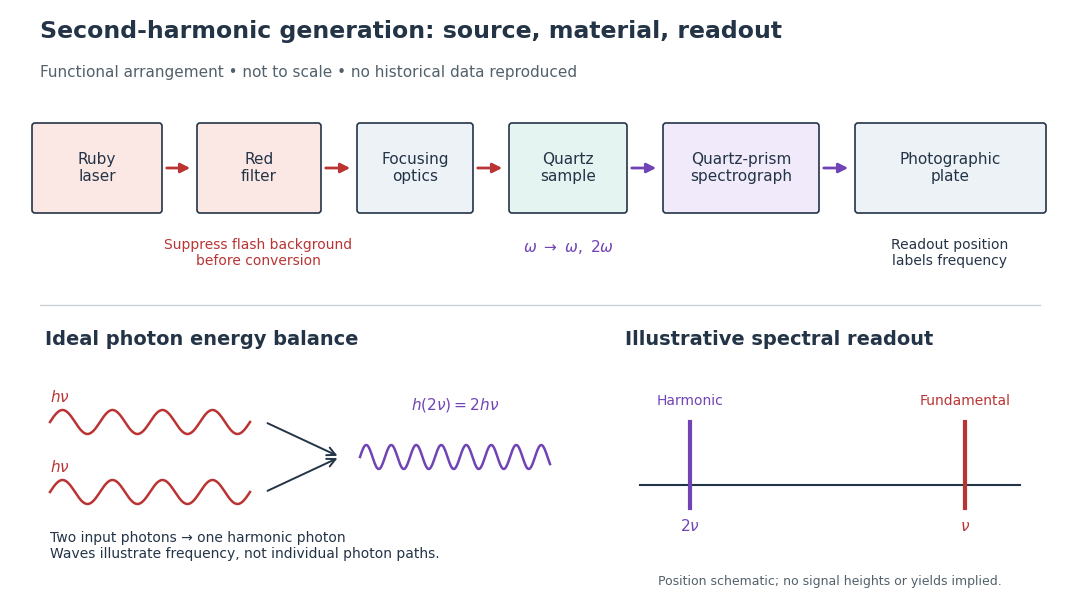

A spectrograph turns output frequency into a recording position. Its spectral separation makes a faint new component distinguishable from bright input light. The reported rounded wavelengths do not constitute an independent precision measurement of the ratio two. Nor do these observations demonstrate perfect phase matching or complete conversion. The experiment and Nicolaas S later theoretical account are distinct contributions to nonlinear optics.
Articles by others on the same topic
There are currently no matching articles.