Nonlinear optics studies the response of matter to light when the induced electric polarization is not proportional to the driving electric field. An intense laser can make these additional terms observable. The striking consequence is that a material can emit light at a frequency absent from the incident beam: second-harmonic generation doubles it. This extends a s usable optical spectrum without requiring a second lasing transition.
Franken and colleagues frequency-doubling experiment established an optical harmonic in 1961. Nicolaas S theoretical work developed the description of interacting light waves in nonlinear matter. His 1981 lecture connects a nonlinear constitutive relation with Maxwell's equations and explains compensation of optical dispersion by birefringence.[ref]
Nonlinear Optics and Spectroscopy by Nicolaas Bloembergen. Nonlinear Optics and Spectroscopy, introduction and p. 19
A crystal used for its nonlinear optics response, allowing processes such as spontaneous parametric down-conversion when the appropriate phase matching is satisfied.
Nonlinear polarization is the part of an induced electric polarization nonlinear in the driving electric field. A quadratic response multiplies field components, creating sums and differences of their frequencies; second-harmonic generation is the equal-frequency sum case. Conversion strength also depends on phase matching and the material response.
An optical wave envelope whose spreading is balanced by nonlinear refraction. A temporal optical soliton balances dispersion, while a spatial optical soliton balances diffraction. Persistence of a profile in an ideal propagation model does not by itself establish robustness in a lossy, higher-dimensional or delayed-response medium.
A localized temporal wave envelope supported by a balance of group velocity dispersion and self-phase modulation. Bright solitons decay to zero background; dark solitons are dips on a nonzero background. This temporal balance differs from the diffraction balance of a spatial optical soliton.
A dimensionless comparison of dispersion and self-phase modulation scales. For the focusing cubic fibre equation with a sech input, gives a fundamental temporal bright soliton, and integer gives an ideal higher-order temporal soliton. It is a scale parameter for an arbitrary initial pulse, not a theorem that the pulse contains exactly that many separated solitons.
An integer-order sech initial pulse in the ideal focusing cubic fibre equation has periodic shape evolution involving compression and recombination. It does not preserve a single fixed profile like a fundamental temporal bright soliton. Arbitrary noninteger-order initial pulses can contain radiation as well as solitons.
For positive Kerr nonlinearity and anomalous group velocity dispersion, the displayed sech envelope solves the ideal cubic fibre equation. Substitution uses . Dispersion and nonlinear lengths coincide. Higher-order corrections, attenuation and a delayed response can change actual propagation.
Treat the strong input pump amplitudes as prescribed while solving for weaker fields. It is self-consistent only when conversion removes a small fraction of pump energy and the assumed pump phases remain valid. An apparent divergent gain is evidence of breakdown of this approximation, not unlimited energy generation.
A third-order nonlinear optical susceptibility produces a polarization term proportional to . Its temporal and spatial phases give the displayed output frequency and the source wave vector . Efficient emission also requires that this source match a propagating optical mode. The pump waves supply the generated energy.
All four interacting waves have the same frequency. Counterpropagating equal-frequency pumps can give a source proportional to the conjugate signal field, providing phase conjugation. The pump product must have the appropriate uniform spatial phase, and finite apertures and phase mismatch limit reconstruction.
Because one wave travels backward, its incident boundary condition belongs at the opposite end of the medium. With and , differentiating once gives and the solutionThe invariant is constant along , while the input/output powers obey transmission minus reflection equal to the incident power in this normalization. A proposed solution must satisfy both first-order equations, not just their second derivatives.
The first zero of makes the homogeneous opposite-end boundary problem singular. Its undepleted-pump treatment admits a nontrivial field without an imposed signal, indicating a parametric oscillation threshold. Depletion, saturation and the actual noise-seeded dynamics determine finite fields near threshold.
For opposite equal pump wave vectors, a conjugate mixing source has wave vector . In an isotropic nondispersive medium this exactly matches a free backward wave at the generated frequency only in the degenerate case. Away from degeneracy the longitudinal mismatch has magnitude ; a finite interaction length supplies a tolerance, not exact vector matching.
A beam with a transverse profile sustained by a balance between diffraction and a nonlinear change of refractive index. A one-transverse-dimensional focusing cubic model supports a stationary bright profile after its propagation wave phase is removed. Existence in that model does not establish stability in two transverse dimensions or in a saturating, absorbing material.
Cross-phase modulation occurs when one beam changes the wave phase of another through an intensity-dependent optical response. In an optical Kerr effect medium, a pump changes the refractive index sampled by a probe; propagation over length gives the probe an additional phase approximately .
A delayed weak probe can therefore acquire a time-dependent phase from a strong pump optical pulse. Interfering the probe with an unaffected reference makes the phase change observable as an intensity change. Changing the pump intensity or blocking the pump tests the coupling. The coefficient depends on the beams' relative polarization and the material response; a phase change need not imply appreciable transfer of energy to the probe.
Self-defocusing is the spreading tendency caused when a beam lowers the refractive index most strongly where its own intensity is largest. In the local optical Kerr effect model , a beam brightest on its axis produces this behavior for : its transverse phase profile resembles that of a diverging optical lens.
Compare the beam width after the same sample at several input powers while holding the input profile fixed. A power-dependent change can reveal nonlinear spreading, but ordinary diffraction, optical absorption and heating must also be considered. Self-defocusing modifies a beam's propagation rather than removing the ordinary diffraction it already experiences.
Loss of spatial overlap between interacting finite beams because their energy flux directions differ. In an anisotropic crystal, the direction of the Poynting vector need not coincide with the wave vector. For beam radius and relative walk-off angle , an overlap length is of order . A full conversion calculation also includes beam profiles, diffraction and phase mismatch.
An interaction among three waves mediated by a second-order nonlinear optical susceptibility. In sum-frequency generation, two input angular frequencies satisfy . The same coupling permits reverse conversion. Phase matching determines whether successive generated contributions reinforce; the Manley-Rowe relations express the associated lossless exchange constraints.
Conservation relations for resonant, lossless wave mixing. For sum-frequency generation with , the intensities obey . Thus and are constant. Their difference gives a third, dependent invariant. Adding the intensity derivatives yields conservation of energy.
The exchange interpretation divides each intensity by its photon energy . One conversion removes a photon from each lower-frequency mode and adds one to the upper mode. For classical coupled-wave equations, differentiating the squared complex amplitudes gives the same common exchange rate multiplied by . Loss or externally replenished pumps require corresponding source terms.
An optical parametric amplifier transfers energy from a pump beam into a signal and an idler through nonlinear optics. For the common three-wave mixing process, their angular frequencies obey . A strong pump and a weaker signal enter a nonlinear medium; the signal grows and an idler is generated.
Efficient growth requires phase matching so that contributions generated along the medium reinforce. Changing crystal orientation or temperature can tune the matched frequencies. Measuring the signal with and without the pump tests amplification, while observing the corresponding idler checks the frequency-conversion mechanism. The pump supplies the extra energy; the process does not require a stored population inversion.[ref]
Overview of Nonlinear Processes by Camacho Lab. Sum and Difference Frequency Generation: pump, signal, idler and difference-frequency amplification
An optical parametric oscillator places an optical parametric amplifier inside an optical resonator that feeds back at least one generated wave. Pump energy is converted into signal and idler waves satisfying the frequency relation of the underlying three-wave mixing process.
Oscillation begins when round-trip gain overcomes loss at an allowed resonator mode. Below that threshold, weak generated emission can still occur, but sustained oscillation is absent. Tuning the phase matching and resonator together gives a tunable source at wavelengths difficult to obtain directly from a particular laser. Pump power alone does not select the output: cavity resonances, conversion gain and optical losses also matter.
Difference-frequency generation produces a wave at the positive difference of two incident angular frequencies, through a second-order nonlinear optical susceptibility. The product of two oscillating electric fields contains both sum and difference frequencies, and the corresponding polarization density drives the generated wave.
For plane waves in a uniform medium, coherent buildup is favored by , the relevant phase matching condition. Two shorter-wavelength inputs can thereby generate longer-wavelength infrared radiation. Collecting the output after removing both incident frequencies distinguishes frequency generation from scattered pump light.[ref]
Overview of Nonlinear Processes by Camacho Lab. Sum and Difference Frequency Generation: quadratic field products and difference-frequency output
A nonlinear optics process producing a field at the sum of two input angular frequencies. The driven electric polarization contains a term proportional to the product of the input complex amplitudes. With undepleted plane-wave inputs, integration along a crystal gives an output amplitude proportional to ; the sinc function therefore determines the ideal length and phase mismatch dependence. A nonzero initial output field also interferes with this generated field.
The Kerr effect is a change in a material's refractive index quadratic in an applied electric field. A static applied electric field can produce linear birefringence; the optical field itself can also produce an intensity-dependent refractive index in nonlinear optics.
An intensity-dependent refractive index produced by the optical field itself. In a simple instantaneous isotropic model, . A transversely nonuniform intensity produces self-focusing for positive and self-defocusing for negative . Temporal intensity variation produces self-phase modulation. These are consequences of a third-order nonlinear optical susceptibility, distinct from a static applied-field electro-optic Kerr effect.
An ideal two-mode intensity-intensity coupling makes the phase of each mode depend on the other's photon number. With this sign convention, evolution for time sends a mode-1 coherent amplitude to when mode 2 has definite occupation. This single-mode unitary model does not by itself establish a strong, noiseless interaction between real travelling single photons.
A one-photon polarization qubit can conditionally rotate another mode's coherent amplitude: the horizontal branch leaves unchanged and the vertical branch gives . The output is generally entangled. Measuring the polarization in a superposition basis can erase the branch label and prepare a coherent superposition of the two amplitudes.
Normalize the initial polarization qubit and its analysing wave-plate transformation. For a conditional phase rotation of , a vertical detection has the displayed probability and prepares . At , that outcome has zero probability, explaining the singular normalization of the absent branch.
A beam's transverse intensity changes its own refractive index. For positive nonlinear index and a bright centre, the accumulated phase has the curvature of a converging lens. For over a short length , the in-medium thin-lens approximation gives . Negative instead produces self-defocusing.
The electro-optic Kerr effect produces linear birefringence proportional to the square of a static applied electric field. Defining the Kerr effect coefficient by , a length produces phase retardation . A switchable quarter-wave plate requires modulo , with fixed principal axes. This differs from the Faraday effect, whose eigenpolarizations are circular polarizations.
In spontaneous parametric down-conversion, a strong pump drives a second-order nonlinear optical susceptibility, producing paired output photons in initially unseeded modes. The two outputs are conventionally called the signal photon and idler photon. They need not have equal frequencies. For a monochromatic pump, conservation of energy gives
Efficient bulk generation also requires phase matching: the nonlinear source and emitted waves must remain in phase. In the ideal plane-wave geometry this is . Different refractive indices and propagation directions determine which pairs satisfy it. A finite interaction length supplies a mismatch bandwidth rather than an infinitely sharp wavevector constraint. [ref]
At weak gain, the SPDC pair state contains a large vacuum component and a small pair amplitude. Detecting one output conditions the other, producing a heralded single-photon source. This is probabilistic: stronger pumping also increases unwanted multiple-pair events. Experiments collect two output modes with optical filters and single-photon detectors, comparing coincident detections with background counts. [ref]
Sources of Nonclassical Light for Quantum Networks by NIST. Spontaneous Parametric Down-Conversion and Figure 2, pair generation and heralding
A signal photon is the photon assigned to a designated signal mode in a photon-pair process such as spontaneous parametric down-conversion. Its partner is called the idler photon. The labels identify modes or experimental roles; they do not universally mean the higher-energy and lower-energy photon.
For a narrowband pump, pair production obeys . Spatial and polarization correlations also depend on the phase matching arrangement. Detecting the idler can herald the presence of the signal, but heralding efficiency depends on collection and loss. At degeneracy, signal and idler can have equal frequencies while remaining distinguishable by propagation direction or another mode label.
An idler photon is the partner of a signal photon in a specified nonlinear optical process. In spontaneous parametric down-conversion, one pump photon supplies the energy of the pair, .
The idler can be measured to herald a signal photon or to condition a correlation measurement. It is not a physically expendable photon: losses in its channel reduce heralding rates and can bias an uncorrected coincidence sample. When the two output modes have the same frequency, the signal/idler distinction comes from their assigned spatial, polarization or experimental roles rather than from energy ordering.
Detection of one member of a pair conditions the other mode towards a one-photon state. Imperfect collection reduces heralding efficiency; unresolved spectral correlations can leave a mixed state, and multiple pairs can contaminate the heralded output. Filtering can improve purity while reducing brightness. Heralding is conditional preparation, not deterministic conversion of every pump pulse.
The weak-gain state generated by an undepleted pump contains a vacuum term and a photon-pair amplitude. A continuum pair amplitude combines the pump spectrum with a phase-matching factor . Its joint spectrum determines spectral correlations and the purity attainable by heralding one partner.
For two collected spatial modes , each with polarizations , put . The one-pair state is a Bell state. The normalized two-pair component isThis follows by expanding and using the bosonic creation operator identity . The three orthogonal normalized Fock states have equal probability . A tensor product of independently labelled pairs is a different multimode description; identifying its labels without renormalization changes its norm.
For an ideal undepleted pump and one collected pair of spatial modes, the two orthogonal polarization-pair creation terms generate two commuting two-mode squeezed vacua. If , either squeezed pair has geometric occupation probability . Adding their pair counts gives equal-weight possibilities, hence . Thus and at weak gain. Different unresolved temporal or spectral modes need not obey this single-mode formula.
Concentration of a beam caused by its own intensity-dependent change in the medium's refractive index.
A broad focusing beam can amplify transverse intensity perturbations. Linearizing about its uniform solution gives the displayed growth rate for transverse wave number . For , a finite band grows; noise can develop into filaments. A finite beam and saturating response change the ideal plane-background prediction.
An intensity-dependent refractive index gives an optical pulse a time-dependent wave phase, changing its instantaneous frequency and spectrum.
The distance for an order-one self-phase modulation at peak power in a lossless Kerr envelope model. With attenuation, the phase accumulates over an effective interaction length instead.
Choose one driving electric field component and one responding electric polarization component. A schematic local, instantaneous expansion isHere is the vacuum permittivity, is the linear electric susceptibility, and the higher coefficients describe nonlinear response. In SI, has units , has units , and has units . The selected scalar coefficient depends on polarization of waves and crystal orientation; it is not a universal material number independent of geometry.
For a chosen monochromatic wave , the quadratic contribution is exactlyThe cosine identity separates a constant contribution, associated with optical rectification, from an oscillation at twice the angular frequency, the source for second-harmonic generation. A term oscillating at is a local driving source; efficient outgoing light additionally requires propagation and phase matching.
For a material with optical dispersion, the scalar instantaneous expansion is only a teaching model. The actual quadratic response is a tensor with output and input frequency arguments: describes the harmonic, whereas describes the constant response. Their coefficients need not coincide. The cosine calculation establishes which frequencies are available, without assigning measured coefficients to any crystal.
The order- response has one output vector index and input vector indices. Material point-group invariance, permutation of input index-frequency pairs, and reality of the electric polarization impose different constraints. They must not be conflated with the stronger dispersion-neglecting Kleinman symmetry.
For identical input frequencies, intrinsic permutation symmetry of nonlinear susceptibility makes the last two Cartesian indices symmetric. Store their six independent pairs as one index, so the quadratic response uses a three-by-six array . In the convention , the contracted input vector is . The factors of two preserve the sum over both off-diagonal orderings. This bookkeeping does not assert the stronger Kleinman symmetry and does not change the tensor's physical order.
An isotropic fourth-rank polar tensor has the displayed form. If its three input slots are fully interchangeable at the same relevant frequency arguments, then , giving . For mixed-sign or unequal frequencies, intrinsic permutation exchanges the arguments too; it need not make all coefficients at one fixed ordering equal.
Far from relevant resonances, when frequency dispersion of the nonlinear response can be neglected, a susceptibility can acquire full permutation symmetry among spatial indices. For second order this reduces a general symmetric-input tensor's 18 components to 10 before material point-group reductions. Mere transparency does not establish this approximation. The name refers to D. A. Kleinman.[ref]
Nonlinear Dielectric Polarization in Optical Media by D. A. Kleinman. abstract, electronic high-frequency response and additional symmetry constraints
Commuting input field factors permit the response kernel to be symmetrized under interchange of input index-frequency pairs. For example . This does not authorize exchanging indices while keeping unequal frequency arguments in their old slots, nor exchanging the output index without further assumptions.
Suppose a homogeneous bulk material is unchanged when all spatial coordinates are reversed. Both electric polarization and electric field reverse under this inversion, so a local electric dipole response must obey . Substituting the nonlinear optical susceptibility expansion givesFor every sufficiently small , all even coefficients vanish. In the full tensor relation, two reversed input electric fields leave their product unchanged while the output electric polarization changes sign, forcing every bulk electric-dipole component of to vanish.
The qualification matters: the argument assumes inversion symmetry, a local bulk electric dipole response, and no applied bias that breaks that symmetry. A surface breaks bulk inversion symmetry; spatially varying or magnetic responses also lie outside this local electric-dipole model. Thus detecting second-harmonic generation at a surface or through a weaker magnetic contribution does not contradict the bulk selection rule. Conversely, absence of inversion symmetry permits some quadratic components but does not guarantee a nonzero component in every beam geometry.
A static or slowly varying electric polarization produced by nonlinear response to an oscillating optical electric field. The constant term in nonlinear optical susceptibility is its simplest model. An optical pulse has a varying envelope, so its cycle-averaged quadratic response can vary during the pulse rather than remaining constant forever. This term alone does not imply a radiated zero-frequency wave.
Second-harmonic generation converts an incident optical frequency into through a material's nonlinear response. In the photon description of an ideal lossless conversion, two input photons supply one output photon:Here is the Planck constant. The relation states conservation of energy; the material mediates the interaction. It does not say that each input photon independently splits its wavelength in half.
For vacuum wavelengths, and , where is the speed of light. HenceThe second relation uses the refractive index for each propagating mode and frequency. Within a medium with optical dispersion, the wavelength need not halve. For an invented example, , , and give in vacuum, but in the material the two wavelengths are and ; their ratio is .
Two identical phase-matched crystals generate coherent harmonic amplitudes. In a dispersive gap, the harmonic from the first crystal accumulates a different phase from twice the transmitted pump phase. Their interference gives the displayed undepleted-pump intensity in the stated equal-coupling amplitude normalization. Depletion changes the fringe shape; in the ideal lossless identical-crystal model, an opposite relative phase can coherently undo the first conversion.
In 1961, Peter Alden Franken, Alan Hill, C. Wilbur Peters and Gabriel Weinreich focused a pulsed ruby laser through a red optical filter into quartz. The filter suppressed xenon-flash background. A quartz-prism spectrograph used red-insensitive Eastman Type 103 plates. A single shot recorded a feature near from input. Removing the quartz or substituting glass removed the feature; changing polarization of waves and orientation followed their predicted pattern. These controls supported second-harmonic generation; photographic density gave an estimated yield.[ref]
Generation of Optical Harmonics by Peter Alden Franken and others. pp. 118–119, Table I, Fig. 1 and controls
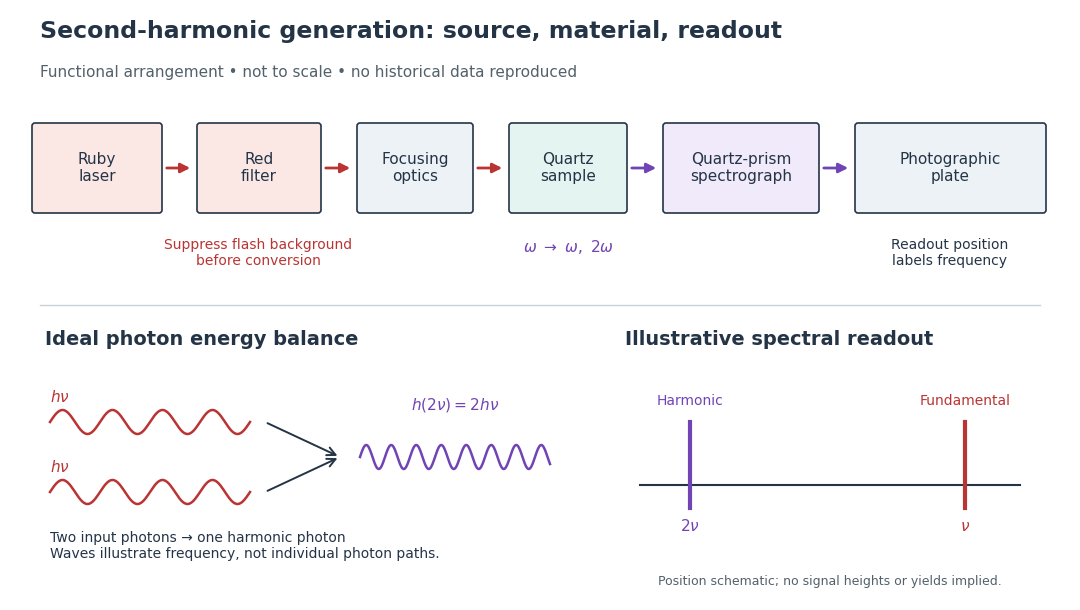

A spectrograph turns output frequency into a recording position. Its spectral separation makes a faint new component distinguishable from bright input light. The reported rounded wavelengths do not constitute an independent precision measurement of the ratio two. Nor do these observations demonstrate perfect phase matching or complete conversion. The experiment and Nicolaas Bloembergen's later theoretical account are distinct contributions to nonlinear optics.
Phase matching makes wave amplitudes emitted at different depths add coherently. Consider collinear plane waves in a uniform transparent material of length , with fixed polarization of waves and nonzero selected nonlinear optical susceptibility. Assume negligible pump depletion, negligible absorption, an initially absent harmonic, and a wide beam for which diffraction is negligible. The pump's wave amplitude is then constant throughout the interaction.
The pump electric field has spatial wave phase ; its quadratic source has spatial wave phase . The freely propagating harmonic has wave number . Define the second-harmonic phase mismatch byFor the chosen complex-field convention, the outgoing harmonic wave amplitude, up to an overall constant and propagation phase, is proportional toChoosing the conjugate complex-field convention reverses the exponent's sign without changing the wave intensity. Taking the squared complex modulus givesHere is fixed for the chosen modes and material; its dimensions accommodate the stated wave intensity convention. The quadratic pump dependence follows because the source wave amplitude is proportional to , whereas is proportional to . The sinc function comes from summing contributions along the whole material, just as a finite aperture produces diffraction through addition of complex amplitudes.
At , the integral is and the harmonic wave intensity grows as . At , all those contributions cancel. This cancellation needs no absorption: their wave phases wind through a full turn. At high conversion, the constant-pump assumption fails, so the law cannot continue indefinitely. Tight focusing, finite optical pulses, absorption, and transverse separation of modes also require a more complete model.
Optical dispersion generally makes . In a suitable crystal, birefringence allows modes with different polarization of waves to experience different refractive indices, making their selected values equal. The appropriate crystal direction and allowed nonlinear optical susceptibility component must both work.[ref]
Nonlinear Optics and Spectroscopy by Nicolaas Bloembergen. p. 19: momentum mismatch and birefringence compensation
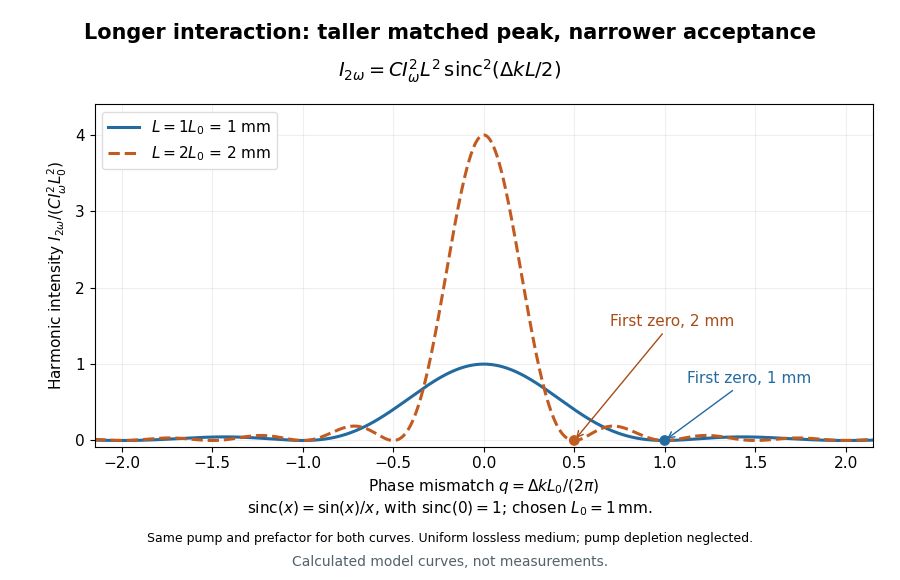

For a worked calculation, choose and . At , the harmonic wave intensity is of its perfectly matched value. At it vanishes in this model. More material can therefore reduce the output. If instead , doubling multiplies output by four. The two curves retain that common normalization, so their different peak heights are meaningful.
The difference between the harmonic's wave number and that of the quadratic driving electric polarization. It has units of inverse length. For collinear modes, , so matching frequencies alone does not ensure matching spatial wave phases.
The length over which the harmonic and its quadratic source accumulate a relative wave phase of . For nonzero second-harmonic phase mismatch, ; the first output zero of the uniform undepleted model occurs at . This is a propagation mismatch length, distinct from the pump's optical coherence length. It diverges as perfect phase matching is approached.
Articles by others on the same topic
There are currently no matching articles.